- Person
- Rosalind Franklin
- Lived
- 1920–1958
- Field
- X-ray crystallography
- From
- British
The story
Rosalind Franklin grew up in a prominent Anglo-Jewish family with a strong tradition of public service. Her father, Ellis Franklin, was a merchant banker who taught evening classes at the Working Men's College in London, and her great-uncle Herbert Samuel had been the first practising Jew to serve in the British Cabinet. The women of the family were expected to put their education and talents into political, educational and charitable work for the community.
As Nazi persecution drove Jews from Germany and Austria in the late 1930s, the family responded. Her parents helped settle Jewish refugees in Britain, particularly children who arrived on the Kindertransport, the rescue operation that brought Jewish children from Nazi-ruled Europe to Britain. They took two refugee children into their own home. One of them, a nine-year-old girl from Austria named Evi Eisenstädter, shared a bedroom with Rosalind's younger sister Jenifer and remained close to the family as an adult. When Rosalind won a university scholarship in 1938, her father asked her to give the money to a deserving refugee student.
Rosalind followed the family tradition. She went up to Newnham College, Cambridge, in 1938 to study chemistry, and during her university vacations she worked with the German-Jewish Refugee Committee at Woburn House, the London headquarters of the major Anglo-Jewish organisations, helping people who had fled persecution to begin new lives. At Cambridge she also became close to Adrienne Weill, a French physicist and refugee who had studied with Marie Curie, and who became one of the most important influences on her life and career.
Franklin was not religious; she questioned belief in God from childhood and is best described as an agnostic. Yet she never abandoned her Jewish identity. As the only Jewish pupil at her boarding school she took Hebrew lessons on her own, she joined the Jewish Society in her first term at Cambridge, and she told her sister that she was always consciously a Jew.
She died in 1958, aged 37, and is buried in the Willesden Jewish cemetery in London. Her headstone gives her Hebrew name, Rachel bat Yehuda, and honours her research on viruses as being of lasting benefit to mankind. In 2024 a street in Netanya, Israel, was named for her as Rachel (Rosalind) Franklin.
Why it matters
The Franklin family's support for refugees was part of a wider effort by British Jews that helped thousands of people escape Nazi Europe and rebuild their lives.
About Rosalind Franklin
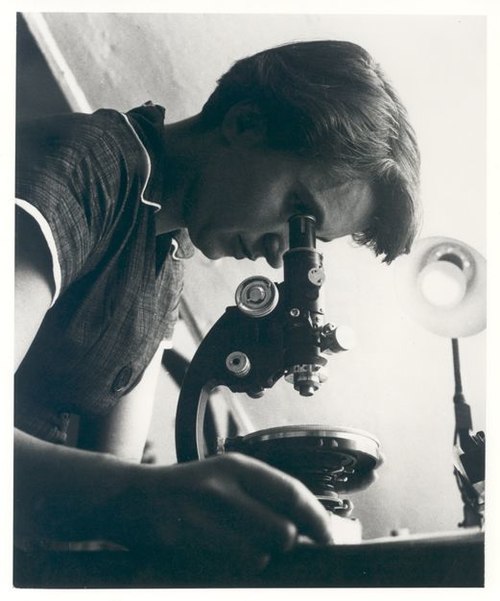
London-born Jewish chemist whose X-ray images of DNA, including Photograph 51, were crucial to the double helix; she also pioneered the structure of viruses and coal.
More about Rosalind Franklin
- Rosalind Franklin found DNA's two formsUsing a humidity-controlled X-ray camera she adapted herself, Rosalind Franklin showed that DNA exists in two forms, A and B, clearing up confusion that had blurred earlier images.
- Rosalind Franklin coined terms still used for carbonWorking in Paris from 1947, Rosalind Franklin used X-ray diffraction to study carbons and coined the terms graphitising and non-graphitising carbon, distinctions still used by materials scientists.
- Rosalind Franklin kept working while fighting cancerDiagnosed with ovarian cancer in 1956, Rosalind Franklin kept leading her research team, publishing seven papers that year and six in 1957 while undergoing treatment.
- Rosalind Franklin inspired Aaron Klug's Nobel PrizeAaron Klug, Rosalind Franklin's closest Birkbeck colleague, continued her virus research, won the 1982 Nobel Prize in Chemistry and credited her example of tackling large, difficult problems.
- Rosalind Franklin's Photo 51 revealed DNA's helixRosalind Franklin’s X-ray work at King’s College London, including Photo 51 taken on 2 May 1952, provided crucial evidence for DNA’s double-helix structure.
- Rosalind Franklin won a US grant to study polioIn the mid-1950s Rosalind Franklin's team at Birkbeck won substantial funding from the United States to study the structure of the polio virus, then a feared cause of childhood paralysis.
- Rosalind Franklin helped found structural virologyAt Birkbeck College, Rosalind Franklin's team showed how tobacco mosaic virus is built, with its RNA wound inside a helical protein coat, publishing seventeen papers in five years.
- Rosalind Franklin unlocked the secrets of coal in wartimeDuring the Second World War, Rosalind Franklin studied the microscopic pores of coal for the British Coal Utilisation Research Association, work that earned her a Cambridge PhD in 1945.
Sources
- Rosalind Elsie Franklin Shalvi/Hyman Encyclopedia of Jewish Women, Jewish Women's Archive
- Rosalind Franklin Wikipedia
Another act of tikkun olam. This is part of tikkun olam, the Jewish idea of repairing the world, and every one of us can add to it.