- Person
- Rosalind Franklin
- Lived
- 1920–1958
- Field
- X-ray crystallography
- From
- British
The story
Rosalind Franklin arrived at King's College London in January 1951 on a three-year fellowship, joining the Medical Research Council's Biophysics Unit directed by John Randall. Trained as a physical chemist at Cambridge, she had spent four years in Paris learning to use X-ray diffraction on poorly ordered materials such as coal and carbon. Randall had hired her to study proteins, but before she started he redirected her to fibres of DNA, the molecule many scientists suspected carried genetic information. The graduate student Raymond Gosling became her assistant.
At the time, X-ray pictures of DNA were confusing. The molecule absorbs water from the air and changes shape, and experiments since the 1930s had unknowingly photographed mixtures of different states, producing muddy patterns that could not be fully interpreted. Maurice Wilkins at King's had already noticed that DNA could take more than one form, but no one had pinned the forms down.
Franklin attacked the problem with the precision of a chemist. She used a new fine-focus X-ray tube and microcamera, which she refined and focused carefully, and her critical innovation was a specimen chamber whose humidity she could control precisely using different saturated salt solutions. Working with the very pure DNA sample prepared by the Swiss chemist Rudolf Signer, she showed that when the relative humidity rose above about 75 percent the DNA fibre became long and thin, and when it was drier it became short and fat. She called the drier, more ordered state the A form and the wetter state the B form, and found that she could switch one into the other simply by changing the humidity.
Separating the two was essential, because each gave a clean pattern only when studied alone. Historians Matthew Cobb and Nathaniel Comfort, writing in Nature in 2023, describe this clear differentiation of the A and B forms as one of her key insights, solving a problem that had confused earlier researchers. She presented the results in a lecture at King's in November 1951, suggesting a helical structure with the phosphate groups on the outside.
This careful work made possible her outstanding images of the B form, including the one later known as Photograph 51, taken with Gosling in May 1952, and the precise measurements of the molecule's dimensions and symmetry that later served to check and confirm the double-helix model. The B form turned out to be the form DNA takes inside living cells.
Why it matters
Franklin's distinction between the A and B forms gave scientists clean data on DNA, a key step toward understanding how genetic information is stored.
About Rosalind Franklin
London-born Jewish chemist whose X-ray images of DNA, including Photograph 51, were crucial to the double helix; she also pioneered the structure of viruses and coal.
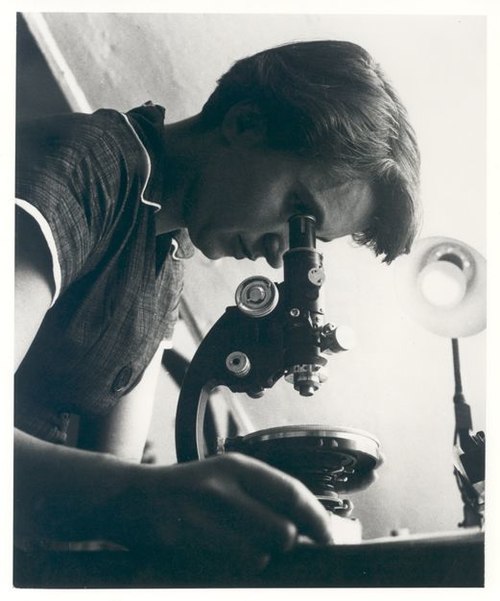
More about Rosalind Franklin
- Rosalind Franklin coined terms still used for carbonWorking in Paris from 1947, Rosalind Franklin used X-ray diffraction to study carbons and coined the terms graphitising and non-graphitising carbon, distinctions still used by materials scientists.
- Rosalind Franklin kept working while fighting cancerDiagnosed with ovarian cancer in 1956, Rosalind Franklin kept leading her research team, publishing seven papers that year and six in 1957 while undergoing treatment.
- Rosalind Franklin inspired Aaron Klug's Nobel PrizeAaron Klug, Rosalind Franklin's closest Birkbeck colleague, continued her virus research, won the 1982 Nobel Prize in Chemistry and credited her example of tackling large, difficult problems.
- Rosalind Franklin's Photo 51 revealed DNA's helixRosalind Franklin’s X-ray work at King’s College London, including Photo 51 taken on 2 May 1952, provided crucial evidence for DNA’s double-helix structure.
- Rosalind Franklin won a US grant to study polioIn the mid-1950s Rosalind Franklin's team at Birkbeck won substantial funding from the United States to study the structure of the polio virus, then a feared cause of childhood paralysis.
- Rosalind Franklin helped found structural virologyAt Birkbeck College, Rosalind Franklin's team showed how tobacco mosaic virus is built, with its RNA wound inside a helical protein coat, publishing seventeen papers in five years.
- Rosalind Franklin unlocked the secrets of coal in wartimeDuring the Second World War, Rosalind Franklin studied the microscopic pores of coal for the British Coal Utilisation Research Association, work that earned her a Cambridge PhD in 1945.
- Rosalind Franklin volunteered to help Jewish refugeesAs a Cambridge student, Rosalind Franklin spent her vacations with the German-Jewish Refugee Committee in London, while her parents helped resettle refugees, including Kindertransport children.
Sources
- Rosalind Franklin Wikipedia
- What Rosalind Franklin truly contributed to the discovery of DNA's structure Nature
- Rosalind Elsie Franklin Shalvi/Hyman Encyclopedia of Jewish Women, Jewish Women's Archive
Another act of tikkun olam. This is part of tikkun olam, the Jewish idea of repairing the world, and every one of us can add to it.