- Person
- Rosalind Franklin
- Lived
- 1920–1958
- Field
- X-ray crystallography
- From
- British
The story
In March 1953 Rosalind Franklin left King's College London for Birkbeck College, a move she described in a letter to a friend as going from a palace to the slums, though pleasanter all the same. She was recruited by the physicist and crystallographer J. D. Bernal, known for supporting women crystallographers. Her laboratories were in a pair of cramped, run-down Georgian houses in Torrington Square, with her desk on the fourth floor and her X-ray tube in the basement.
She turned her X-ray skills from DNA to the other major nucleic acid, RNA, and to viruses, beginning with tobacco mosaic virus (TMV). This plant virus had been the first virus ever discovered and, in 1935, the first to be crystallised, by the American biochemist Wendell Stanley. It could be produced in large quantities and did not infect animals, which made it the best-studied virus of the day. From the end of 1954, funding that Bernal secured from the Agricultural Research Council allowed Franklin to lead her own research group.
In 1955 she showed in Nature that TMV particles are all the same length, contradicting the eminent virologist Norman Pirie, and her observation proved correct. With her student Kenneth Holmes she then found that the virus's protein coat is made of protein units arranged in a helix. In March 1956 she and the American postdoctoral researcher Donald Caspar published complementary papers in Nature showing that the RNA is wound along the inner surface of the hollow virus. The Jewish Women's Archive describes her finding that the helical protein coat surrounds a single strand of infectious RNA, lying about halfway out from a hollow central core, as probably the first example of structural virology. Franklin also proposed that the RNA of TMV is single-stranded, an idea confirmed after her death.
Within five years Franklin published seventeen papers on the virus, five on her own and twelve with the team she directed, which also included Aaron Klug and John Finch. For the 1958 Brussels World's Fair she built a five-foot-high model of TMV. She died of ovarian cancer the day before the fair opened, aged 37. Her headstone describes her as a scientist whose research and discoveries on viruses remain of lasting benefit to mankind.
Klug carried the work forward and, building on what she had begun, won the 1982 Nobel Prize in Chemistry.
Why it matters
Understanding how viruses are assembled is central to modern virology and vaccine design, a field Franklin helped create.
About Rosalind Franklin
London-born Jewish chemist whose X-ray images of DNA, including Photograph 51, were crucial to the double helix; she also pioneered the structure of viruses and coal.
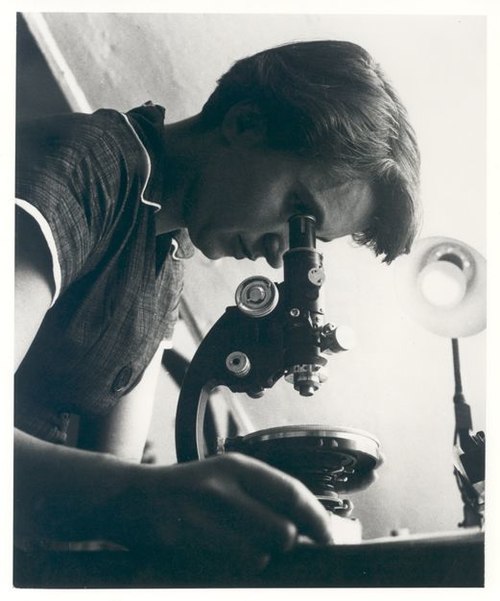
More about Rosalind Franklin
- Rosalind Franklin found DNA's two formsUsing a humidity-controlled X-ray camera she adapted herself, Rosalind Franklin showed that DNA exists in two forms, A and B, clearing up confusion that had blurred earlier images.
- Rosalind Franklin coined terms still used for carbonWorking in Paris from 1947, Rosalind Franklin used X-ray diffraction to study carbons and coined the terms graphitising and non-graphitising carbon, distinctions still used by materials scientists.
- Rosalind Franklin kept working while fighting cancerDiagnosed with ovarian cancer in 1956, Rosalind Franklin kept leading her research team, publishing seven papers that year and six in 1957 while undergoing treatment.
- Rosalind Franklin inspired Aaron Klug's Nobel PrizeAaron Klug, Rosalind Franklin's closest Birkbeck colleague, continued her virus research, won the 1982 Nobel Prize in Chemistry and credited her example of tackling large, difficult problems.
- Rosalind Franklin's Photo 51 revealed DNA's helixRosalind Franklin’s X-ray work at King’s College London, including Photo 51 taken on 2 May 1952, provided crucial evidence for DNA’s double-helix structure.
- Rosalind Franklin won a US grant to study polioIn the mid-1950s Rosalind Franklin's team at Birkbeck won substantial funding from the United States to study the structure of the polio virus, then a feared cause of childhood paralysis.
- Rosalind Franklin unlocked the secrets of coal in wartimeDuring the Second World War, Rosalind Franklin studied the microscopic pores of coal for the British Coal Utilisation Research Association, work that earned her a Cambridge PhD in 1945.
- Rosalind Franklin volunteered to help Jewish refugeesAs a Cambridge student, Rosalind Franklin spent her vacations with the German-Jewish Refugee Committee in London, while her parents helped resettle refugees, including Kindertransport children.
Sources
- Rosalind Elsie Franklin Shalvi/Hyman Encyclopedia of Jewish Women, Jewish Women's Archive
- Rosalind Franklin Wikipedia
- Tobacco mosaic virus Wikipedia
Another act of tikkun olam. This is part of tikkun olam, the Jewish idea of repairing the world, and every one of us can add to it.