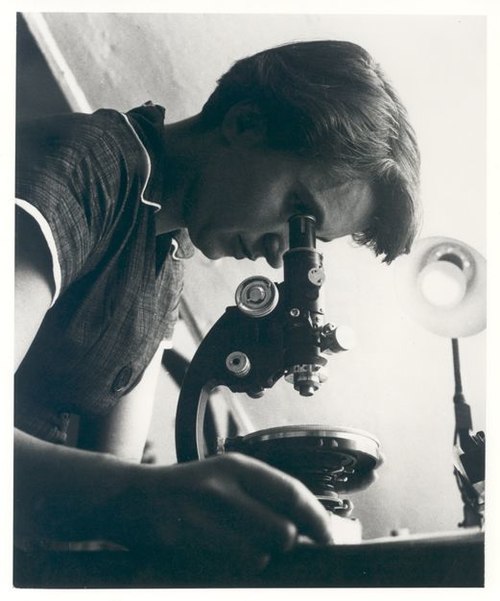
A London Jewish family
Rosalind Elsie Franklin was born on 25 July 1920 at 50 Chepstow Villas in Notting Hill, London, into an affluent and influential Anglo-Jewish family. Her father, Ellis Franklin, was a merchant banker who also taught electricity, magnetism and history in the evenings at the Working Men’s College; her mother was Muriel Waley. Rosalind was the second of five children and the elder daughter. Both sides of the family had been in England since the eighteenth or nineteenth century, and were known for their sense of public duty: her great-uncle Herbert Samuel had been the first practising Jew to serve in a British cabinet, and an aunt, Helen Bentwich, was a trade-union organiser and suffragist.
That ethic of service shaped her childhood. In the late 1930s her parents helped settle Jewish refugees from Nazi Europe, including children who came on the Kindertransport, and took two refugee children into their home; one, a nine-year-old Austrian girl, shared a room with Rosalind’s younger sister. During university vacations Rosalind herself volunteered with the German-Jewish refugee committee at Woburn House, the headquarters of London’s main Jewish organisations.
“Alarmingly clever”
Her ability showed early. Her aunt described the six-year-old Rosalind as “alarmingly clever”, spending her time doing arithmetic for pleasure. After a boarding school on the Sussex coast, chosen for her delicate health, she went at eleven to St Paul’s Girls’ School in Hammersmith, one of the few girls’ schools in London that taught physics and chemistry. She excelled in science, Latin and sport, became fluent in French, and passed her matriculation in 1938 with six distinctions. (Her one weakness was music: the school’s music director, the composer Gustav Holst, once asked her mother whether she might be hard of hearing.)
In 1938 she went up to Newnham College, Cambridge, to read natural sciences, specialising in chemistry, and graduated in 1941. There she met the French physicist Adrienne Weill, a former student of Marie Curie and a refugee, who became a close friend and mentor and deepened her love of France and its language.
Holes in coal
After an unhappy year of graduate research under the chemist Ronald Norrish, Franklin took a war-work post in 1942 at the British Coal Utilisation Research Association. While serving in her spare time as an air-raid warden in London, she studied the fine structure and porosity of coal, measuring how gases penetrated its microscopic pores. Her work helped explain why different coals behaved differently as fuels and in products such as gas masks, earned her a Cambridge PhD in 1945 and produced several frequently cited papers.
In 1947 she moved to Paris to work with Jacques Mering at the Laboratoire Central des Services Chimiques de l’État, where she mastered X-ray diffraction, the technique of firing X-rays at a material and deducing its atomic arrangement from the pattern of scattered rays, and applied it to disordered materials such as carbons. She coined the terms “graphitising” and “non-graphitising” carbons, distinctions still used today. She loved Paris: its laboratory camaraderie, its food, its weekend walks and mountain holidays. She wrote to her mother that she could wander happily in France forever, and she seriously considered staying, before returning to England in 1950 on the advice of Dorothy Hodgkin and under pressure from her family.
King’s College and the two forms of DNA
In January 1951 Franklin joined the Medical Research Council’s Biophysics Unit at King’s College London, headed by John Randall, on a three-year fellowship. Randall assigned her to study DNA by X-ray diffraction, with the graduate student Raymond Gosling as her assistant, but failed to make the arrangement clear to his deputy, Maurice Wilkins, who had been working on DNA and assumed Franklin had come to assist him. The misunderstanding poisoned relations between two people of opposite temperaments: Franklin quick, direct and argumentative; Wilkins shy and conflict-averse.
Franklin brought superb experimental skill to the problem. She refined a fine-focus X-ray camera and, drawing on her training as a physical chemist, built a chamber in which the humidity around DNA fibres could be precisely controlled. She found that DNA exists in two forms: a drier, crystalline “A” form and a wetter, longer “B” form, and that one could be turned into the other by changing the humidity. Separating them was essential, because earlier photographs had mixed the two and blurred the evidence. In a lecture in November 1951 she proposed that DNA was helical, with its phosphate groups on the outside.
Photograph 51
In May 1952 Franklin and Gosling recorded an exceptionally clear diffraction image of the B form, later catalogued as Photograph 51. Its bold X-shaped pattern was the signature of a helix, and its spacings revealed the molecule’s dimensions. The crystallographer J. D. Bernal later called Franklin’s DNA photographs among the most beautiful X-ray photographs of any substance ever taken. True to her rigorous approach, Franklin preferred to work through the mathematics of her data rather than leap to model-building.
In January 1953, without her knowledge, Wilkins showed Photograph 51 to James Watson of the Cavendish Laboratory in Cambridge, who with Francis Crick was trying to build a model of DNA. Soon afterwards Crick and Watson also saw a Medical Research Council report containing Franklin’s detailed measurements and her determination of the crystal’s symmetry, which told Crick that the molecule’s two strands must run in opposite directions. On 7 March 1953 they completed their double-helix model. Franklin, who had independently concluded that both forms of DNA were helical and was drafting papers on the B form, published her data in the same issue of Nature as the Watson–Crick paper on 25 April 1953, presented, through an arrangement between the laboratory heads, as supporting evidence.
Viruses at Birkbeck
Franklin left King’s in March 1953 for Birkbeck College, London, where the crystallographer J. D. Bernal welcomed her. Her laboratories were in cramped, dilapidated Georgian houses, she described the move as going from a palace to the slums, but pleasanter all the same. There she turned to the structure of viruses, beginning a highly productive collaboration with the young scientist Aaron Klug, who had joined Birkbeck after completing his PhD at Cambridge.
Her group showed that the particles of tobacco mosaic virus are all the same length, contradicting a leading virologist of the day, and that the virus’s protein coat is arranged in a helix, with its RNA wound along the inner surface of the hollow particle. They went on to study other plant viruses and, with funding from the US National Institutes of Health, began work on the polio virus. In five years at Birkbeck she published some seventeen papers on tobacco mosaic virus alone, and her group laid foundations for the field of structural virology.
Jewish identity and private life
Franklin was an agnostic from childhood; her mother remembered her asking, when told about God, how anyone knew that He was not a She. In a 1940 letter to her father she argued that science gave a partial explanation of life and that her faith rested on the future of humanity rather than on belief in an afterlife. Yet she never abandoned her Jewish identity. As the only Jewish pupil at her boarding school she took Hebrew lessons while her friends went to church; she joined the Jewish Society at Cambridge at her grandfather’s request; and she told her sister she was “always consciously a Jew”.
Away from the laboratory she was sociable, funny and adventurous: a passionate hiker and traveller who preferred third-class trains so she could talk to ordinary people, an excellent cook, and a loyal friend. She never married. James Watson’s 1968 memoir The Double Helix caricatured her as difficult and drab, a portrait her friends, family and many colleagues rejected. Her American friends in particular remembered her warmth and humour, the side of her that her biographer Brenda Maddox called her “sunny side”.
Illness and death
In the summer of 1956, on a working trip to the United States, Franklin noticed that her abdomen was swelling. In September surgeons found two tumours; she had ovarian cancer. Over the following eighteen months she underwent further operations and treatment while continuing to work, and her group published seven papers in 1956 and six in 1957. She was promoted at Birkbeck in February 1958.
Rosalind Franklin died in Chelsea, London, on 16 April 1958, aged thirty-seven. She was buried the next day in the family plot at the Willesden United Synagogue Cemetery. Her headstone, inscribed with her Hebrew name, Rachel bat Yehuda, describes her as a scientist whose research and discoveries on viruses remain of lasting benefit to mankind. The day after her death, a large model of tobacco mosaic virus that she had designed went on display at the Brussels World’s Fair.
Recognition
In 1962 Watson, Crick and Wilkins shared the Nobel Prize in Physiology or Medicine for the structure of DNA. Franklin could not have been included: the prize is not awarded posthumously. Her colleague Aaron Klug, continuing the virus research she had begun, received the Nobel Prize in Chemistry in 1982, and credited her example in tackling large and difficult problems. Klug also wrote papers defending her contribution to the double helix after The Double Helix appeared.
For decades her role was minimised in textbooks and exhibits. Today it is recognised as indispensable. In 2023 the historians Matthew Cobb and Nathaniel Comfort, after studying her notebooks and a long-forgotten draft magazine article from 1953, argued in Nature that she was not the victim of a theft so much as an equal member of the quartet that solved DNA’s structure. King’s College London named its Franklin-Wilkins Building after her and Wilkins; Britain issued a commemorative 50-pence coin bearing Photograph 51 for her centenary in 2020; and the European Space Agency named its Mars rover after her. Her name now stands, as it should, beside the discovery that founded modern molecular biology, and beside her pioneering work on viruses that her gravestone chose to remember.
Sources & further reading
Rosalind Franklin, Wikipedia · Rosalind Elsie Franklin, Shalvi/Hyman Encyclopedia of Jewish Women, Jewish Women’s Archive · What Rosalind Franklin truly contributed to the discovery of DNA’s structure, Nature (2023) · Researched from the sources above and checked against them. Spotted an error? Tell us.
A life of tikkun olam. This is part of tikkun olam, the Jewish idea of repairing the world, and every one of us can add to it.