- Person
- Rosalind Franklin
- Lived
- 1920–1958
- Field
- X-ray crystallography
- From
- British
The story
Rosalind Franklin graduated in natural sciences from Newnham College, Cambridge, in 1941 and won a research fellowship to work in the university's physical chemistry laboratory under Ronald Norrish. The year went badly: Norrish could not decide what she should work on, and the two did not get on. With Britain at war, Franklin left and in 1942 fulfilled her national service obligations by taking a post as an assistant research officer at the British Coal Utilisation Research Association, known as BCURA.
BCURA was based at Coombe Springs, near Kingston upon Thames on the south-western edge of London. Coal was vital to the war effort, yet little was understood about its inner structure and why different coals behaved so differently. Among the consultants who lectured there while Franklin worked at BCURA were two refugee scientists from the Nazis, Marcello Pirani and Victor Goldschmidt.
Franklin studied the porosity of coal, using helium to measure its density. She found a relationship between the fine constrictions in the pores of coals and the permeability of the spaces inside them, and showed that as coal was heated, substances were driven out in order of their molecular size. The results helped classify coals and predict how they would perform as fuels and in wartime products such as gas masks. She published five fundamental papers that became widely cited, and the work formed the basis of her thesis, The physical chemistry of solid organic colloids with special reference to coal, for which Cambridge awarded her a PhD in 1945.
At the same time she served her community in another way. She shared a house in Putney with her cousin Irene Franklin, and the two volunteered as Air Raid Precautions wardens, regularly patrolling to check on the welfare of people during air raids.
When the war ended, Franklin asked Adrienne Weill, a French physicist friend, to tell her of any job openings for a physical chemist who knew very little physical chemistry, but quite a lot about the holes in coal. That modest description led her to Paris in 1947 and to mastery of X-ray diffraction. Her coal research gave her the expertise in disordered carbon materials that she would soon apply to graphite and then, brilliantly, to DNA, and she kept publishing on carbons almost every year for the rest of her career.
Why it matters
Franklin's coal studies advanced understanding of an essential wartime fuel and launched a career that would transform biology.
About Rosalind Franklin
London-born Jewish chemist whose X-ray images of DNA, including Photograph 51, were crucial to the double helix; she also pioneered the structure of viruses and coal.
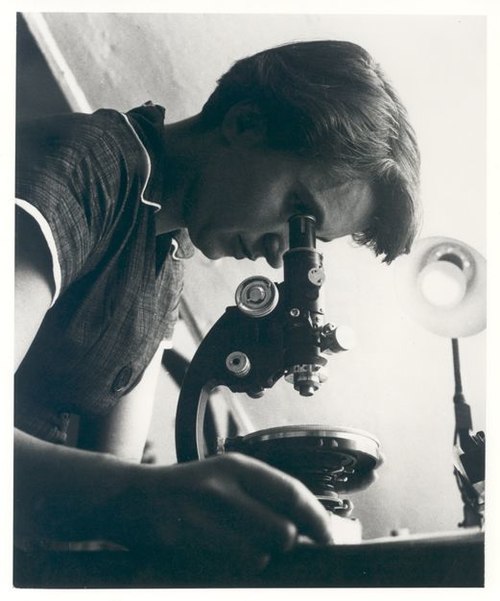
More about Rosalind Franklin
- Rosalind Franklin found DNA's two formsUsing a humidity-controlled X-ray camera she adapted herself, Rosalind Franklin showed that DNA exists in two forms, A and B, clearing up confusion that had blurred earlier images.
- Rosalind Franklin coined terms still used for carbonWorking in Paris from 1947, Rosalind Franklin used X-ray diffraction to study carbons and coined the terms graphitising and non-graphitising carbon, distinctions still used by materials scientists.
- Rosalind Franklin kept working while fighting cancerDiagnosed with ovarian cancer in 1956, Rosalind Franklin kept leading her research team, publishing seven papers that year and six in 1957 while undergoing treatment.
- Rosalind Franklin inspired Aaron Klug's Nobel PrizeAaron Klug, Rosalind Franklin's closest Birkbeck colleague, continued her virus research, won the 1982 Nobel Prize in Chemistry and credited her example of tackling large, difficult problems.
- Rosalind Franklin's Photo 51 revealed DNA's helixRosalind Franklin’s X-ray work at King’s College London, including Photo 51 taken on 2 May 1952, provided crucial evidence for DNA’s double-helix structure.
- Rosalind Franklin won a US grant to study polioIn the mid-1950s Rosalind Franklin's team at Birkbeck won substantial funding from the United States to study the structure of the polio virus, then a feared cause of childhood paralysis.
- Rosalind Franklin helped found structural virologyAt Birkbeck College, Rosalind Franklin's team showed how tobacco mosaic virus is built, with its RNA wound inside a helical protein coat, publishing seventeen papers in five years.
- Rosalind Franklin volunteered to help Jewish refugeesAs a Cambridge student, Rosalind Franklin spent her vacations with the German-Jewish Refugee Committee in London, while her parents helped resettle refugees, including Kindertransport children.
Sources
- Rosalind Franklin Wikipedia
- Rosalind Elsie Franklin Shalvi/Hyman Encyclopedia of Jewish Women, Jewish Women's Archive
Another act of tikkun olam. This is part of tikkun olam, the Jewish idea of repairing the world, and every one of us can add to it.