- Person
- Rosalind Franklin
- Lived
- 1920–1958
- Field
- X-ray crystallography
- From
- British
The story
Rosalind Franklin ended the Second World War as an expert on what she called the holes in coal. She had studied its porosity for the British Coal Utilisation Research Association and earned a Cambridge PhD in 1945. Looking for her next post, she asked her friend Adrienne Weill, a French physicist and former student of Marie Curie, to let her know of openings. At a conference in 1946 Weill introduced her to Marcel Mathieu, a director of France's national research organisation, the CNRS.
This led to a post with the crystallographer Jacques Mering at the Laboratoire Central des Services Chimiques de l'État in Paris, where she started on 14 February 1947 as one of fifteen researchers. Mering applied X-ray diffraction, firing X-rays at a material and working out its atomic arrangement from the pattern of scattered rays to substances with little regular order. He taught Franklin the practical side of this difficult art, and she became an accomplished X-ray crystallographer.
She applied the technique to carbons, materials that are notoriously hard to study because their atoms are only partly ordered, and in particular to the changes in their atomic arrangement when they are heated and converted to graphite, the ordered form of carbon found in pencil lead. In a 1951 paper in the Proceedings of the Royal Society, refereed by J. D. Bernal and Dorothy Hodgkin, she showed that carbons fall into two families. Graphitising carbons turn into crystalline graphite when heated to about 3,000 °C. Non-graphitising carbons never do, however hot they get. She named the two classes. Later work showed that in the second family, cross-links between tiny crystallites lock the structure in place and block the change to graphite.
The classification proved lasting. Graphitising carbons, made from materials such as petroleum coke, tend to be soft and non-porous, while non-graphitising carbons, such as chars and glassy carbon made from substances like sucrose, are hard and low in density. Later researchers refined her structural picture, but the distinction itself remains part of the mainstream physics and chemistry of carbon, and her work is covered in the long-running textbook series Chemistry and Physics of Carbon.
Franklin kept up her interest in carbons for the rest of her career, publishing on their structure almost every year. Her years in Paris also gave her the skill in X-ray diffraction of imperfectly ordered matter that led John Randall to recruit her to King's College London in 1951 to work on DNA.
Why it matters
Franklin's classification of carbons is still used by materials scientists to understand why some carbons become graphite and others stay hard and porous.
About Rosalind Franklin
London-born Jewish chemist whose X-ray images of DNA, including Photograph 51, were crucial to the double helix; she also pioneered the structure of viruses and coal.
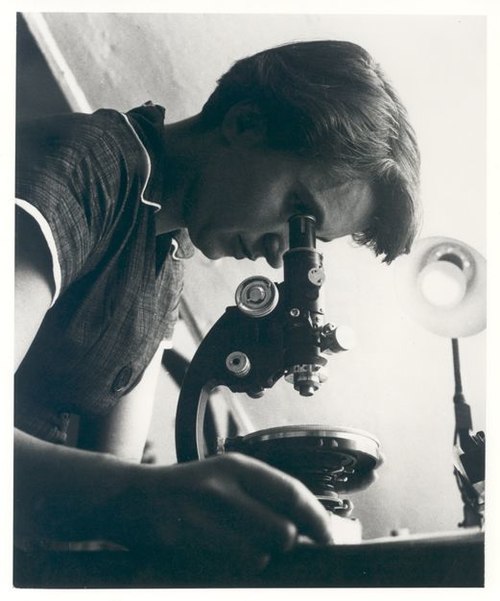
More about Rosalind Franklin
- Rosalind Franklin found DNA's two formsUsing a humidity-controlled X-ray camera she adapted herself, Rosalind Franklin showed that DNA exists in two forms, A and B, clearing up confusion that had blurred earlier images.
- Rosalind Franklin kept working while fighting cancerDiagnosed with ovarian cancer in 1956, Rosalind Franklin kept leading her research team, publishing seven papers that year and six in 1957 while undergoing treatment.
- Rosalind Franklin inspired Aaron Klug's Nobel PrizeAaron Klug, Rosalind Franklin's closest Birkbeck colleague, continued her virus research, won the 1982 Nobel Prize in Chemistry and credited her example of tackling large, difficult problems.
- Rosalind Franklin's Photo 51 revealed DNA's helixRosalind Franklin’s X-ray work at King’s College London, including Photo 51 taken on 2 May 1952, provided crucial evidence for DNA’s double-helix structure.
- Rosalind Franklin won a US grant to study polioIn the mid-1950s Rosalind Franklin's team at Birkbeck won substantial funding from the United States to study the structure of the polio virus, then a feared cause of childhood paralysis.
- Rosalind Franklin helped found structural virologyAt Birkbeck College, Rosalind Franklin's team showed how tobacco mosaic virus is built, with its RNA wound inside a helical protein coat, publishing seventeen papers in five years.
- Rosalind Franklin unlocked the secrets of coal in wartimeDuring the Second World War, Rosalind Franklin studied the microscopic pores of coal for the British Coal Utilisation Research Association, work that earned her a Cambridge PhD in 1945.
- Rosalind Franklin volunteered to help Jewish refugeesAs a Cambridge student, Rosalind Franklin spent her vacations with the German-Jewish Refugee Committee in London, while her parents helped resettle refugees, including Kindertransport children.
Sources
- Rosalind Franklin Wikipedia
- Graphitizing and non-graphitizing carbons Wikipedia
- Rosalind Elsie Franklin Shalvi/Hyman Encyclopedia of Jewish Women, Jewish Women's Archive
Another act of tikkun olam. This is part of tikkun olam, the Jewish idea of repairing the world, and every one of us can add to it.