- Person
- Rosalind Franklin
- Lived
- 1920–1958
- Field
- X-ray crystallography
- From
- British
The story
By 1956 Rosalind Franklin was leading one of the most productive virus research groups in Britain. At Birkbeck College in London, with Aaron Klug, John Finch, Kenneth Holmes and Donald Caspar, she was working out how tobacco mosaic virus and other plant viruses are built. That summer she made a long working trip to the United States, visiting laboratories from Woods Hole to Berkeley.
In New York she noticed that she could hardly zip her skirt because her abdomen had swollen. Back in London her doctor marked her case urgent, and an operation on 4 September 1956 found two tumours. She had ovarian cancer. She was only thirty-six.
Over the next eighteen months she underwent several operations and treatments, convalescing between them with friends and family, including Francis Crick and his wife Odile, with whom she had become close. Yet she continued to work. Her group published seven papers in 1956 and six in 1957, advancing the structural study of viruses. In 1957 she won a three-year grant from the US National Institutes of Health, the largest Birkbeck had ever received, to extend the work to the polio virus, and she began trying to mount crystals of the virus for X-ray study.
She also accepted an invitation to build a five-foot-high model of tobacco mosaic virus for the Brussels World's Fair, Expo 58, to show the public how a virus is put together. She made it in part from table tennis balls and plastic bicycle handlebar grips. At the end of 1957 she fell ill again and was admitted to the Royal Marsden Hospital, where she made her will, naming Klug as its principal beneficiary. In January 1958 she returned to work, and on 25 February she was promoted to Research Associate in Biophysics.
She fell ill once more on 30 March and died in London on 16 April 1958, aged thirty-seven. The fair opened the next day, displaying the model she had created in the International Science Pavilion. She was buried in the Willesden Jewish cemetery, where her headstone describes her as a scientist whose research and discoveries on viruses remain of lasting benefit to mankind.
Her colleagues carried on the projects she had begun. Under Klug's leadership the group revealed the symmetry of the polio virus in 1959, and the virus work she led in those last difficult years became a foundation of structural virology.
Why it matters
Franklin's determination in her final years left a body of work that underpinned structural virology and an example of courage that continues to inspire scientists.
About Rosalind Franklin
London-born Jewish chemist whose X-ray images of DNA, including Photograph 51, were crucial to the double helix; she also pioneered the structure of viruses and coal.
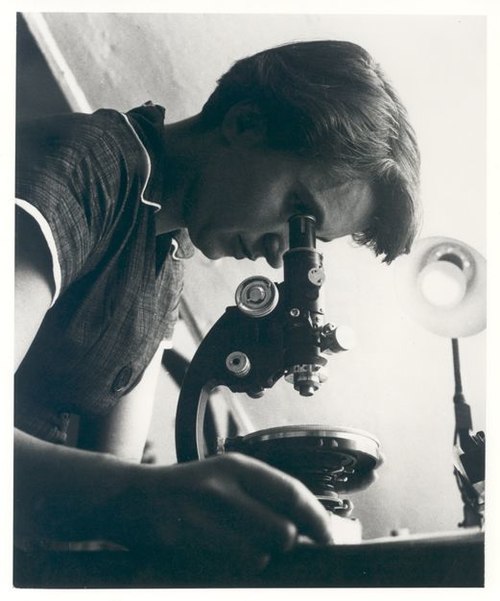
More about Rosalind Franklin
- Rosalind Franklin found DNA's two formsUsing a humidity-controlled X-ray camera she adapted herself, Rosalind Franklin showed that DNA exists in two forms, A and B, clearing up confusion that had blurred earlier images.
- Rosalind Franklin coined terms still used for carbonWorking in Paris from 1947, Rosalind Franklin used X-ray diffraction to study carbons and coined the terms graphitising and non-graphitising carbon, distinctions still used by materials scientists.
- Rosalind Franklin inspired Aaron Klug's Nobel PrizeAaron Klug, Rosalind Franklin's closest Birkbeck colleague, continued her virus research, won the 1982 Nobel Prize in Chemistry and credited her example of tackling large, difficult problems.
- Rosalind Franklin's Photo 51 revealed DNA's helixRosalind Franklin’s X-ray work at King’s College London, including Photo 51 taken on 2 May 1952, provided crucial evidence for DNA’s double-helix structure.
- Rosalind Franklin won a US grant to study polioIn the mid-1950s Rosalind Franklin's team at Birkbeck won substantial funding from the United States to study the structure of the polio virus, then a feared cause of childhood paralysis.
- Rosalind Franklin helped found structural virologyAt Birkbeck College, Rosalind Franklin's team showed how tobacco mosaic virus is built, with its RNA wound inside a helical protein coat, publishing seventeen papers in five years.
- Rosalind Franklin unlocked the secrets of coal in wartimeDuring the Second World War, Rosalind Franklin studied the microscopic pores of coal for the British Coal Utilisation Research Association, work that earned her a Cambridge PhD in 1945.
- Rosalind Franklin volunteered to help Jewish refugeesAs a Cambridge student, Rosalind Franklin spent her vacations with the German-Jewish Refugee Committee in London, while her parents helped resettle refugees, including Kindertransport children.
Sources
- Rosalind Franklin Wikipedia
Another act of tikkun olam. This is part of tikkun olam, the Jewish idea of repairing the world, and every one of us can add to it.