- Person
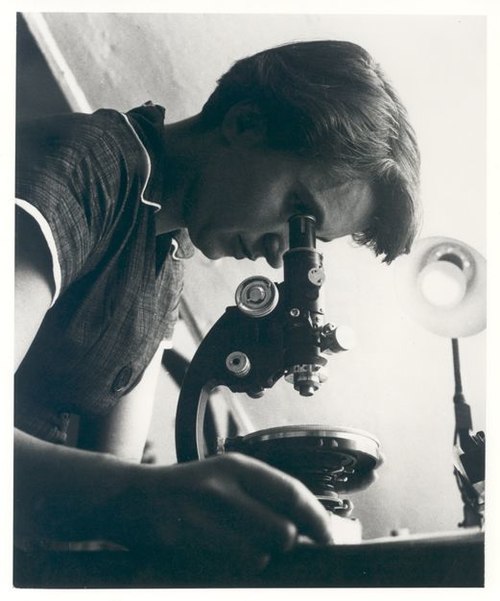
- Rosalind Franklin
- Lived
- 1920–1958
- Field
- X-ray crystallography
- From
- British
The story
Rosalind Franklin was born in Notting Hill, London, on 25 July 1920 into an affluent and influential British Jewish family; her parents helped settle Jewish refugees who had escaped the Nazis, including children of the Kindertransport. She studied chemistry at Newnham College, Cambridge, earned a PhD in 1945 for research on the fine structure of coal, and then spent four years in Paris mastering X-ray diffraction, which she used to study the structure of carbons and graphite.
In January 1951 she joined King's College London, where John Randall put her in charge of X-ray diffraction studies of DNA, with the graduate student Raymond Gosling as her assistant. She refined the equipment, built a camera chamber in which she could control the humidity precisely, and showed that DNA exists in two forms, A and B. On 2 May 1952 Gosling, working under her direction, took the 51st diffraction photograph in their series, an exceptionally clear image of the B form. Photo 51 showed a sharp X-shaped pattern, the signature of a helix. The crystallographer J. D. Bernal later called her X-ray photographs among the most beautiful of any substance ever taken.
Franklin set the image aside to concentrate on the A form. When she was preparing to leave King's, Gosling passed it to Maurice Wilkins, who was to take over his supervision, and in January 1953 Wilkins showed it to James Watson; Franklin did not know at the time. Shortly afterwards Watson and Francis Crick also saw a report containing her measurements of DNA's dimensions and symmetry. Her data helped guide and confirm the double-helix model they published in Nature on 25 April 1953, in the same issue as papers by Wilkins's group and by Franklin and Gosling, whose Photo 51 appeared as supporting evidence.
Franklin moved to Birkbeck College in 1953 and led pioneering studies of the structure of viruses, including tobacco mosaic virus. She died of ovarian cancer in 1958, aged 37, four years before Watson, Crick and Wilkins received the Nobel Prize. Her contribution to the discovery of DNA's structure, largely unrecognised in her lifetime, is now widely honoured. In 2020 a British 50-pence coin marking her centenary featured a stylised version of Photo 51.
Why it matters
Franklin's images helped reveal how genetic information is stored and copied, the foundation of modern genetics, medicine and biotechnology.
About Rosalind Franklin
London-born Jewish chemist whose X-ray images of DNA, including Photograph 51, were crucial to the double helix; she also pioneered the structure of viruses and coal.
More about Rosalind Franklin
- Rosalind Franklin found DNA's two formsUsing a humidity-controlled X-ray camera she adapted herself, Rosalind Franklin showed that DNA exists in two forms, A and B, clearing up confusion that had blurred earlier images.
- Rosalind Franklin coined terms still used for carbonWorking in Paris from 1947, Rosalind Franklin used X-ray diffraction to study carbons and coined the terms graphitising and non-graphitising carbon, distinctions still used by materials scientists.
- Rosalind Franklin kept working while fighting cancerDiagnosed with ovarian cancer in 1956, Rosalind Franklin kept leading her research team, publishing seven papers that year and six in 1957 while undergoing treatment.
- Rosalind Franklin inspired Aaron Klug's Nobel PrizeAaron Klug, Rosalind Franklin's closest Birkbeck colleague, continued her virus research, won the 1982 Nobel Prize in Chemistry and credited her example of tackling large, difficult problems.
- Rosalind Franklin won a US grant to study polioIn the mid-1950s Rosalind Franklin's team at Birkbeck won substantial funding from the United States to study the structure of the polio virus, then a feared cause of childhood paralysis.
- Rosalind Franklin helped found structural virologyAt Birkbeck College, Rosalind Franklin's team showed how tobacco mosaic virus is built, with its RNA wound inside a helical protein coat, publishing seventeen papers in five years.
- Rosalind Franklin unlocked the secrets of coal in wartimeDuring the Second World War, Rosalind Franklin studied the microscopic pores of coal for the British Coal Utilisation Research Association, work that earned her a Cambridge PhD in 1945.
- Rosalind Franklin volunteered to help Jewish refugeesAs a Cambridge student, Rosalind Franklin spent her vacations with the German-Jewish Refugee Committee in London, while her parents helped resettle refugees, including Kindertransport children.
Sources
- Photo 51 Wikipedia
- Rosalind Franklin Wikipedia
- Rosalind Franklin Jewish Women's Archive
Another act of tikkun olam. This is part of tikkun olam, the Jewish idea of repairing the world, and every one of us can add to it.