- Person
- Rosalind Franklin
- Lived
- 1920–1958
- Field
- X-ray crystallography
- From
- British
The story
Aaron Klug was born in 1926 in Želva, Lithuania, to Jewish parents who took him to South Africa when he was two. He studied physics in Johannesburg and Cape Town, then won a fellowship to Cambridge, where he completed a PhD at Trinity College in 1953. Late that year he moved to Birkbeck College in London, joining the laboratory of the crystallographer J. D. Bernal, where Rosalind Franklin had just arrived from King's College.
Their meeting in early 1954 began a long and highly productive partnership. Franklin introduced Klug to the X-ray study of tobacco mosaic virus, and the experience gave him a lifelong interest in viruses. Within the group she led, Klug and his student John Finch studied spherical viruses, with Franklin coordinating and overseeing the work, while Klug and Donald Caspar went on to develop a general theory of how the shells of spherical viruses are built from regular arrays of identical units.
After Franklin's death from ovarian cancer in 1958, Klug succeeded her as group leader and carried on the research she had begun, including her project on the polio virus. In her will she had named him its principal beneficiary. In 1962 the team moved to the new Medical Research Council Laboratory of Molecular Biology in Cambridge. There Klug developed crystallographic electron microscopy, combining two-dimensional images of a specimen taken from different angles into a three-dimensional picture. He went on to study transfer RNA and the protein filaments found in Alzheimer's disease, and discovered the zinc finger proteins.
In 1982 he was the sole winner of the Nobel Prize in Chemistry, for this development of crystallographic electron microscopy and for revealing the structures of biologically important complexes of nucleic acids and proteins. It was exactly the line of work that Franklin had started and introduced him to. In his acceptance speech, according to the Jewish Women's Archive, he credited Franklin with setting the example of tackling large and difficult problems. He later directed the Laboratory of Molecular Biology, was knighted, and served as President of the Royal Society from 1995 to 2000.
Klug also defended Franklin's reputation. After James Watson's 1968 memoir caricatured her, Klug wrote articles in Nature in 1968 and 1974 setting out the importance of her contribution to the discovery of DNA's structure, the second based on a draft manuscript he had found among her papers. Few scientists have had a more loyal or more effective champion.
Why it matters
Through Klug, Franklin's ambition and methods shaped a Nobel-winning body of work on the structures of viruses and the complexes inside living cells.
About Rosalind Franklin
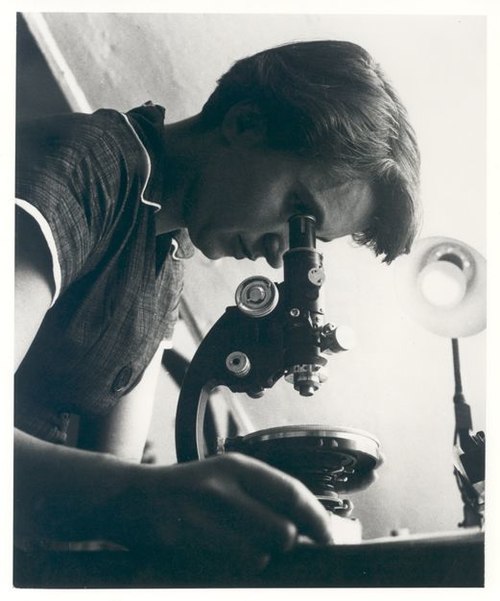
London-born Jewish chemist whose X-ray images of DNA, including Photograph 51, were crucial to the double helix; she also pioneered the structure of viruses and coal.
More about Rosalind Franklin
- Rosalind Franklin found DNA's two formsUsing a humidity-controlled X-ray camera she adapted herself, Rosalind Franklin showed that DNA exists in two forms, A and B, clearing up confusion that had blurred earlier images.
- Rosalind Franklin coined terms still used for carbonWorking in Paris from 1947, Rosalind Franklin used X-ray diffraction to study carbons and coined the terms graphitising and non-graphitising carbon, distinctions still used by materials scientists.
- Rosalind Franklin kept working while fighting cancerDiagnosed with ovarian cancer in 1956, Rosalind Franklin kept leading her research team, publishing seven papers that year and six in 1957 while undergoing treatment.
- Rosalind Franklin's Photo 51 revealed DNA's helixRosalind Franklin’s X-ray work at King’s College London, including Photo 51 taken on 2 May 1952, provided crucial evidence for DNA’s double-helix structure.
- Rosalind Franklin won a US grant to study polioIn the mid-1950s Rosalind Franklin's team at Birkbeck won substantial funding from the United States to study the structure of the polio virus, then a feared cause of childhood paralysis.
- Rosalind Franklin helped found structural virologyAt Birkbeck College, Rosalind Franklin's team showed how tobacco mosaic virus is built, with its RNA wound inside a helical protein coat, publishing seventeen papers in five years.
- Rosalind Franklin unlocked the secrets of coal in wartimeDuring the Second World War, Rosalind Franklin studied the microscopic pores of coal for the British Coal Utilisation Research Association, work that earned her a Cambridge PhD in 1945.
- Rosalind Franklin volunteered to help Jewish refugeesAs a Cambridge student, Rosalind Franklin spent her vacations with the German-Jewish Refugee Committee in London, while her parents helped resettle refugees, including Kindertransport children.
Sources
- Rosalind Elsie Franklin Shalvi/Hyman Encyclopedia of Jewish Women, Jewish Women's Archive
- Rosalind Franklin Wikipedia
- Aaron Klug Wikipedia
Another act of tikkun olam. This is part of tikkun olam, the Jewish idea of repairing the world, and every one of us can add to it.