- Person
- Rosalind Franklin
- Lived
- 1920–1958
- Field
- X-ray crystallography
- From
- British
The story
In the 1950s polio was one of the most feared diseases in the world, a leading cause of paralysis in children. Scientists were racing to understand the virus, but no one yet knew how its particles were built.
Rosalind Franklin's group at Birkbeck College in London had become a world leader in working out the structures of viruses. Using X-ray diffraction, she and her colleagues Aaron Klug, John Finch, Kenneth Holmes and Donald Caspar had shown how tobacco mosaic virus is assembled, with its RNA wound inside a helical coat of protein, and had begun to study spherical plant viruses such as turnip yellow mosaic virus. In 1956, during a visit to the University of California, Berkeley, colleagues suggested that her group take on the polio virus.
The following year she applied to the United States Public Health Service of the National Institutes of Health. The grant approved was £10,000 over three years, the largest Birkbeck had ever received, and a sign of her international reputation. In her application she described her new interest in viruses that infect animals. Her plan to work with live rather than killed polio virus in London raised serious safety concerns, so J. D. Bernal, the head of her department, arranged for the virus to be stored safely at the London School of Hygiene and Tropical Medicine while the group worked on it. Franklin began trying to mount crystals of the virus in fine capillary tubes for X-ray study.
Her health failed before she could complete the project. She had been diagnosed with ovarian cancer in 1956 and died in April 1958, aged 37. But the work continued. Klug succeeded her as group leader, and with Finch and Holmes he obtained extremely detailed X-ray images of the virus. In June 1959 Klug and Finch reported that the polio virus has icosahedral symmetry, like a twenty-sided die, and suggested that all spherical viruses might share this symmetry because it allows the largest possible number of identical building blocks, sixty, to form a shell.
That insight became a cornerstone of structural virology. In 1962 the team moved to the new Laboratory of Molecular Biology in Cambridge, where Klug's work on the architecture of viruses and other biological structures won him the 1982 Nobel Prize in Chemistry.
Why it matters
Franklin's polio project helped extend structural virology from plant viruses to human disease, the approach later used to understand viruses from polio to coronaviruses.
About Rosalind Franklin
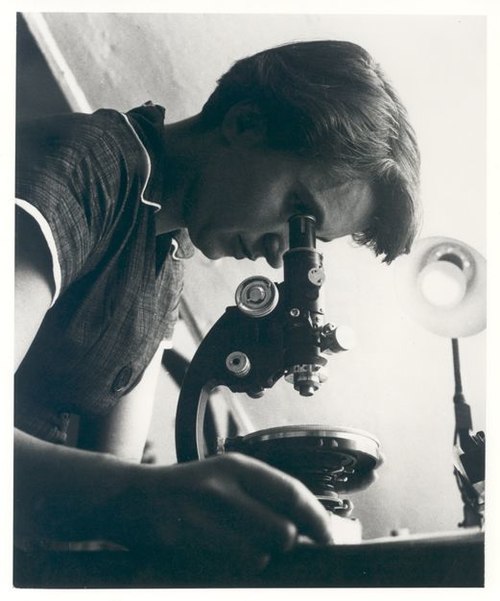
London-born Jewish chemist whose X-ray images of DNA, including Photograph 51, were crucial to the double helix; she also pioneered the structure of viruses and coal.
More about Rosalind Franklin
- Rosalind Franklin found DNA's two formsUsing a humidity-controlled X-ray camera she adapted herself, Rosalind Franklin showed that DNA exists in two forms, A and B, clearing up confusion that had blurred earlier images.
- Rosalind Franklin coined terms still used for carbonWorking in Paris from 1947, Rosalind Franklin used X-ray diffraction to study carbons and coined the terms graphitising and non-graphitising carbon, distinctions still used by materials scientists.
- Rosalind Franklin kept working while fighting cancerDiagnosed with ovarian cancer in 1956, Rosalind Franklin kept leading her research team, publishing seven papers that year and six in 1957 while undergoing treatment.
- Rosalind Franklin inspired Aaron Klug's Nobel PrizeAaron Klug, Rosalind Franklin's closest Birkbeck colleague, continued her virus research, won the 1982 Nobel Prize in Chemistry and credited her example of tackling large, difficult problems.
- Rosalind Franklin's Photo 51 revealed DNA's helixRosalind Franklin’s X-ray work at King’s College London, including Photo 51 taken on 2 May 1952, provided crucial evidence for DNA’s double-helix structure.
- Rosalind Franklin helped found structural virologyAt Birkbeck College, Rosalind Franklin's team showed how tobacco mosaic virus is built, with its RNA wound inside a helical protein coat, publishing seventeen papers in five years.
- Rosalind Franklin unlocked the secrets of coal in wartimeDuring the Second World War, Rosalind Franklin studied the microscopic pores of coal for the British Coal Utilisation Research Association, work that earned her a Cambridge PhD in 1945.
- Rosalind Franklin volunteered to help Jewish refugeesAs a Cambridge student, Rosalind Franklin spent her vacations with the German-Jewish Refugee Committee in London, while her parents helped resettle refugees, including Kindertransport children.
Sources
- Rosalind Franklin Wikipedia
Another act of tikkun olam. This is part of tikkun olam, the Jewish idea of repairing the world, and every one of us can add to it.