- Person
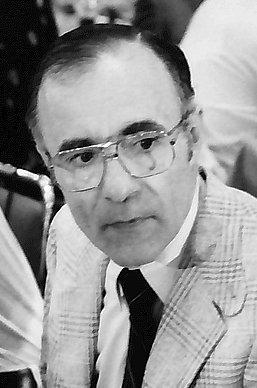
- Arno Penzias
- Lived
- 1933–2024
- Field
- Radio astronomy, physics
- From
- German-born American
The story
Arno Penzias was born in Munich in 1933 to a Jewish family. In 1939, aged six, he and his younger brother were sent to England on the Kindertransport, and the reunited family reached New York in January 1940. He studied at the City College of New York and Columbia University and in 1961 joined Bell Telephone Laboratories in Holmdel, New Jersey.
Bell Labs had a large horn-shaped antenna built for satellite communications, fitted with an ultra-sensitive maser receiver. When it became available for research, Penzias and the radio astronomer Robert Wilson set out to measure faint radio emission from our galaxy, which required accounting for every source of noise. They found a weak microwave signal they could not explain. It came equally from every direction, at all times. They ruled out New York City as its source and even cleared the antenna of pigeon droppings, which Penzias called “white dielectric material,” but the hiss remained. The receiver, originally used to communicate with the Echo and Telstar satellites, was tuned to a wavelength of 7 centimetres, where the background from space was expected to be very low. By painstaking testing, the Nobel committee noted, the two men showed that the radiation came from outer space and that the universe is filled uniformly with it.
Penzias contacted the Princeton physicist Robert Dicke, who suggested it might be the background radiation predicted by some theories of the early universe. Measurements soon showed that the radiation matched what would be expected from a body at about 3 degrees above absolute zero, solid support for the view that it was the fossil remains of the Big Bang, as George Gamow and his colleagues had predicted in the 1940s and 1950s.
The Nobel committee, which awarded Penzias and Wilson the 1978 Nobel Prize in Physics, said the discovery made it possible to obtain information about cosmic processes from the very creation of the universe, and noted that the radiation could serve as a probe of the universe itself. Penzias went on to discover molecules in interstellar space and to lead research at Bell Labs.
Why it matters
The cosmic microwave background is the cornerstone evidence that the universe began in a Big Bang, and a probe scientists still use to study its earliest history.
About Arno Penzias
Kindertransport child who became a Bell Labs radio astronomer and, with Robert Wilson, found the faint afterglow of the Big Bang. Nobel Prize in Physics 1978.
Sources
- Press release: The Nobel Prize in Physics 1978 NobelPrize.org
- Arno Penzias, Biographical NobelPrize.org
- Arno Allan Penzias Wikipedia
Another act of tikkun olam. This is part of tikkun olam, the Jewish idea of repairing the world, and every one of us can add to it.