- Person
- Arthur Miller
- Lived
- 1915–2005
- Field
- Theatre
- From
- American
The story
Arthur Miller wove Jewish characters and themes into his writing for more than half a century, from the plays he wrote at the University of Michigan to his 1945 novel Focus and the 1964 play Incident at Vichy. Late in his career he turned to the subject most directly. The drama critic Martin Gottfried observed that Miller was the only great British or American playwright to write a play about what it means to be Jewish, apparently trying to deal with his own Jewishness. That play was Broken Glass.
It is set in Brooklyn in the last days of November 1938, just after Kristallnacht, the Night of Broken Glass, when synagogues were burned and Jewish homes and shops smashed across Germany and Austria. Sylvia Gellburg, a Jewish housewife who has been reading the newspaper reports from Germany, suddenly finds herself partly paralysed from the waist down with no physical cause.
Her husband, Phillip, who forecloses on mortgages for a Brooklyn bank, is a Jew uneasy with his own Jewishness. The family's doctor, Harry Hyman, believes the paralysis is psychological and begins to treat her, learning more about her fears and her troubled marriage. Hyman insists that Jews are no different from their neighbours, and that in one way or another everyone is persecuted. Through these characters the play asks how American Jews responded, or failed to respond, to the catastrophe gathering in Europe, and what denial costs.
Broken Glass had its premiere at the Long Wharf Theatre in New Haven in March 1994 and opened on Broadway at the Booth Theatre on 24 April 1994, with Amy Irving, Ron Rifkin and David Dukes, earning a Tony nomination for Best Play. In August it opened at the National Theatre in London, and the London staging won the Olivier Award for Best Supporting Actor for Ken Stott, and it was televised on PBS's Masterpiece Theatre in 1996.
The play has continued to find audiences. A London revival starring Antony Sher began at the Tricycle Theatre in 2010 and transferred to the West End, and an adaptation was staged in Athens in 2018.
Why it matters
Broken Glass invited audiences to reflect on indifference and denial in the face of persecution, lessons that reach beyond 1938.
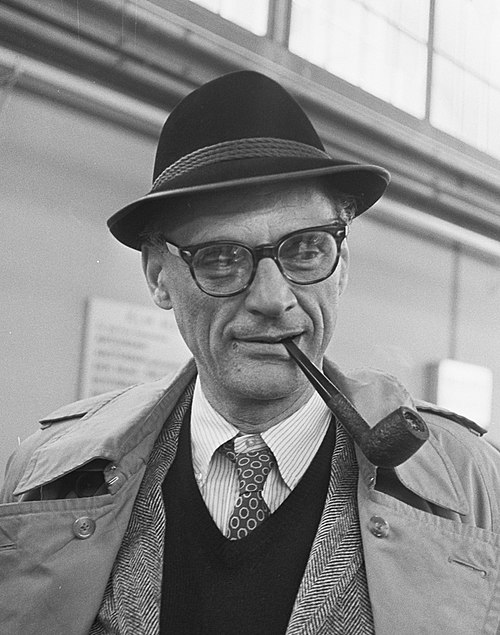
About Arthur Miller
Playwright of Death of a Salesman and The Crucible who turned the American family into tragedy and refused to name names before the House Un-American Activities Committee.
More about Arthur Miller
- The Crucible became Arthur Miller's most performed playArthur Miller's The Crucible (1953), set during the Salem witch trials, became his most frequently produced work around the world.
- Arthur Miller directed Death of a Salesman in BeijingIn 1983 Arthur Miller travelled to China to direct Death of a Salesman with Chinese actors at the Beijing People's Art Theatre.
- Arthur Miller's legacy supports young people in theatreThe University of Michigan opened the Arthur Miller Theatre in 2007, and the Arthur Miller Foundation supports theatre education in New York City public schools.
- Arthur Miller's novel Focus confronted American antisemitismIn 1945 Arthur Miller published Focus, a novel about a gentile mistaken for a Jew, one of the first American novels to confront antisemitism at home.
- Arthur Miller led PEN International for persecuted writersIn 1965 Arthur Miller became the first American president of PEN International, using the role to campaign for imprisoned and persecuted writers.
- Arthur Miller refused to name names before CongressCalled before the House Un-American Activities Committee in 1956, Arthur Miller refused to identify others; his contempt conviction was overturned in 1958.
- Incident at Vichy asked what each person owes the persecutedArthur Miller's 1964 play Incident at Vichy, about men detained in wartime France to be checked for Jewishness, asks what responsibility each of us bears for others.
- Arthur Miller brought an Auschwitz survivor's memoir to TVArthur Miller wrote Playing for Time (1980), a television drama based on Fania Fénelon's memoir of surviving Auschwitz by playing in its women's orchestra.
Sources
- Arthur Miller's Jewish Themes My Jewish Learning
- Arthur Miller Wikipedia
- Broken Glass (play) Wikipedia
Another act of tikkun olam. This is part of tikkun olam, the Jewish idea of repairing the world, and every one of us can add to it.