- Person
- Arthur Miller
- Lived
- 1915–2005
- Field
- Theatre
- From
- American
The story
Arthur Miller found his calling at the University of Michigan. After graduating from Abraham Lincoln High School in Brooklyn in 1932, he worked at menial jobs to pay his tuition. At Michigan he first studied journalism and wrote for The Michigan Daily, then switched to English. His first play, No Villain, won the university's Avery Hopwood Award, which convinced him that he could make a career as a playwright, and he studied playwriting with Professor Kenneth Rowe, who became a lifelong friend. In 1937 his play Honors at Dawn won the Hopwood Award as well.
Miller never forgot the debt. He kept close ties with his alma mater for the rest of his life, establishing the university's Arthur Miller Award in 1985 and the Arthur Miller Award for Dramatic Writing in 1999. In 2000 he agreed to lend his name to a new theatre on the campus.
The Arthur Miller Theatre opened in March 2007, two years after his death. By his express wish, it is the only theatre in the world that bears his name, giving students a stage of their own on the campus where his career began.
In New York, the Arthur Miller Foundation was founded to honour his legacy and his own education in the city's public schools. Its mission is to increase access and equity in theatre arts education, so that more students experience theatre as an integral part of their schooling. Its work has included certifying new theatre teachers and placing them in public schools, at a time when the system was estimated to have about 180 theatre teachers for some 1,800 schools, supporting their professional development, and providing teaching artists, cultural partners and theatre tickets for students.
The foundation marked Miller's 100th birthday in November 2015 with a one-night performance of scenes from his major works, and it has supported a pilot theatre and film programme at the New York public school Quest to Learn. His son-in-law, the actor Daniel Day-Lewis, has served on its board since 2016.
Why it matters
Miller's name now helps open the stage to new generations of students, from university theatre-makers to New York schoolchildren.
About Arthur Miller
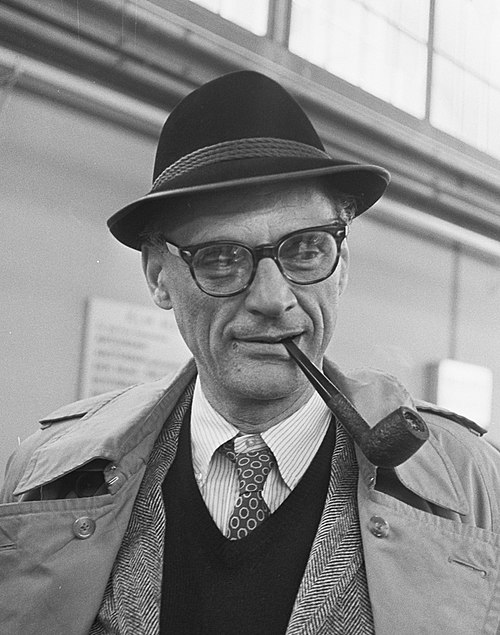
Playwright of Death of a Salesman and The Crucible who turned the American family into tragedy and refused to name names before the House Un-American Activities Committee.
More about Arthur Miller
- The Crucible became Arthur Miller's most performed playArthur Miller's The Crucible (1953), set during the Salem witch trials, became his most frequently produced work around the world.
- Arthur Miller directed Death of a Salesman in BeijingIn 1983 Arthur Miller travelled to China to direct Death of a Salesman with Chinese actors at the Beijing People's Art Theatre.
- Arthur Miller's novel Focus confronted American antisemitismIn 1945 Arthur Miller published Focus, a novel about a gentile mistaken for a Jew, one of the first American novels to confront antisemitism at home.
- Arthur Miller led PEN International for persecuted writersIn 1965 Arthur Miller became the first American president of PEN International, using the role to campaign for imprisoned and persecuted writers.
- Arthur Miller refused to name names before CongressCalled before the House Un-American Activities Committee in 1956, Arthur Miller refused to identify others; his contempt conviction was overturned in 1958.
- Arthur Miller's Broken Glass returned to KristallnachtArthur Miller's 1994 play Broken Glass, set in Brooklyn after Kristallnacht, is his most direct exploration of American Jewish identity.
- Incident at Vichy asked what each person owes the persecutedArthur Miller's 1964 play Incident at Vichy, about men detained in wartime France to be checked for Jewishness, asks what responsibility each of us bears for others.
- Arthur Miller brought an Auschwitz survivor's memoir to TVArthur Miller wrote Playing for Time (1980), a television drama based on Fania Fénelon's memoir of surviving Auschwitz by playing in its women's orchestra.
Sources
- Arthur Miller Wikipedia
Another act of tikkun olam. This is part of tikkun olam, the Jewish idea of repairing the world, and every one of us can add to it.