- Person
- Arthur Miller
- Lived
- 1915–2005
- Field
- Theatre
- From
- American
The story
In the early 1950s, congressional committees were pressing Americans to name friends suspected of Communist sympathies. In 1952 Arthur Miller's close friend and director Elia Kazan testified before the House Un-American Activities Committee and named former colleagues. After speaking with Kazan about his testimony, Miller travelled to Salem, Massachusetts, to research the witch trials of 1692. Out of that research came The Crucible.
The play is a dramatised and partly fictionalised account of the trials. A Puritan community tears itself apart through accusation, hysteria and forced confession. The farmer John Proctor agrees to save his life with a false confession, but when the court demands that he name others and post his signed statement on the church door, he tears it up and goes to the gallows rather than give up his name. Audiences immediately read it as an allegory of McCarthyism.
The Crucible opened at the Martin Beck Theatre on Broadway on 22 January 1953. Miller felt the production was too stylised and cold, and many reviews were hostile, although it won the Tony Award for Best Play. A new production the following year succeeded, and the play steadily grew into a classic. Miller soon lived out its themes himself: in 1956 he refused to name names before the same committee.
The Crucible has been adapted many times. Robert Ward's opera, first performed in 1961, won the 1962 Pulitzer Prize for Music. A 1957 French and East German film used a screenplay by Jean-Paul Sartre, and Miller wrote the screenplay for the 1996 film with Daniel Day-Lewis, Winona Ryder and Paul Scofield, which earned him his only Academy Award nomination.
It is regarded as a central work of American drama and is Miller's most frequently produced play throughout the world, staged and studied in schools and theatres wherever communities have known the pressure of fear and accusation.
Why it matters
The Crucible gave generations a language for recognising witch-hunts and a model of integrity under pressure.
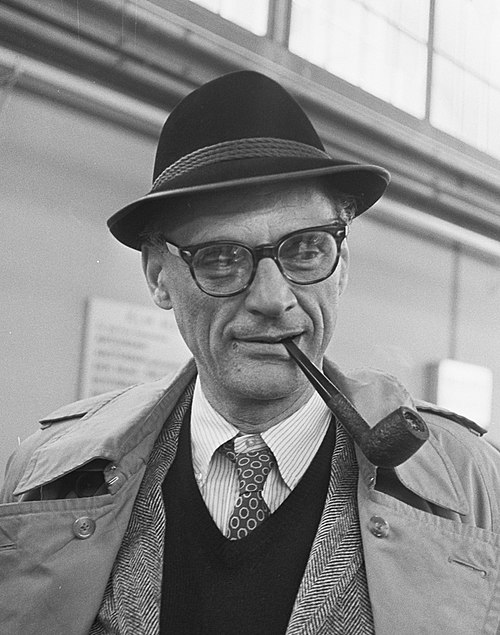
About Arthur Miller
Playwright of Death of a Salesman and The Crucible who turned the American family into tragedy and refused to name names before the House Un-American Activities Committee.
More about Arthur Miller
- Arthur Miller directed Death of a Salesman in BeijingIn 1983 Arthur Miller travelled to China to direct Death of a Salesman with Chinese actors at the Beijing People's Art Theatre.
- Arthur Miller's legacy supports young people in theatreThe University of Michigan opened the Arthur Miller Theatre in 2007, and the Arthur Miller Foundation supports theatre education in New York City public schools.
- Arthur Miller's novel Focus confronted American antisemitismIn 1945 Arthur Miller published Focus, a novel about a gentile mistaken for a Jew, one of the first American novels to confront antisemitism at home.
- Arthur Miller led PEN International for persecuted writersIn 1965 Arthur Miller became the first American president of PEN International, using the role to campaign for imprisoned and persecuted writers.
- Arthur Miller refused to name names before CongressCalled before the House Un-American Activities Committee in 1956, Arthur Miller refused to identify others; his contempt conviction was overturned in 1958.
- Arthur Miller's Broken Glass returned to KristallnachtArthur Miller's 1994 play Broken Glass, set in Brooklyn after Kristallnacht, is his most direct exploration of American Jewish identity.
- Incident at Vichy asked what each person owes the persecutedArthur Miller's 1964 play Incident at Vichy, about men detained in wartime France to be checked for Jewishness, asks what responsibility each of us bears for others.
- Arthur Miller brought an Auschwitz survivor's memoir to TVArthur Miller wrote Playing for Time (1980), a television drama based on Fania Fénelon's memoir of surviving Auschwitz by playing in its women's orchestra.
Sources
- Arthur Miller Wikipedia
- The Crucible Wikipedia
Another act of tikkun olam. This is part of tikkun olam, the Jewish idea of repairing the world, and every one of us can add to it.