- Person
- Arthur Miller
- Lived
- 1915–2005
- Field
- Theatre
- From
- American
The story
Fania Fénelon was a French Jewish singer and pianist who was deported to Auschwitz-Birkenau. Because she was a professional musician, she was admitted to the Women's Orchestra of Auschwitz, a group of prisoners spared hard labour in return for playing music for their captors. Its leader was the violinist Alma Rosé. Fénelon survived and told the story in a memoir, published in English as The Musicians of Auschwitz.
Arthur Miller, who had confronted the Holocaust in Incident at Vichy and After the Fall, adapted the memoir as a television film for CBS. Playing for Time follows the women as they rehearse and perform under the constant threat of death, and it explores the moral dilemmas of survival: whether staying alive by playing for the Nazis was worth the loss of dignity, and how far solidarity could survive inside the camp.
Miller wrote the screenplay, and Daniel Mann completed the direction. The production was filmed in Pennsylvania after rehearsals in New York, and it was one of the first productions in which an ensemble of actresses shaved their heads for their roles. The casting of Vanessa Redgrave, an outspoken critic of Israel and Zionism, as Fénelon drew protests from Jewish organisations and from Fénelon herself. The Jewish Virtual Library notes that Miller staunchly defended the casting against those critics, and the other actresses issued a statement denouncing blacklisting.
Playing for Time was broadcast in 1980 and was praised by critics, winning several awards. It was the most watched prime-time programme on American television in the week of its broadcast, seen in some 20.4 million homes. Miller later adapted it as a stage play.
The film brought the story of the Auschwitz women's orchestra to an enormous audience, and it gained an important place in popular understanding of the Holocaust. Other survivors of the orchestra later disputed parts of Fénelon's account, and their own testimonies have since added to the history.
Why it matters
Playing for Time made the story of music and endurance in Auschwitz known to millions of viewers.
About Arthur Miller
Playwright of Death of a Salesman and The Crucible who turned the American family into tragedy and refused to name names before the House Un-American Activities Committee.
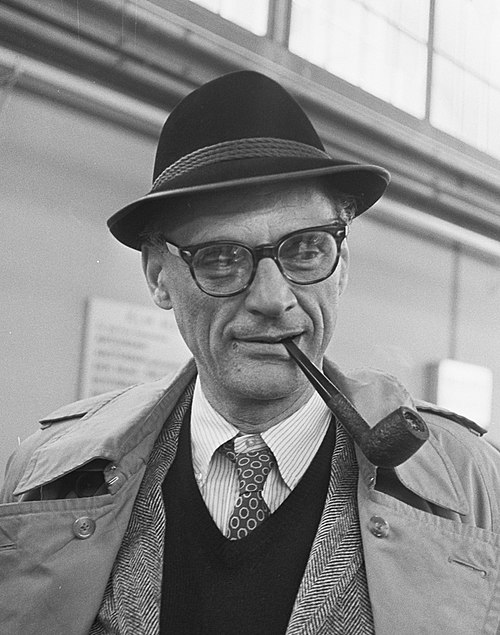
More about Arthur Miller
- The Crucible became Arthur Miller's most performed playArthur Miller's The Crucible (1953), set during the Salem witch trials, became his most frequently produced work around the world.
- Arthur Miller directed Death of a Salesman in BeijingIn 1983 Arthur Miller travelled to China to direct Death of a Salesman with Chinese actors at the Beijing People's Art Theatre.
- Arthur Miller's legacy supports young people in theatreThe University of Michigan opened the Arthur Miller Theatre in 2007, and the Arthur Miller Foundation supports theatre education in New York City public schools.
- Arthur Miller's novel Focus confronted American antisemitismIn 1945 Arthur Miller published Focus, a novel about a gentile mistaken for a Jew, one of the first American novels to confront antisemitism at home.
- Arthur Miller led PEN International for persecuted writersIn 1965 Arthur Miller became the first American president of PEN International, using the role to campaign for imprisoned and persecuted writers.
- Arthur Miller refused to name names before CongressCalled before the House Un-American Activities Committee in 1956, Arthur Miller refused to identify others; his contempt conviction was overturned in 1958.
- Arthur Miller's Broken Glass returned to KristallnachtArthur Miller's 1994 play Broken Glass, set in Brooklyn after Kristallnacht, is his most direct exploration of American Jewish identity.
- Incident at Vichy asked what each person owes the persecutedArthur Miller's 1964 play Incident at Vichy, about men detained in wartime France to be checked for Jewishness, asks what responsibility each of us bears for others.
Sources
- Arthur Miller Jewish Virtual Library
- Arthur Miller Wikipedia
- Playing for Time (film) Wikipedia
Another act of tikkun olam. This is part of tikkun olam, the Jewish idea of repairing the world, and every one of us can add to it.