- Person
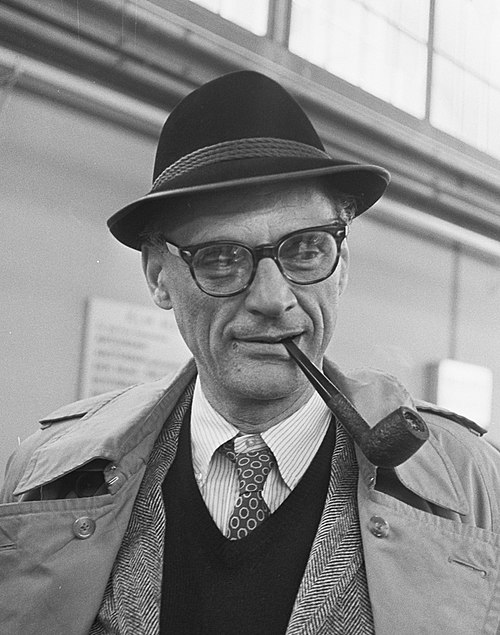
- Arthur Miller
- Lived
- 1915–2005
- Field
- Theatre
- From
- American
The story
In 1964 the New York Herald Tribune asked Arthur Miller to cover the trial in Frankfurt of Nazi officials who had run the Auschwitz-Birkenau death camp. Listening to the testimony, Miller began to write a new play. He came away convinced that the questions raised in the courtroom reached beyond the defendants to the conscience of ordinary people who had profited, if only by surviving, from crimes they did not commit themselves.
The result was Incident at Vichy, a one-act play set in a detention room in Vichy France in 1942. A group of men have been rounded up and wait to be examined, one by one, by German officers and French police to determine whether they are Jews. Most of them are Jewish refugees from the north. As they wait, they offer each other explanations and hopes: it must be a routine document check. A Communist electrician warns of trains to the camps; a Jewish psychiatrist, Leduc, tries to rally the others to resist.
At the climax an Austrian prince, Von Berg, who is not Jewish, receives a pass to go free. He gives it to Leduc, risking his own life so that one Jew can escape. Miller said the play explored the relationship between those who side with justice and their implication in the evil they oppose, insisting that good and evil are not separate compartments but two elements of a transaction. My Jewish Learning quotes Leduc's line that each man has his Jew, the other he can blame.
The play opened on 3 December 1964 at the ANTA Washington Square Theatre in New York. Some critics found it too didactic, but it was staged in London in 1966 with Alec Guinness and Anthony Quayle, and Miller adapted it for a 1973 television production.
Incident at Vichy asks audiences how the Holocaust could proceed with so little resistance, and what each person owes to others in danger. In Von Berg's choice it holds out the possibility of acting against persecution, at a time when the Holocaust was rarely brought to the stage.
Why it matters
Incident at Vichy brought questions of Holocaust responsibility and rescue to theatre audiences at a time when they were rarely staged.
About Arthur Miller
Playwright of Death of a Salesman and The Crucible who turned the American family into tragedy and refused to name names before the House Un-American Activities Committee.
More about Arthur Miller
- The Crucible became Arthur Miller's most performed playArthur Miller's The Crucible (1953), set during the Salem witch trials, became his most frequently produced work around the world.
- Arthur Miller directed Death of a Salesman in BeijingIn 1983 Arthur Miller travelled to China to direct Death of a Salesman with Chinese actors at the Beijing People's Art Theatre.
- Arthur Miller's legacy supports young people in theatreThe University of Michigan opened the Arthur Miller Theatre in 2007, and the Arthur Miller Foundation supports theatre education in New York City public schools.
- Arthur Miller's novel Focus confronted American antisemitismIn 1945 Arthur Miller published Focus, a novel about a gentile mistaken for a Jew, one of the first American novels to confront antisemitism at home.
- Arthur Miller led PEN International for persecuted writersIn 1965 Arthur Miller became the first American president of PEN International, using the role to campaign for imprisoned and persecuted writers.
- Arthur Miller refused to name names before CongressCalled before the House Un-American Activities Committee in 1956, Arthur Miller refused to identify others; his contempt conviction was overturned in 1958.
- Arthur Miller's Broken Glass returned to KristallnachtArthur Miller's 1994 play Broken Glass, set in Brooklyn after Kristallnacht, is his most direct exploration of American Jewish identity.
- Arthur Miller brought an Auschwitz survivor's memoir to TVArthur Miller wrote Playing for Time (1980), a television drama based on Fania Fénelon's memoir of surviving Auschwitz by playing in its women's orchestra.
Sources
- Arthur Miller's Jewish Themes My Jewish Learning
- Arthur Miller Wikipedia
- Incident at Vichy Wikipedia
Another act of tikkun olam. This is part of tikkun olam, the Jewish idea of repairing the world, and every one of us can add to it.