- Person
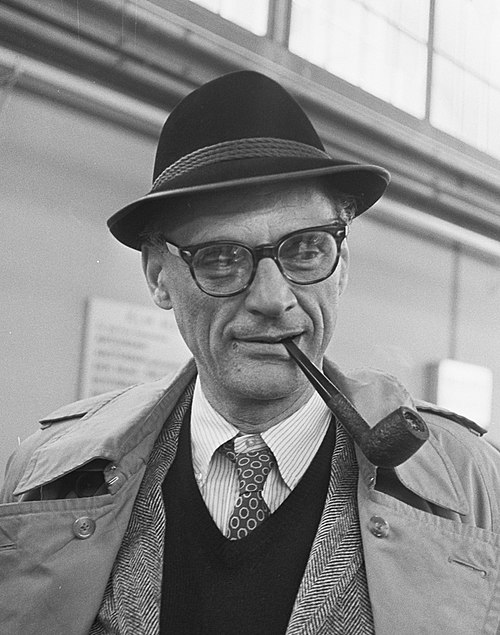
- Arthur Miller
- Lived
- 1915–2005
- Field
- Theatre
- From
- American
The story
PEN International was founded at a London restaurant on 5 October 1921 by Catherine Amy Dawson Scott, with John Galsworthy as its first president and members such as Joseph Conrad, George Bernard Shaw and H. G. Wells. Its aim was to promote friendship and intellectual co-operation among writers everywhere, and it grew into a worldwide association with centres in more than 100 countries.
In 1965 Arthur Miller was elected its president, the first American to hold the post. He served for four years, at a time when the Cold War made contact between writers of East and West difficult and often dangerous. Miller had personal reasons to care. In the McCarthy era the State Department had denied him a passport, and in 1957 he was convicted of contempt of Congress for refusing to name other writers, a conviction overturned on appeal in 1958.
He threw himself into the work. In 1966 he organised the PEN congress in New York City, bringing writers from around the world to the United States. He used his fame to press governments on behalf of writers jailed or silenced for their words.
His advocacy had consequences. In 1969 his own works were banned in the Soviet Union because he had campaigned for the freedom of dissident writers. That same year he published In Russia, the first of three books made with his wife, the photographer Inge Morath, recording his impressions of Soviet society. He continued to speak out for persecuted authors for the rest of his life.
Later presidents of PEN International have included Heinrich Böll and Mario Vargas Llosa, and the organisation continues to campaign for writers imprisoned or threatened for what they write. In 1993 Miller received the Four Freedoms Award for Freedom of Speech, and in 2003 the Jerusalem Prize for the Freedom of the Individual in Society.
Why it matters
Miller's leadership strengthened an international network that still defends writers imprisoned or threatened for what they write.
About Arthur Miller
Playwright of Death of a Salesman and The Crucible who turned the American family into tragedy and refused to name names before the House Un-American Activities Committee.
More about Arthur Miller
- The Crucible became Arthur Miller's most performed playArthur Miller's The Crucible (1953), set during the Salem witch trials, became his most frequently produced work around the world.
- Arthur Miller directed Death of a Salesman in BeijingIn 1983 Arthur Miller travelled to China to direct Death of a Salesman with Chinese actors at the Beijing People's Art Theatre.
- Arthur Miller's legacy supports young people in theatreThe University of Michigan opened the Arthur Miller Theatre in 2007, and the Arthur Miller Foundation supports theatre education in New York City public schools.
- Arthur Miller's novel Focus confronted American antisemitismIn 1945 Arthur Miller published Focus, a novel about a gentile mistaken for a Jew, one of the first American novels to confront antisemitism at home.
- Arthur Miller refused to name names before CongressCalled before the House Un-American Activities Committee in 1956, Arthur Miller refused to identify others; his contempt conviction was overturned in 1958.
- Arthur Miller's Broken Glass returned to KristallnachtArthur Miller's 1994 play Broken Glass, set in Brooklyn after Kristallnacht, is his most direct exploration of American Jewish identity.
- Incident at Vichy asked what each person owes the persecutedArthur Miller's 1964 play Incident at Vichy, about men detained in wartime France to be checked for Jewishness, asks what responsibility each of us bears for others.
- Arthur Miller brought an Auschwitz survivor's memoir to TVArthur Miller wrote Playing for Time (1980), a television drama based on Fania Fénelon's memoir of surviving Auschwitz by playing in its women's orchestra.
Sources
- Arthur Miller Wikipedia
- PEN International Wikipedia
Another act of tikkun olam. This is part of tikkun olam, the Jewish idea of repairing the world, and every one of us can add to it.