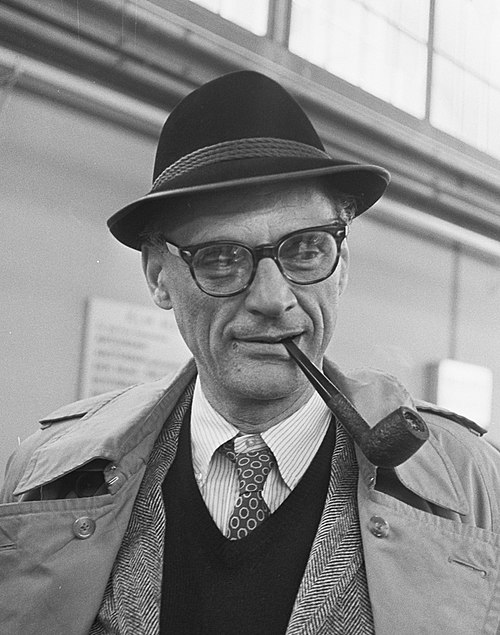
A Harlem boyhood, a Brooklyn fall
Arthur Asher Miller was born on 17 October 1915 in Harlem, Manhattan, the second of three children of Isidore and Augusta Miller. His father had come to America as a boy from Radomyśl Wielki, a small town in Galician Poland; his mother was born in New York to parents from the same town. Isidore built a women’s coat-manufacturing business that employed hundreds of workers, and the family lived well on West 110th Street, overlooking Central Park, with a summer house at Far Rockaway and a chauffeur. His younger sister, Joan, later became the actress Joan Copeland.
The Wall Street Crash of 1929 took almost everything. The Millers moved to a modest house in Brooklyn, and the boy who had been driven to school was soon delivering bread before dawn to help out. Miller had his bar mitzvah in 1928, on the eve of the collapse, but the religious observance of his childhood left little mark on him. What did stay with him was the spectacle of a proud, self-made father humiliated by forces he could not understand, a theme that would run through his greatest work.
Michigan and the making of a playwright
Miller graduated from Abraham Lincoln High School in 1932 with an unremarkable record. He spent the next two years in a series of menial jobs, including work in an auto-parts warehouse, saving money to pay for college. The University of Michigan finally admitted him, and there he found his vocation. He started out in journalism, writing for The Michigan Daily, then switched to English after his first play, No Villain, won the university’s Avery Hopwood Award. A second Hopwood followed for Honors at Dawn. In the playwriting seminar of Professor Kenneth Rowe he learned what he called the dynamics of play construction, how a drama is built, beam by beam, to reach its effect.
After graduating in 1938 he joined the Federal Theatre Project, the New Deal programme that paid writers to make theatre, turning down a more lucrative offer to write for 20th Century Fox. Congress closed the project the next year amid fears of Communist influence. In 1940 he married Mary Slattery; they had two children, Jane and Robert. Exempted from wartime military service by an old football injury to his knee, he worked at the Brooklyn Navy Yard and wrote radio plays, some of them broadcast on CBS.
Focus: confronting American antisemitism
Miller’s first Broadway play, The Man Who Had All the Luck, closed in 1944 after four performances. The following year he published a novel, Focus, which tackled a subject he believed American fiction had all but avoided: antisemitism at home. On the night shift at the Navy Yard he had heard the anti-Jewish talk of his co-workers, and it frightened him for American Jews even as the war against Hitler was being fought.
In Focus a gentile personnel manager named Lawrence Newman buys a pair of glasses and is suddenly taken for a Jew. He loses his job and becomes the target of the hostility his neighbours once reserved for the Jewish shopkeeper down the street, Mr Finkelstein. The novel’s insight, that the “Jew” of the bigot’s imagination is a projection, a role imposed from outside, would return in Miller’s plays for the rest of his life. The book was filmed decades later, in 2001, but it was the theatre that would make his name.
All My Sons and Death of a Salesman
In 1947 All My Sons, the story of a manufacturer who knowingly shipped defective aircraft parts during the war, became a Broadway success and won Miller his first Tony Award. The next year, in a small studio he built himself in Roxbury, Connecticut, he wrote the first act of a new play in less than a day and finished the rest in about six weeks. Death of a Salesman opened at the Morosco Theatre on 10 February 1949, directed by Elia Kazan, with Lee J. Cobb as Willy Loman, an ageing travelling salesman who has lived by the dream of being well liked and is now being discarded.
It was the first play to win the Pulitzer Prize for Drama, the Tony Award and the New York Drama Critics’ Circle Award, and it ran for 742 performances. Its idea was revolutionary: that an ordinary man could be the hero of a tragedy as surely as a king. Willy is never identified as Jewish, and critics have argued about it for decades; Miller wrote in his memoir Timebends that the Lomans were light years away from a Jewish identity. Yet many saw in the family the striving immigrant households Miller had grown up among. The play has been staged all over the world ever since, and its phrase “attention must be paid” entered the language.
The Crucible and the committee
In 1952 Kazan, Miller’s close friend and director, named former Communist associates before the House Un-American Activities Committee (HUAC). The two men did not speak for ten years. Miller went to Salem, Massachusetts, to read the records of the witch trials of 1692, and out of them came The Crucible, which opened on 22 January 1953. Its picture of a community destroying itself through accusation and forced confession was understood at once as a commentary on McCarthyism. Coolly received at first, it became the most frequently produced of all his plays.
The committee soon turned its attention to Miller himself. The State Department refused him a passport to attend the London opening of The Crucible, and in June 1956 he was subpoenaed. He described his own past involvement with left-wing causes frankly and said he was not protecting the Communist Party, but he refused to identify others he had seen at meetings of Communist writers. In May 1957 he was convicted of contempt of Congress and sentenced to a $500 fine and a suspended 30-day jail term; he was also blacklisted in Hollywood and denied a passport. The conviction was overturned on appeal in August 1958.
Marilyn Monroe and The Misfits
Miller had met Marilyn Monroe in 1951. In June 1956, in the middle of his HUAC ordeal and after leaving his first wife, he married her. Before the wedding Monroe converted to Judaism, and she accompanied him to Washington when he testified, at real risk to her own career. For a time the playwright and the most famous film star in the world tried to live a quiet life in the country.
It did not last. Miller wrote the screenplay for The Misfits as a gift to Monroe, and during the 1960 filming in Nevada, directed by John Huston, their marriage came apart; Miller later called it one of the lowest points of his life. They divorced in January 1961, shortly before the film’s release. In 1962 he married the Austrian-born photographer Inge Morath, who had photographed the production; they remained together until her death forty years later. His play After the Fall (1964), with a character widely read as a portrait of Monroe, provoked outrage, but it also reunited him professionally with Kazan.
A conscience on the world stage
The same year Miller returned to his Jewish themes in Incident at Vichy (1964), in which a group of men are detained in wartime France and examined to see whether they are Jews. That year he had attended the Frankfurt trial of former Auschwitz guards and visited the Mauthausen camp, experiences his biographer Christopher Bigsby sees as moving the Holocaust to the centre of his attention, and the play asks what responsibility each person bears for the persecution of others. The Price (1968), a sombre family drama, was his biggest success since Salesman.
In 1965 Miller became the first American president of PEN International, the writers’ association, and used the position to campaign for imprisoned and persecuted writers; in 1969 his work was banned in the Soviet Union because of that advocacy. He wrote the television film Playing for Time (1980), based on the memoir of Fania Fénelon, who survived Auschwitz by playing in the camp’s women’s orchestra, and in 1983 he travelled to Beijing to direct Death of a Salesman with Chinese actors. His late play Broken Glass (1994), set in Brooklyn in the days after Kristallnacht, centres on a Jewish man ashamed of his Jewishness and a wife paralysed by news from Germany, his most direct treatment of the American Jewish experience.
Private shadows and final years
Miller was famously private. Friends described him as a secular humanist with little interest in religious practice; his Jewishness was a matter of history, conscience and the people he wrote about rather than faith. His life also contained a painful silence. In 1966 he and Morath had a son, Daniel, born with Down syndrome. Against his wife’s wishes, Miller placed the boy in an institution and rarely spoke of him in public, though Daniel was named an heir alongside his siblings. His daughter Rebecca became a writer and filmmaker, and married the actor Daniel Day-Lewis.
He kept writing to the end, and kept collecting honours: the National Medal of Arts in 1993, the Jefferson Lecture in 2001, Spain’s Prince of Asturias Award in 2002 and the Jerusalem Prize in 2003. After Morath’s death in 2002 he found companionship with the painter Agnes Barley. His final play, Finishing the Picture, opened in Chicago in 2004. Arthur Miller died at his home in Roxbury on 10 February 2005, the 56th anniversary of the opening night of Death of a Salesman, aged 89. Broadway theatres dimmed their lights in tribute.
Legacy
Miller’s plays remain among the most performed in the world, studied in classrooms from Brooklyn to Beijing. Death of a Salesman gave the modern stage a tragic hero in a worn suit, and The Crucible gave every generation since a vocabulary for describing a witch-hunt. His refusal to name names, at a time when doing so could have saved his career, made him a model of the writer as public conscience.
His papers are held at the Harry Ransom Center in Austin, Texas, and the University of Michigan opened the Arthur Miller Theatre in 2007, at his own request, the only theatre in the world that bears his name. The Arthur Miller Foundation works to bring theatre education into New York City’s public schools. More than anything, his work insists that ordinary lives carry moral weight, and that each person is responsible for what happens to others.
Sources & further reading
Arthur Miller, Wikipedia · Arthur Miller, Jewish Virtual Library · Excerpts from Arthur Miller’s testimony before HUAC, PBS American Masters · Arthur Miller’s work had Jewish themes, JTA (2005) · Arthur Miller’s Jewish Themes, My Jewish Learning · Researched from the sources above and checked against them. Spotted an error? Tell us.
A life of tikkun olam. This is part of tikkun olam, the Jewish idea of repairing the world, and every one of us can add to it.