- Person
- Arthur Miller
- Lived
- 1915–2005
- Field
- Theatre
- From
- American
The story
By the mid-1950s Arthur Miller was the most celebrated playwright in America, the author of All My Sons, Death of a Salesman and The Crucible, his allegory of McCarthyism. The House Un-American Activities Committee had already taken an interest in him, and in 1954 the State Department refused him a passport to attend the London opening of The Crucible. When he applied in 1956 for a routine renewal, the committee subpoenaed him.
Before the hearing, Miller asked not to be asked to name names, and the chairman, Francis Walter, agreed. Miller gave a frank account of his own past, including attending a Marxist study course around 1940 and a few meetings of Communist writers in the 1940s, and said he regarded his involvement with Communist-front groups as a mistake. But the committee went back on the chairman's promise and demanded the names of the writers he had seen. Miller refused. He told them that he could not use the name of another person and bring trouble on him, that he would take responsibility for everything he had done but not for another human being, and that his conscience would not permit it.
Others had protected their careers by cooperating, including Elia Kazan, his close friend and director, who had named names in 1952. Miller paid a price instead. In May 1957 a judge found him guilty of contempt of Congress; he was sentenced to a fine and a prison term, blacklisted in Hollywood and denied a passport. He was newly married to Marilyn Monroe, who accompanied him to the hearing at some risk to her own career.
He appealed, and in August 1958 the court of appeals overturned the conviction, ruling that he had been misled by the committee's chairman.
Miller's stand made him a symbol of the writer's duty to conscience, and the experience stayed with him for life. In the 1970s he used his fame to help Peter Reilly, a young Connecticut man convicted of murder on a confession many believed was coerced, and as president of PEN International he campaigned for writers silenced by governments.
Why it matters
Miller's refusal to inform helped expose the injustice of the McCarthy-era hearings and showed that loyalty to others could outweigh personal safety.
About Arthur Miller
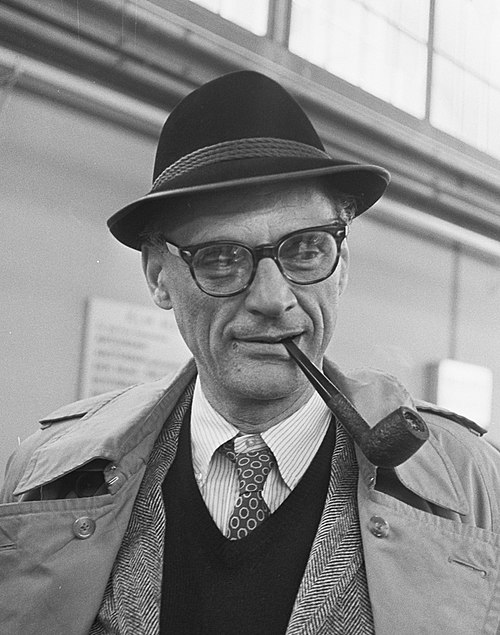
Playwright of Death of a Salesman and The Crucible who turned the American family into tragedy and refused to name names before the House Un-American Activities Committee.
More about Arthur Miller
- The Crucible became Arthur Miller's most performed playArthur Miller's The Crucible (1953), set during the Salem witch trials, became his most frequently produced work around the world.
- Arthur Miller directed Death of a Salesman in BeijingIn 1983 Arthur Miller travelled to China to direct Death of a Salesman with Chinese actors at the Beijing People's Art Theatre.
- Arthur Miller's legacy supports young people in theatreThe University of Michigan opened the Arthur Miller Theatre in 2007, and the Arthur Miller Foundation supports theatre education in New York City public schools.
- Arthur Miller's novel Focus confronted American antisemitismIn 1945 Arthur Miller published Focus, a novel about a gentile mistaken for a Jew, one of the first American novels to confront antisemitism at home.
- Arthur Miller led PEN International for persecuted writersIn 1965 Arthur Miller became the first American president of PEN International, using the role to campaign for imprisoned and persecuted writers.
- Arthur Miller's Broken Glass returned to KristallnachtArthur Miller's 1994 play Broken Glass, set in Brooklyn after Kristallnacht, is his most direct exploration of American Jewish identity.
- Incident at Vichy asked what each person owes the persecutedArthur Miller's 1964 play Incident at Vichy, about men detained in wartime France to be checked for Jewishness, asks what responsibility each of us bears for others.
- Arthur Miller brought an Auschwitz survivor's memoir to TVArthur Miller wrote Playing for Time (1980), a television drama based on Fania Fénelon's memoir of surviving Auschwitz by playing in its women's orchestra.
Sources
- Arthur Miller Wikipedia
- Excerpts from Arthur Miller's testimony before HUAC PBS American Masters
Another act of tikkun olam. This is part of tikkun olam, the Jewish idea of repairing the world, and every one of us can add to it.