- Person
- Arthur Miller
- Lived
- 1915–2005
- Field
- Theatre
- From
- American
The story
In the late 1970s China was emerging from the Cultural Revolution, and contact with Western artists was slowly resuming. Arthur Miller and his wife, the photographer Inge Morath, travelled there and published Chinese Encounters in 1979, describing a society in flux and the hardships many writers, professors and artists had suffered under Mao Zedong.
In 1983 Miller returned to direct Death of a Salesman at the Beijing People's Art Theatre, with a Chinese cast performing in Chinese. Willy Loman was played by Ying Ruocheng, one of the company's leading actors, who also translated the script. At the theatre he was celebrated for roles such as Pockmark Liu in Lao She's Teahouse, and he had first come to Western attention as Kublai Khan in the 1982 television miniseries Marco Polo. Ying had himself been sent to do manual labour in the provinces during the Cultural Revolution; he later became known to Western audiences in films such as The Last Emperor and served as China's vice minister of culture.
Miller found that Chinese audiences grasped the relationship between father and son easily. One thing about the play that is very Chinese, he said, is the way Willy tries to make his sons successful, much as many traditional Chinese fathers want their sons to become dragons.
The production was a success in China. Miller recorded the experience in Salesman in Beijing, illustrated with Morath's photographs and published in 1984, which describes the challenge of directing a Chinese cast in an American play. The same year Dustin Hoffman starred in a Broadway revival, later filmed for television and watched by some 25 million viewers.
The Beijing staging became a landmark of cultural exchange between the United States and China, and it is still remembered: a play about it, Salesman in China, premiered at Canada's Stratford Festival in 2024, performed in English and Chinese.
Why it matters
The Beijing staging showed that Miller's play speaks across cultures and opened a channel of artistic exchange between the two countries.
About Arthur Miller
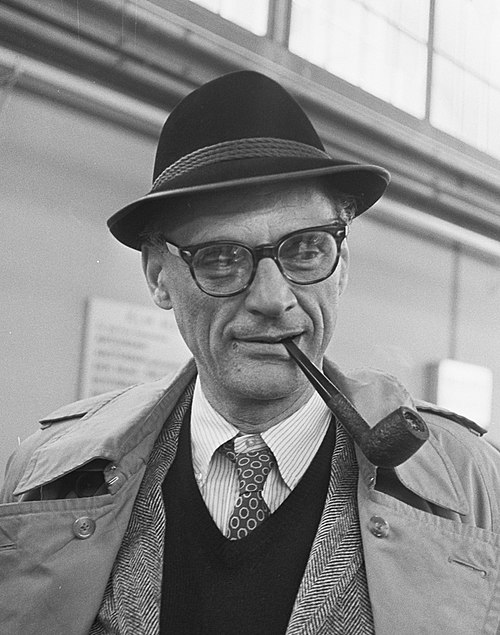
Playwright of Death of a Salesman and The Crucible who turned the American family into tragedy and refused to name names before the House Un-American Activities Committee.
More about Arthur Miller
- The Crucible became Arthur Miller's most performed playArthur Miller's The Crucible (1953), set during the Salem witch trials, became his most frequently produced work around the world.
- Arthur Miller's legacy supports young people in theatreThe University of Michigan opened the Arthur Miller Theatre in 2007, and the Arthur Miller Foundation supports theatre education in New York City public schools.
- Arthur Miller's novel Focus confronted American antisemitismIn 1945 Arthur Miller published Focus, a novel about a gentile mistaken for a Jew, one of the first American novels to confront antisemitism at home.
- Arthur Miller led PEN International for persecuted writersIn 1965 Arthur Miller became the first American president of PEN International, using the role to campaign for imprisoned and persecuted writers.
- Arthur Miller refused to name names before CongressCalled before the House Un-American Activities Committee in 1956, Arthur Miller refused to identify others; his contempt conviction was overturned in 1958.
- Arthur Miller's Broken Glass returned to KristallnachtArthur Miller's 1994 play Broken Glass, set in Brooklyn after Kristallnacht, is his most direct exploration of American Jewish identity.
- Incident at Vichy asked what each person owes the persecutedArthur Miller's 1964 play Incident at Vichy, about men detained in wartime France to be checked for Jewishness, asks what responsibility each of us bears for others.
- Arthur Miller brought an Auschwitz survivor's memoir to TVArthur Miller wrote Playing for Time (1980), a television drama based on Fania Fénelon's memoir of surviving Auschwitz by playing in its women's orchestra.
Sources
- Arthur Miller Wikipedia
- Death of a Salesman Wikipedia
- Ying Ruocheng Wikipedia
Another act of tikkun olam. This is part of tikkun olam, the Jewish idea of repairing the world, and every one of us can add to it.