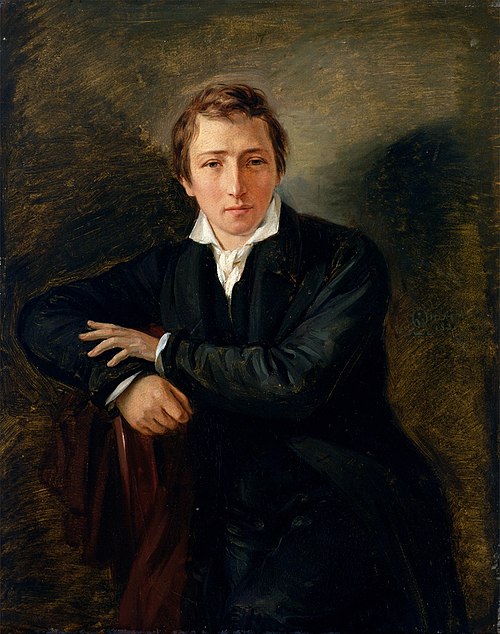
Harry from Düsseldorf
Heinrich Heine was born Harry Heine on 13 December 1797 in Düsseldorf, on the Rhine, into a Jewish family. His father, Samson Heine, was a textile merchant whose business later failed; his mother, Betty (Peira) van Geldern, was the cultivated daughter of a Jewish physician and the strongest influence on his childhood. He was the eldest of four children. Through his family he was distantly related to Karl Marx, who would later become his friend.
Heine’s parents were not especially observant. He went briefly to a Jewish elementary school, where he picked up a little Hebrew, and then to Catholic-run schools. His boyhood coincided with French rule over the Rhineland: Napoleon’s officials brought legal equality for Jews and trial by jury, and Heine never stopped admiring the emperor and France for it. When Napoleon fell in 1815, Düsseldorf became Prussian, and much of the old discrimination against Jews crept back.
A poet who would not be a banker
The family’s great success was Heine’s uncle, Salomon Heine, a millionaire banker in Hamburg. In 1816 Harry was sent to him to learn business, and he showed no talent for it. He also fell hopelessly in love with Salomon’s daughter, his cousin Amalie, who did not return his feelings; the disappointment ran through his early poetry. Salomon, who supported his nephew with money for most of his life, while grumbling at his extravagance, then paid for him to study law.
Heine studied at Bonn, Göttingen and Berlin between 1819 and 1825, more interested in literature and history than law. At Bonn he heard August Wilhelm Schlegel lecture on Romanticism; at Göttingen he was expelled from a student fraternity in an atmosphere of antisemitism and suspended after challenging a fellow student to a duel; in Berlin he attended Hegel’s lectures and was welcomed into the salon of Rahel Varnhagen. His first volume, Gedichte (Poems), appeared in December 1821.
The Jewish question in his own life
In Berlin, Heine joined the Society for the Culture and Science of the Jews, a group of young intellectuals around Leopold Zunz and Eduard Gans who wanted to reconcile Judaism with modern scholarship. He soon lost patience with it, but he began studying Jewish history and started a novel, Der Rabbi von Bacherach, about the persecution of Jews in medieval Germany. He never finished it.
Prussia had barred Jews from academic and many official posts in 1822. On 28 June 1825, in the town of Heiligenstadt, shortly after taking his doctorate in law, Heine was baptised a Lutheran and took the names Christian Johann Heinrich. He called the baptismal certificate the “ticket of admission to European culture” but it brought him no career, and within a year he was writing to a friend that he regretted it and was now hated by Jews and Christians alike. He described himself as baptised but not converted. Late in life he wrote: “I make no secret of my Judaism, to which I have not returned, because I never left it.”
Baptism did not stop others from treating him as a Jew. When the aristocratic poet August von Platen attacked him in a play laced with antisemitic jibes, Heine struck back in The Baths of Lucca by ridiculing Platen’s homosexuality. The so-called Platen affair became a literary scandal that damaged both men and showed how quickly a German writer of Jewish birth could be reminded of where he came from.
The Book of Songs
Heine’s breakthrough came through his lifelong publisher, Julius Campe of Hamburg. The first volume of his Reisebilder (Travel Pictures), including The Harz Journey, appeared in 1826 and created a new kind of German travel writing, mixing Romantic landscape with satire. In 1827 Campe published Buch der Lieder (Book of Songs), a collection of the poems Heine had already printed. Sales were slow at first, but it became one of the most popular books of verse ever published in German.
Its poems are short, musical and deceptively simple, full of moonlight, roses and broken hearts, and then, in the last line, an ironic twist that punctures the sentiment. Composers seized on them. Franz Schubert, Felix Mendelssohn, Robert Schumann (above all in his song cycle Dichterliebe), Johannes Brahms, Clara Schumann, Franz Liszt, Richard Strauss and Tchaikovsky all set his words. His poem about the Lorelei, the siren of the Rhine, in Friedrich Silcher’s setting became so familiar that it was sung almost as a folk song.
Paris, satire and politics
Inspired by the July Revolution of 1830 and tired of German censorship, Heine moved to Paris in 1831 and lived there for the rest of his life. He wrote for the Allgemeine Zeitung as its Paris correspondent and tried to explain Germany and France to each other, notably in On the History of Religion and Philosophy in Germany and The Romantic School. He knew Victor Hugo, Chopin, Berlioz, Liszt and Gérard de Nerval, and he became a celebrity. In 1835 the German Confederation, at Metternich’s insistence, banned his writings along with those of the radical Young Germany movement.
In the 1840s his verse became openly political. Deutschland. Ein Wintermärchen (Germany: A Winter’s Tale, 1844), based on a visit home in 1843, mocked Prussian militarism, censorship and small-minded nationalism. “The Silesian Weavers” (1844), about a workers’ uprising, appeared in Marx’s Paris journal Vorwärts. He shared Marx’s contempt for the German princes, but feared what a communist revolution might do to art and beauty. In 1834 he had met a young shop assistant, Crescence Eugénie Mirat, whom he called Mathilde; they married in 1841 and she stayed with him to the end.
His sharp pen also made enemies on the left. In 1840 he published a scathing memoir of his fellow Jewish-born exile Ludwig Börne, the idol of German radicals in Paris, who had died in 1837. Even Börne’s opponents thought the personal attacks in poor taste, and the husband of Börne’s close friend Jeanette Wohl challenged Heine to a duel. Before it took place, in 1841, Heine married Mathilde to secure her future; he escaped with a flesh wound to the hip. It was the last of the duels he fought.
The Damascus affair and Jewish themes
Heine’s Jewish loyalties surfaced in crises. In 1840 Jews in Damascus were tortured on a false charge of ritual murder, and the French government, courting Catholic opinion, did little. Heine was outraged, and he responded by publishing the fragment of The Rabbi of Bacherach that same year. He supported Jewish emancipation throughout his life, while his own remarks about Jews and Judaism could be sardonic and wounding.
The richest expression of his Jewish identity came late. Romanzero (1851) closes with the Hebrew Melodies, which include “Princess Sabbath” in which the Jewish people, bewitched into a dog through the week, becomes a prince again each Sabbath, and “Jehuda ben Halevy” a long homage to the medieval Hebrew poet of Spain. In the book’s afterword Heine announced that he had returned to belief in a personal God, startling readers who knew him as a mocker of religion.
The mattress-grave
In May 1848 Heine collapsed with a paralysis that confined him to bed for the remaining eight years of his life, his “mattress-grave” as he called it. His sight failed, and at times he had to lift a paralysed eyelid with his finger to see. Doctors then and later suggested various causes; a 1997 analysis of his hair suggested chronic lead poisoning.
He kept working, often dictating, and produced some of his finest poems, as well as his reportage collection Lutezia and unfinished memoirs. He met his pain with ferocious wit. He died in Paris on 17 February 1856, aged 58, and was buried, as he wished, in the Montmartre cemetery, under a monument engraved with his poem “Wo?” (“Where?”), which asks where the weary wanderer will finally rest. Mathilde survived him until 1883; they had no children.
Prophet and target
In On the History of Religion and Philosophy in Germany (1834–35) Heine warned the French that German philosophy might one day unleash a violent force that would make the French Revolution look like an innocent idyll. A century later the Nazis treated him as the archetype of the Jewish writer corrupting German culture. On 10 May 1933 his books were burned with those of other Jewish and liberal authors; his monuments were removed and his works suppressed. Popular settings of his poems were too well known to disappear entirely.
Today the line from his early tragedy Almansor, that where books are burned, people will in the end be burned too, is set into the ground at the memorial to the book burning on Berlin’s Bebelplatz. It has become one of the most quoted sentences in the German language.
Legacy
Heine is one of the great poets of the German language and one of its most widely translated. His lyrics live on in thousands of songs; his prose helped create the modern feuilleton, the witty, personal newspaper essay, and with it a style of cultural journalism that spread across Europe. Critics such as Karl Kraus blamed him for that, while Nietzsche admired him extravagantly.
Germany took a long time to honour him. A planned memorial fountain for Düsseldorf was blocked by antisemitic and nationalist opposition in the 1890s and ended up in the Bronx, New York, as the Lorelei Fountain. Düsseldorf’s university now bears his name. For Jews he remains an emblem of the brilliant, ambivalent modern Jewish writer: baptised for a career he never had, at home neither in church nor synagogue, yet never able, or willing, to stop being a Jew.
Sources & further reading
Heinrich Heine, Wikipedia · Heine, Heinrich, Jewish Encyclopedia (1906) · Heine, Heinrich, Encyclopedia.com · Researched from the sources above and checked against them. Spotted an error? Tell us.
A life of tikkun olam. This is part of tikkun olam, the Jewish idea of repairing the world, and every one of us can add to it.