- Person
- Heinrich Heine
- Lived
- 1797–1856
- Field
- Poetry & prose
- From
- German
The story
In the early 1820s Heinrich Heine was a reluctant law student. After a spell in Berlin and a stay with his family in Lüneburg, where he began the poems of Die Heimkehr (The Homecoming), he returned to the University of Göttingen and was soon bored by the law again. In September 1824 he set off on a walking trip through the Harz mountains, and on his return he began writing an account of the journey.
After completing his doctorate in 1825, Heine struggled to make a living as a writer in a small, heavily censored German book market. In January 1826 he met Julius Campe, a liberal Hamburg publisher who printed as many dissident authors as he could and had developed ways to keep their books out of the censors' hands. Campe became Heine's chief publisher for the rest of his life.
Campe issued the first volume of Reisebilder (Travel Pictures) in May 1826. Alongside Die Heimkehr and the first cycle of North Sea poems, it contained Die Harzreise, which Wikipedia says marked a new style of German travel writing by combining Romantic descriptions of nature with satire. The book was such a success that Campe pressed Heine for more. A second volume followed in April 1827, with more North Sea poems and Ideen: Das Buch Le Grand, which mocked German censorship. A journey to northern Italy produced further travel works, including The Journey from Munich to Genoa and The Baths of Lucca, published in 1829 in a third volume that the Prussian government banned.
The Jewish Encyclopedia notes that between 1822 and 1827 Heine produced a series of poems and travel sketches that practically placed him at the head of German literature. Poems from Die Harzreise were included in his Book of Songs of 1827, and the Reisebilder made his name across the German-speaking world.
In Heine's travel writing the writer's own voice, jokes and opinions mattered as much as the scenery. His mix of personal observation, humour and pointed social comment remains a model for travel writers and essayists today.
Why it matters
Heine's witty travel writing showed that personal observation, humour and social criticism could live together, influencing writers and journalists ever since.
About Heinrich Heine
Düsseldorf-born Jewish poet of the Lorelei and the Book of Songs, a sharp-tongued satirist and Paris exile whose lyrics became some of the best-loved songs in German.
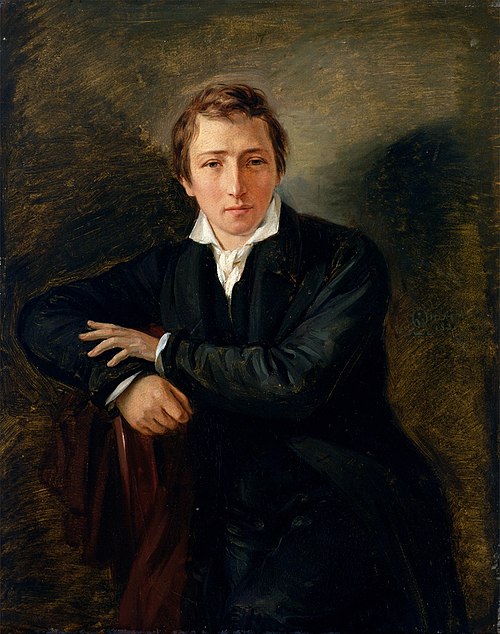
More about Heinrich Heine
- Heine's Book of Songs became a classic of German verseHeinrich Heine's Buch der Lieder (Book of Songs), published in 1827, became one of the most popular books of German poetry ever published.
- Heine's poems inspired songs by Schubert and SchumannHeinrich Heine's lyrics were set to music by Schubert, Schumann, Mendelssohn, Brahms, Liszt, Wagner and many more, including Schumann's song cycle Dichterliebe.
- Heine worked to bridge Germany and FranceFrom Paris, where he settled in 1831, Heinrich Heine saw himself as a mediator between Germany and France, explaining each nation to the other.
- Heine's North Sea poems brought free verse into GermanInspired by the island of Norderney, Heinrich Heine wrote Die Nordsee (The North Sea), free verse poems that appeared in his Travel Pictures of 1826 and 1827.
- Heine kept writing from his 'mattress-grave'Paralysed and bedridden from 1848 until his death in 1856, Heinrich Heine kept writing, producing the poetry collection Romanzero and the journalism of Lutezia.
- Heine's book-burning warning stands at Holocaust museumsHeinrich Heine's 1823 line that where books are burned, people will in the end be burned too, is displayed at Yad Vashem and the US Holocaust Memorial Museum.
- Heine wrote 'The Silesian Weavers' in support of workersHeinrich Heine's 1844 poem "Die schlesischen Weber" (The Silesian Weavers), based on a weavers' uprising, became his most popular political poem.
Sources
- Heinrich Heine Wikipedia
- Heine, Heinrich Jewish Encyclopedia (1906)
Another act of tikkun olam. This is part of tikkun olam, the Jewish idea of repairing the world, and every one of us can add to it.