- Person
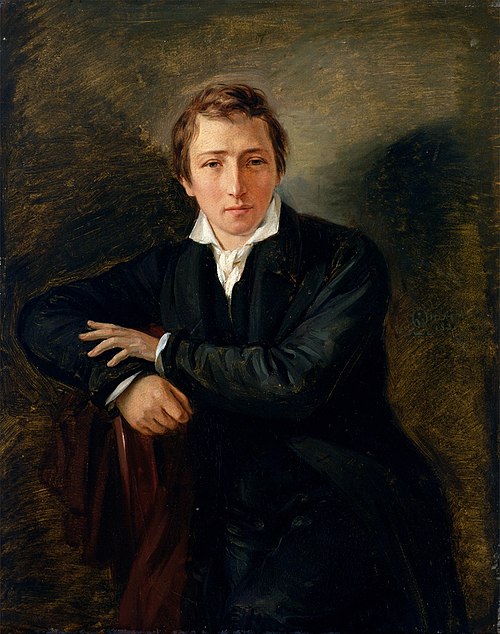
- Heinrich Heine
- Lived
- 1797–1856
- Field
- Poetry & prose
- From
- German
The story
Heinrich Heine was born into a Jewish family in Düsseldorf in 1797 and began writing poetry and plays while still a law student. Between 1821 and 1822 he wrote a tragedy, Almansor, which was published in April 1823 together with a second play, William Ratcliff, and his poem cycle Lyrisches Intermezzo. Neither play had much success on the stage.
Almansor is set in Spain after the Christian conquest of Granada. When the Muslim character Hassan hears that the conquerors have burned the Quran in the city's marketplace, he answers that this was only a prelude: where they burn books, they will ultimately burn people as well. Heine had a lasting interest in the persecuted minorities of medieval Spain, and as a student in Berlin he was especially drawn to the history of its Jews.
More than a century later, the Nazis made Heine one of their chief targets. Their newspaper, the Völkischer Beobachter, attacked him repeatedly, even denouncing a Heine memorial completed in Hamburg in 1926. In 1933 his works were among the thousands of books burned on Berlin's Opernplatz. All his monuments in Germany were removed or destroyed, his books were suppressed and, from 1940, banned. Silencing him proved difficult, however, because so many of his poems lived on as popular songs, and a 1937 New York Times article reported that Goebbels had found it impossible in practice to purge his influence from the German language.
Heine's own words were later chosen to mark the site of the Berlin book burning. The line from Almansor, in its original German, is engraved in the ground there. It is also set into the pavement in Frankfurt am Main and is prominently displayed at Yad Vashem, the Holocaust memorial and museum in Jerusalem, and at the United States Holocaust Memorial Museum in Washington.
Visitors to these places read a sentence written 110 years before the Berlin fire, by a poet whose own books were thrown into it. The line has become a lasting lesson for later generations that attacks on books and ideas can be a first step towards attacks on human beings.
Why it matters
Heine's line is now one of the world's best-known warnings against censorship, reminding museum visitors and passers-by how the persecution of ideas can lead to the persecution of people.
About Heinrich Heine
Düsseldorf-born Jewish poet of the Lorelei and the Book of Songs, a sharp-tongued satirist and Paris exile whose lyrics became some of the best-loved songs in German.
More about Heinrich Heine
- Heine's Book of Songs became a classic of German verseHeinrich Heine's Buch der Lieder (Book of Songs), published in 1827, became one of the most popular books of German poetry ever published.
- Heine's Harz Journey created a new style of travel writingHeinrich Heine's Die Harzreise (The Harz Journey), published in 1826, created a new style of German travel writing, mixing Romantic nature description with satire.
- Heine's poems inspired songs by Schubert and SchumannHeinrich Heine's lyrics were set to music by Schubert, Schumann, Mendelssohn, Brahms, Liszt, Wagner and many more, including Schumann's song cycle Dichterliebe.
- Heine worked to bridge Germany and FranceFrom Paris, where he settled in 1831, Heinrich Heine saw himself as a mediator between Germany and France, explaining each nation to the other.
- Heine's North Sea poems brought free verse into GermanInspired by the island of Norderney, Heinrich Heine wrote Die Nordsee (The North Sea), free verse poems that appeared in his Travel Pictures of 1826 and 1827.
- Heine kept writing from his 'mattress-grave'Paralysed and bedridden from 1848 until his death in 1856, Heinrich Heine kept writing, producing the poetry collection Romanzero and the journalism of Lutezia.
- Heine wrote 'The Silesian Weavers' in support of workersHeinrich Heine's 1844 poem "Die schlesischen Weber" (The Silesian Weavers), based on a weavers' uprising, became his most popular political poem.
Sources
- Heinrich Heine Wikipedia
Another act of tikkun olam. This is part of tikkun olam, the Jewish idea of repairing the world, and every one of us can add to it.