- Person
- Heinrich Heine
- Lived
- 1797–1856
- Field
- Poetry & prose
- From
- German
The story
When Frederick William IV came to the Prussian throne in 1840, censorship was briefly relaxed and a wave of political poets became popular in Germany. Heinrich Heine, living in exile in Paris, thought most of them were poor poets, but his own verse of the 1840s became more political too. He attacked the kings of Bavaria and Prussia, the political torpor of Germany and what he saw as the greed and cruelty of the ruling class.
In 1844 weavers in Peterswaldau, in Silesia, rose up against exploitation and falling wages, grievances that had grown with industrialisation. The revolt made the public across Germany aware of what became known as the social question. Heine responded with a poem first published as "Die armen Weber" (The Poor Weavers) on 10 July 1844 in Vorwärts!, the Paris journal associated with his distant relative Karl Marx, who had arrived in Paris in 1843 and admired Heine's work. It was also printed as a leaflet in 50,000 copies and distributed in the areas of the uprising.
In the poem the weavers sit at their looms weaving a burial shroud for Germany, with a threefold curse: on God, on the King and on the Fatherland, the three powers to which Prussian soldiers swore loyalty. Each verse ends with the refrain "Wir weben, wir weben!" (We are weaving, we are weaving!). Wikipedia describes it as the most popular of Heine's political poems, and Friedrich Engels was the first to translate it into English.
The authorities took it seriously. Prussia's royal supreme court banned the poem for its rebellious tone, and in 1846 a man who recited it in Berlin was sent to prison. Under its later title, "Die schlesischen Weber", it became the best-known literary response to the weavers' revolt.
In the same year Heine published Deutschland: Ein Wintermärchen (Germany: A Winter's Tale), a satirical account of his journey home in late 1843, in his collection Neue Gedichte (New Poems). His radical views led to many of his works being banned, which only increased his fame. The weavers' poem has since been set to music by many folk and punk bands, and it remains one of the best-known German protest poems.
Why it matters
Heine lent his poetic voice to impoverished workers, helping to bring their suffering to the attention of a wide public.
About Heinrich Heine
Düsseldorf-born Jewish poet of the Lorelei and the Book of Songs, a sharp-tongued satirist and Paris exile whose lyrics became some of the best-loved songs in German.
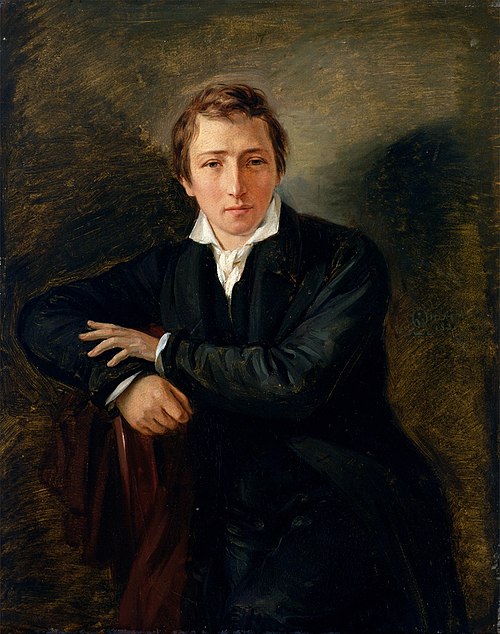
More about Heinrich Heine
- Heine's Book of Songs became a classic of German verseHeinrich Heine's Buch der Lieder (Book of Songs), published in 1827, became one of the most popular books of German poetry ever published.
- Heine's Harz Journey created a new style of travel writingHeinrich Heine's Die Harzreise (The Harz Journey), published in 1826, created a new style of German travel writing, mixing Romantic nature description with satire.
- Heine's poems inspired songs by Schubert and SchumannHeinrich Heine's lyrics were set to music by Schubert, Schumann, Mendelssohn, Brahms, Liszt, Wagner and many more, including Schumann's song cycle Dichterliebe.
- Heine worked to bridge Germany and FranceFrom Paris, where he settled in 1831, Heinrich Heine saw himself as a mediator between Germany and France, explaining each nation to the other.
- Heine's North Sea poems brought free verse into GermanInspired by the island of Norderney, Heinrich Heine wrote Die Nordsee (The North Sea), free verse poems that appeared in his Travel Pictures of 1826 and 1827.
- Heine kept writing from his 'mattress-grave'Paralysed and bedridden from 1848 until his death in 1856, Heinrich Heine kept writing, producing the poetry collection Romanzero and the journalism of Lutezia.
- Heine's book-burning warning stands at Holocaust museumsHeinrich Heine's 1823 line that where books are burned, people will in the end be burned too, is displayed at Yad Vashem and the US Holocaust Memorial Museum.
Sources
- Heinrich Heine Wikipedia
- The Silesian Weavers Wikipedia
Another act of tikkun olam. This is part of tikkun olam, the Jewish idea of repairing the world, and every one of us can add to it.