- Person
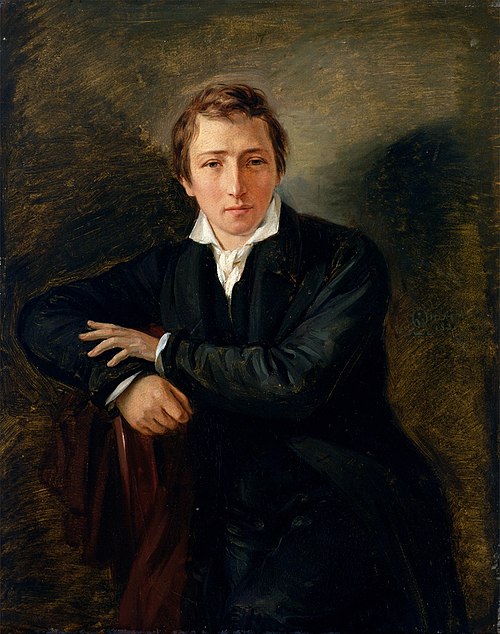
- Heinrich Heine
- Lived
- 1797–1856
- Field
- Poetry & prose
- From
- German
The story
Heinrich Heine was born Harry Heine in 1797 in Düsseldorf to a Jewish family; his father was a textile merchant. His uncle Salomon, a wealthy Hamburg banker, paid for him to study law at Bonn, Göttingen and Berlin, but his real passion was literature. At Bonn the critic August Wilhelm Schlegel gave his early verses a sympathetic reading, and Heine began to make his name as a poet while still a student. His first collection, Gedichte, appeared in December 1821.
In January 1826 Heine met the Hamburg publisher Julius Campe, who would publish him for the rest of his life. That November Heine wrote to a friend that he wanted to gather his poems into a carefully chosen, chronological and affordable volume that could become as popular as the works of Goethe and Uhland. Campe was doubtful at first but agreed, and Buch der Lieder appeared in October 1827.
The book contained 237 poems written between 1817 and 1826, only eight of them new. It brought together the cycles Junge Leiden (Youthful Sorrows), Lyrisches Intermezzo, Die Heimkehr (The Homecoming), poems from his Harz journey and the free verse of Die Nordsee. Many of the poems deal with unrequited love, but the book also includes "Die Lorelei", "The Grenadiers", "Im wunderschönen Monat Mai" and "Donna Clara", a poem that criticises the antisemitism of its day.
Wikipedia notes that nobody expected it to become one of the most popular books of German verse ever published. Sales began slowly but picked up once composers started setting the poems to music; Robert Schumann's song cycle Dichterliebe of 1840 is drawn entirely from the Lyrisches Intermezzo. Heine revised the book for each new edition up to 1844, and it was still being reprinted decades after his death. The Jewish Encyclopedia of 1906 calls it his masterpiece and one of the most exquisite volumes of lyric verse by any German poet.
Its lyrics, by turns tender and ironic, brought a new, modern voice into German poetry. They went on to be translated into many languages; the American poet Emma Lazarus published celebrated English versions in 1881.
Why it matters
The Book of Songs gave readers around the world some of the best-loved lyric poems in the German language.
About Heinrich Heine
Düsseldorf-born Jewish poet of the Lorelei and the Book of Songs, a sharp-tongued satirist and Paris exile whose lyrics became some of the best-loved songs in German.
More about Heinrich Heine
- Heine's Harz Journey created a new style of travel writingHeinrich Heine's Die Harzreise (The Harz Journey), published in 1826, created a new style of German travel writing, mixing Romantic nature description with satire.
- Heine's poems inspired songs by Schubert and SchumannHeinrich Heine's lyrics were set to music by Schubert, Schumann, Mendelssohn, Brahms, Liszt, Wagner and many more, including Schumann's song cycle Dichterliebe.
- Heine worked to bridge Germany and FranceFrom Paris, where he settled in 1831, Heinrich Heine saw himself as a mediator between Germany and France, explaining each nation to the other.
- Heine's North Sea poems brought free verse into GermanInspired by the island of Norderney, Heinrich Heine wrote Die Nordsee (The North Sea), free verse poems that appeared in his Travel Pictures of 1826 and 1827.
- Heine kept writing from his 'mattress-grave'Paralysed and bedridden from 1848 until his death in 1856, Heinrich Heine kept writing, producing the poetry collection Romanzero and the journalism of Lutezia.
- Heine's book-burning warning stands at Holocaust museumsHeinrich Heine's 1823 line that where books are burned, people will in the end be burned too, is displayed at Yad Vashem and the US Holocaust Memorial Museum.
- Heine wrote 'The Silesian Weavers' in support of workersHeinrich Heine's 1844 poem "Die schlesischen Weber" (The Silesian Weavers), based on a weavers' uprising, became his most popular political poem.
Sources
- Heinrich Heine Wikipedia
- Heine, Heinrich Jewish Encyclopedia (1906)
- Emma Lazarus Wikipedia
- Book of Songs (Heinrich Heine) Wikipedia
Another act of tikkun olam. This is part of tikkun olam, the Jewish idea of repairing the world, and every one of us can add to it.