- Person
- Heinrich Heine
- Lived
- 1797–1856
- Field
- Poetry & prose
- From
- German
The story
In 1825 Heinrich Heine completed his law doctorate at Göttingen. He now had to find a way to earn a living, and the only work that really suited him was writing. Before taking up any post, he visited Norderney, a resort island on Germany's North Sea coast.
The sea inspired a cycle of poems, Die Nordsee, which Wikipedia describes as free verse: poems without regular rhyme or metre, unusual in the German poetry of the time. They stood apart from the rhyming stanzas of the love songs that had made his name.
The first cycle appeared in May 1826 in the first volume of his Reisebilder (Travel Pictures), published in Hamburg by Julius Campe alongside his Harz Journey and the poems of Die Heimkehr. Its success led Campe to ask for more, and in April 1827 the second volume included a second North Sea cycle and a third section, a prose essay on the North Sea. The same volume carried Ideen: Das Buch Le Grand, whose satire on German censorship was sharp enough that Heine left for England to avoid the expected controversy. Later that year both verse cycles were gathered into the closing section of his Book of Songs, where they reached a much wider readership.
They became part of the body of work from 1822 to 1827 that the Jewish Encyclopedia says practically placed Heine at the head of German literature. From the mid-1820s he also moved away from Romanticism, adding irony and satire to his poetry and gently mocking its sentimental awe of nature, even the blue flower that the poet Novalis had made a symbol of the Romantic movement.
This modern, ironic voice became his signature and was soon admired by readers far beyond Germany. The North Sea poems showed that serious German poetry could set aside rhyme and strict metre altogether, a freedom that later generations of poets would explore.
Why it matters
Heine's experiments with free verse and irony widened the possibilities of German poetry and helped open the way for the unrhymed poetry that later writers took for granted.
About Heinrich Heine
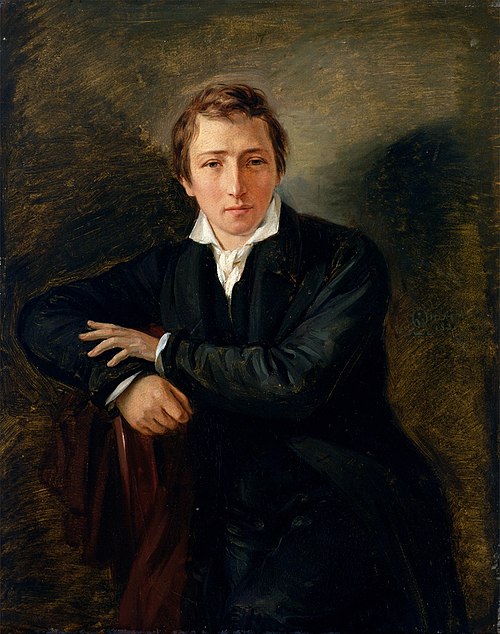
Düsseldorf-born Jewish poet of the Lorelei and the Book of Songs, a sharp-tongued satirist and Paris exile whose lyrics became some of the best-loved songs in German.
More about Heinrich Heine
- Heine's Book of Songs became a classic of German verseHeinrich Heine's Buch der Lieder (Book of Songs), published in 1827, became one of the most popular books of German poetry ever published.
- Heine's Harz Journey created a new style of travel writingHeinrich Heine's Die Harzreise (The Harz Journey), published in 1826, created a new style of German travel writing, mixing Romantic nature description with satire.
- Heine's poems inspired songs by Schubert and SchumannHeinrich Heine's lyrics were set to music by Schubert, Schumann, Mendelssohn, Brahms, Liszt, Wagner and many more, including Schumann's song cycle Dichterliebe.
- Heine worked to bridge Germany and FranceFrom Paris, where he settled in 1831, Heinrich Heine saw himself as a mediator between Germany and France, explaining each nation to the other.
- Heine kept writing from his 'mattress-grave'Paralysed and bedridden from 1848 until his death in 1856, Heinrich Heine kept writing, producing the poetry collection Romanzero and the journalism of Lutezia.
- Heine's book-burning warning stands at Holocaust museumsHeinrich Heine's 1823 line that where books are burned, people will in the end be burned too, is displayed at Yad Vashem and the US Holocaust Memorial Museum.
- Heine wrote 'The Silesian Weavers' in support of workersHeinrich Heine's 1844 poem "Die schlesischen Weber" (The Silesian Weavers), based on a weavers' uprising, became his most popular political poem.
Sources
- Heinrich Heine Wikipedia
- Heine, Heinrich Jewish Encyclopedia (1906)
Another act of tikkun olam. This is part of tikkun olam, the Jewish idea of repairing the world, and every one of us can add to it.