- Person
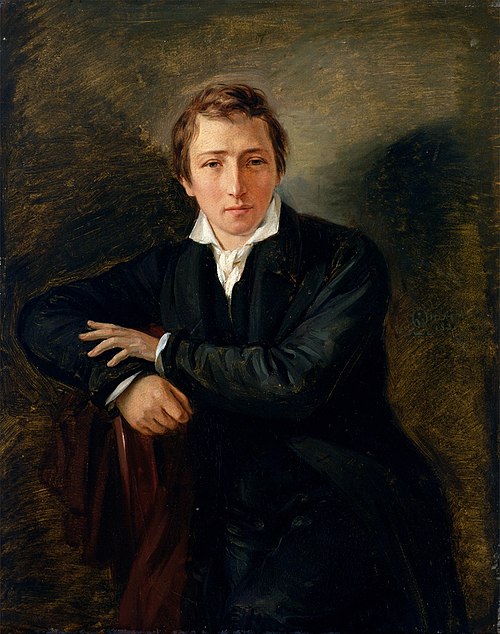
- Heinrich Heine
- Lived
- 1797–1856
- Field
- Poetry & prose
- From
- German
The story
Outside Germany, Heinrich Heine is best known for his early lyric poetry, which composers turned into Lieder, or art songs. When his Book of Songs appeared in 1827, sales were slow at first; Wikipedia notes that they only picked up when composers began setting his poems. One short poem, "Allnächtlich im Traume", was set by both Robert Schumann and Felix Mendelssohn.
Schumann's response was the most famous. In 1840 he composed Dichterliebe (A Poet's Love), choosing poems from Heine's Lyrisches Intermezzo, a cycle of 65 poems written in 1822 and 1823. Schumann first set 20 of them, but the published cycle of 1844 contains 16 songs, beginning with "Im wunderschönen Monat Mai". Together with Franz Schubert's song cycles, Dichterliebe forms the core of the genre. Another poem from the same cycle, "Auf Flügeln des Gesanges" (On Wings of Song), is best known in Felix Mendelssohn's setting.
The list of composers who set Heine's words is remarkable: Schubert, Schumann, Mendelssohn, Fanny Hensel, Clara Schumann, Johannes Brahms, Franz Liszt, Hugo Wolf, Richard Strauss, Pyotr Ilyich Tchaikovsky, Edward MacDowell and Richard Wagner. Friedrich Silcher's 1837 setting of "Die Lorelei" became well known throughout the German-speaking world, and Liszt also set it, as did dozens of others. In the twentieth century composers including Nikolai Medtner, Carl Orff, Hans Werner Henze and the Israeli Yehezkel Braun continued the tradition.
His play William Ratcliff became operas by César Cui and Pietro Mascagni. In 1964 Gert Westphal recorded Heine's lyrics with the Attila Zoller jazz quartet, and in 1994 Wilhelm Killmayer set 37 of his poems in a song book. The songs were so widely loved that, when the Nazis tried to erase Heine from German culture, their popularity became a problem for the censors.
Today Dichterliebe and many other Heine settings are central to the repertoire of art song, sung in recital halls, studied by music students and recorded again and again. Through them, listeners who may never open a book of German poetry still come to know Heine's words.
Why it matters
Heine's poems became the words of hundreds of songs still performed in concert halls around the world.
About Heinrich Heine
Düsseldorf-born Jewish poet of the Lorelei and the Book of Songs, a sharp-tongued satirist and Paris exile whose lyrics became some of the best-loved songs in German.
More about Heinrich Heine
- Heine's Book of Songs became a classic of German verseHeinrich Heine's Buch der Lieder (Book of Songs), published in 1827, became one of the most popular books of German poetry ever published.
- Heine's Harz Journey created a new style of travel writingHeinrich Heine's Die Harzreise (The Harz Journey), published in 1826, created a new style of German travel writing, mixing Romantic nature description with satire.
- Heine worked to bridge Germany and FranceFrom Paris, where he settled in 1831, Heinrich Heine saw himself as a mediator between Germany and France, explaining each nation to the other.
- Heine's North Sea poems brought free verse into GermanInspired by the island of Norderney, Heinrich Heine wrote Die Nordsee (The North Sea), free verse poems that appeared in his Travel Pictures of 1826 and 1827.
- Heine kept writing from his 'mattress-grave'Paralysed and bedridden from 1848 until his death in 1856, Heinrich Heine kept writing, producing the poetry collection Romanzero and the journalism of Lutezia.
- Heine's book-burning warning stands at Holocaust museumsHeinrich Heine's 1823 line that where books are burned, people will in the end be burned too, is displayed at Yad Vashem and the US Holocaust Memorial Museum.
- Heine wrote 'The Silesian Weavers' in support of workersHeinrich Heine's 1844 poem "Die schlesischen Weber" (The Silesian Weavers), based on a weavers' uprising, became his most popular political poem.
Sources
- Heinrich Heine Wikipedia
- Dichterliebe Wikipedia
Another act of tikkun olam. This is part of tikkun olam, the Jewish idea of repairing the world, and every one of us can add to it.