- Person
- Heinrich Heine
- Lived
- 1797–1856
- Field
- Poetry & prose
- From
- German
The story
Heinrich Heine grew up in Düsseldorf while it was under French rule, and he admired the French for bringing the Napoleonic Code and trial by jury. At school he learned French, which became his second language. After Napoleon's defeat, the conservative order imposed on Germany, with its censored press, left him frustrated.
Inspired by the July Revolution of 1830 and eager to escape German censorship, Heine moved to Paris in 1831 and lived there for the rest of his life. He soon became a celebrity, and his friends included Victor Hugo, Gérard de Nerval, Frédéric Chopin, Hector Berlioz and Franz Liszt. He wrote everything in German and then translated it into French with a collaborator.
Heine believed that if the two countries understood each other, Europe would progress. As the Paris correspondent for the Allgemeine Zeitung, he reported on French life for German readers, beginning with the Salon of 1831; the articles were collected in 1833 as Französische Zustände (Conditions in France). For French readers he wrote De l'Allemagne (On Germany), begun in 1833, which explained German religion, philosophy and literature. It answered Madame de Staël's earlier book of the same name, which Heine felt had shown a dreamy land of poets and thinkers cut off from the modern world. In German the work became two books, On the History of Religion and Philosophy in Germany and The Romantic School.
The Jewish Encyclopedia describes Heine as playing the same mediating role between French and German culture that Spain's Jews had once played between Christians and Moors, and says he tried to make the depths of German thought accessible to the French. In 1835 the German authorities banned his works along with those of the Young Germany writers, but he kept commenting from Paris, where he remained free to publish.
His journalism shaped a new kind of writing. Wikipedia notes that Heine is often credited with spreading the feuilleton, the cultural newspaper essay, across Europe, and the Jewish Encyclopedia calls his work as a journalist epoch-making in the German-speaking countries. Today's arts and culture pages, and the idea of a foreign correspondent explaining one society to another, both owe something to him.
Why it matters
Heine's journalism helped two great European cultures understand one another and shaped the modern culture pages of newspapers.
About Heinrich Heine
Düsseldorf-born Jewish poet of the Lorelei and the Book of Songs, a sharp-tongued satirist and Paris exile whose lyrics became some of the best-loved songs in German.
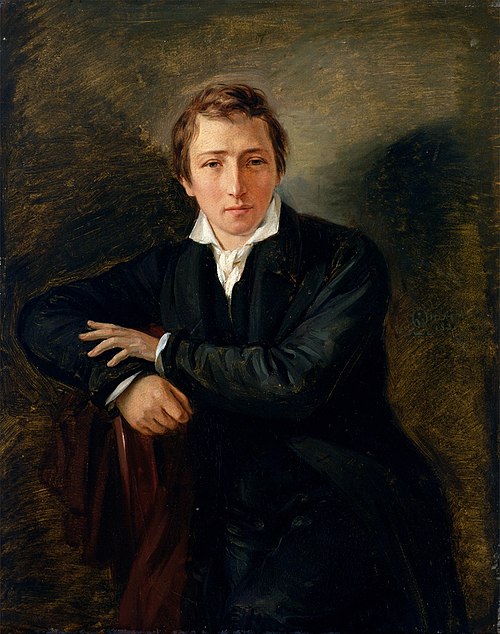
More about Heinrich Heine
- Heine's Book of Songs became a classic of German verseHeinrich Heine's Buch der Lieder (Book of Songs), published in 1827, became one of the most popular books of German poetry ever published.
- Heine's Harz Journey created a new style of travel writingHeinrich Heine's Die Harzreise (The Harz Journey), published in 1826, created a new style of German travel writing, mixing Romantic nature description with satire.
- Heine's poems inspired songs by Schubert and SchumannHeinrich Heine's lyrics were set to music by Schubert, Schumann, Mendelssohn, Brahms, Liszt, Wagner and many more, including Schumann's song cycle Dichterliebe.
- Heine's North Sea poems brought free verse into GermanInspired by the island of Norderney, Heinrich Heine wrote Die Nordsee (The North Sea), free verse poems that appeared in his Travel Pictures of 1826 and 1827.
- Heine kept writing from his 'mattress-grave'Paralysed and bedridden from 1848 until his death in 1856, Heinrich Heine kept writing, producing the poetry collection Romanzero and the journalism of Lutezia.
- Heine's book-burning warning stands at Holocaust museumsHeinrich Heine's 1823 line that where books are burned, people will in the end be burned too, is displayed at Yad Vashem and the US Holocaust Memorial Museum.
- Heine wrote 'The Silesian Weavers' in support of workersHeinrich Heine's 1844 poem "Die schlesischen Weber" (The Silesian Weavers), based on a weavers' uprising, became his most popular political poem.
Sources
- Heinrich Heine Wikipedia
- Heine, Heinrich Jewish Encyclopedia (1906)
Another act of tikkun olam. This is part of tikkun olam, the Jewish idea of repairing the world, and every one of us can add to it.