- Person
- Heinrich Heine
- Lived
- 1797–1856
- Field
- Poetry & prose
- From
- German
The story
By the late 1840s Heinrich Heine had lived in Paris for more than fifteen years and was one of the best-known writers in Europe. Around 1847 his health began to fail, and in May 1848 he suddenly became paralysed and was confined to bed. He called it his "mattress-grave" and did not leave it until his death eight years later. He also had trouble with his eyes. Doctors and biographers suggested various diseases, but analysis of his hair in 1997 indicated that he had suffered from chronic lead poisoning.
Wikipedia records that he bore his sufferings stoically and won much public sympathy. His illness kept him from following the revolutions of 1848 closely, but it did not stop him writing. In 1848 he also returned to a belief in God, though he remained sceptical of organised religion.
In September 1851 Campe published Romanzero, his third great collection of poems. It is divided into three books: Historien (Histories), Lamentationen (Lamentations) and Hebräische Melodien (Hebrew Melodies). The Jewish Encyclopedia notes that in these years his thoughts often turned to the faith of his youth and the finer sides of Judaism and the Jewish people, and that Romanzero contains perhaps the most striking picture of the medieval Hebrew poet Judah Halevi, as well as "Prinzessin Sabbath", a tribute to the Jewish Sabbath at home.
He kept working on the poems collected as Gedichte 1853 und 1854, on the autobiographical Geständnisse (Confessions), on the essay The Gods in Exile, and on the journalism gathered in Lutezia, all published in 1854 in three volumes of miscellaneous writings. His unfinished memoirs appeared after his death. The Jewish Encyclopedia says that through excruciating pain he showed a heroic patience.
He died in Paris on 17 February 1856 and was buried in the Montmartre Cemetery, beneath a tombstone by the Danish sculptor Louis Hasselriis on which his poem "Wo?" (Where?) is engraved. Romanzero, written in the hardest years of his life, remains one of his three great collections of verse, alongside the Book of Songs and New Poems.
Why it matters
Heine's determination to keep creating through years of paralysis gave literature some of its most moving late poems and has inspired readers facing their own hardships.
About Heinrich Heine
Düsseldorf-born Jewish poet of the Lorelei and the Book of Songs, a sharp-tongued satirist and Paris exile whose lyrics became some of the best-loved songs in German.
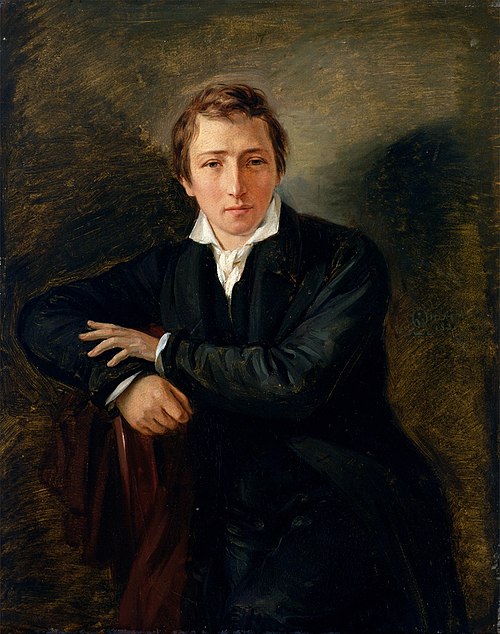
More about Heinrich Heine
- Heine's Book of Songs became a classic of German verseHeinrich Heine's Buch der Lieder (Book of Songs), published in 1827, became one of the most popular books of German poetry ever published.
- Heine's Harz Journey created a new style of travel writingHeinrich Heine's Die Harzreise (The Harz Journey), published in 1826, created a new style of German travel writing, mixing Romantic nature description with satire.
- Heine's poems inspired songs by Schubert and SchumannHeinrich Heine's lyrics were set to music by Schubert, Schumann, Mendelssohn, Brahms, Liszt, Wagner and many more, including Schumann's song cycle Dichterliebe.
- Heine worked to bridge Germany and FranceFrom Paris, where he settled in 1831, Heinrich Heine saw himself as a mediator between Germany and France, explaining each nation to the other.
- Heine's North Sea poems brought free verse into GermanInspired by the island of Norderney, Heinrich Heine wrote Die Nordsee (The North Sea), free verse poems that appeared in his Travel Pictures of 1826 and 1827.
- Heine's book-burning warning stands at Holocaust museumsHeinrich Heine's 1823 line that where books are burned, people will in the end be burned too, is displayed at Yad Vashem and the US Holocaust Memorial Museum.
- Heine wrote 'The Silesian Weavers' in support of workersHeinrich Heine's 1844 poem "Die schlesischen Weber" (The Silesian Weavers), based on a weavers' uprising, became his most popular political poem.
Sources
- Heinrich Heine Wikipedia
- Heine, Heinrich Jewish Encyclopedia (1906)
Another act of tikkun olam. This is part of tikkun olam, the Jewish idea of repairing the world, and every one of us can add to it.