- Person
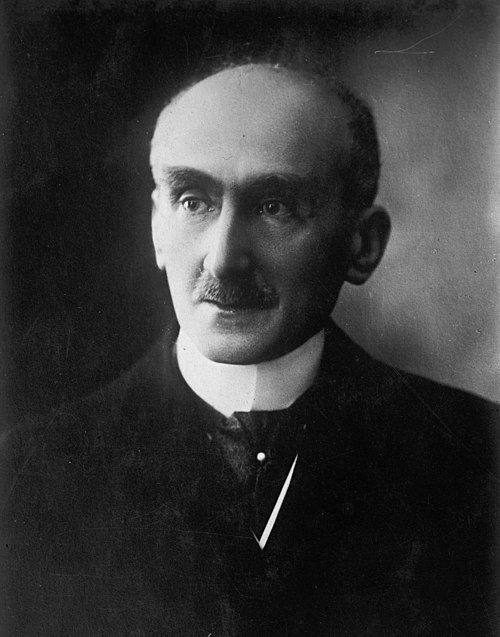
- Henri Bergson
- Lived
- 1859–1941
- Field
- Philosophy
- From
- French
The story
Henri Bergson first developed his ideas about comedy in a lecture given early in his career, while he was teaching in the Auvergne region of France in the 1880s. He returned to the subject in three essays for the Revue de Paris, and in 1900 the publisher Félix Alcan issued them as a book, Le Rire (Laughter), subtitled an essay on the meaning of the comic.
Bergson begins with three observations. The comic is strictly human: a landscape is never funny, and when we laugh at animals it is because we see human behaviour in them. Laughter needs a certain detachment from emotion, since it is hard to laugh at what moves us deeply. And laughter is social: it is hard to laugh alone, and people laugh together.
The essay's main thesis is that laughter is a corrective that evolved to make social life possible. People laugh, Bergson argued, at those who fail to adapt to the demands of society when that failure resembles the rigidity of a machine, such as a man who trips and falls in the street or an absent-minded person going through habitual motions. Comic writers exploit this tendency in many ways, and what they share is the idea that the comic consists in "something mechanical encrusted on the living". Bergson also warned that laughter is not a moral judgement and can wound a person's self-esteem.
Wikipedia calls Laughter one of the most important of Bergson's minor works and essential to understanding his view of life, especially the place of art in it. It appeared the same year that he was appointed to a chair at the Collège de France, marking the beginning of his growing fame. An English translation by Cloudesley Brereton and Fred Rothwell followed in 1911 and has been reprinted many times since.
The philosopher Mark Sinclair places Bergson among the small number of major philosophers to have studied laughter and the comic in depth. More than a century later, Laughter is still widely read, and its image of the mechanical encrusted on the living still offers a way to understand why slapstick, caricature and comic routines make audiences laugh.
Why it matters
Bergson's Laughter offered a lasting explanation of why we find things funny and what laughter does for society.
About Henri Bergson
French philosopher of time, memory and the élan vital who won the 1927 Nobel Prize in Literature and, drawn to Catholicism, chose to remain among the persecuted Jews.
More about Henri Bergson
- Bergson's Matter and Memory explored mind and brainIn Matter and Memory (1896), Henri Bergson investigated perception, memory and the brain, drawing on the medical research of his day.
- Henri Bergson, Nobel philosopher who stood with his peopleHenri Bergson won the 1927 Nobel Prize in Literature for his ideas on time and creativity, and later declined to convert so as not to leave the persecuted Jews of Europe.
- Bergson's first book redefined how we think about timeIn Time and Free Will (1889), Henri Bergson distinguished lived time, or duration, from clock time; Louis de Broglie said it anticipated ideas of Bohr and Heisenberg.
- Bergson's last book called for an open, universal moralityIn The Two Sources of Morality and Religion (1932), Henri Bergson contrasted a closed morality of the group with an open morality of love for all.
Sources
- Henri Bergson Wikipedia
- Henri Bergson Stanford Encyclopedia of Philosophy
- Laughter (book) Wikipedia
Another act of tikkun olam. This is part of tikkun olam, the Jewish idea of repairing the world, and every one of us can add to it.