A childhood between two worlds
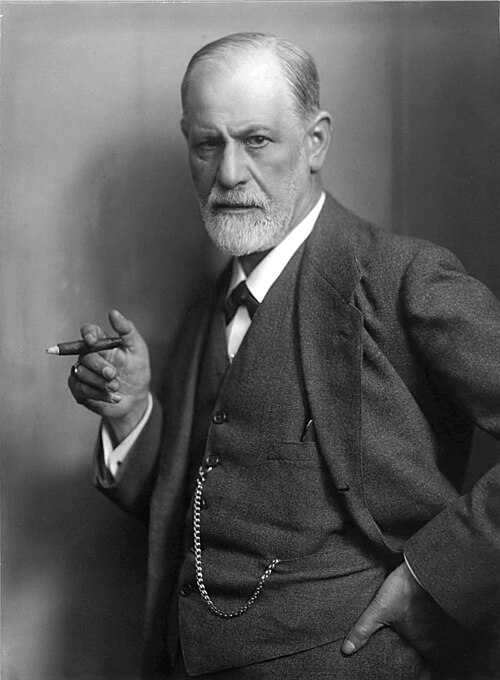
Sigmund Freud was born Sigismund Schlomo Freud on 6 May 1856 in Freiberg, in Moravia, then part of the Austrian Empire and now in the Czech Republic. He was the first child of his father Jacob's third marriage, to the much younger Amalia, and he grew up as the adored eldest son of a large Jewish family of modest means. When Freud was a small boy the wool trade declined and the family moved, settling in 1860 in Vienna, the imperial capital that would be his home for nearly eighty years. The Freuds were not strictly observant, but their Jewish identity was central to their sense of themselves, and the young Freud absorbed both pride in that heritage and an early awareness of the antisemitism woven through Viennese life. A precociously brilliant student, he was given his own room and special privileges to study, and he repaid the family's hopes by excelling at the demanding Gymnasium and developing a vast appetite for languages, literature and science.
Medicine and the laboratory
Freud entered the University of Vienna in 1873, drawn at first toward broad scientific and philosophical questions before committing himself to medicine. He was an unusually slow graduate, partly because he lingered in the research laboratory, fascinated by neurology and the microscopic study of nervous tissue. He earned his medical degree in 1881 and would have preferred a life of pure research, but academic posts were scarce, poorly paid and, for a Jew in Vienna, harder still to obtain. The need to support a family pushed him into clinical practice. During these early years he also conducted studies of cocaine, which he initially praised as a possible treatment for a range of physical and mental complaints, an enthusiasm that proved a serious misjudgement as reports of addiction mounted and damaged his professional standing. The episode is an early sign of a recurring pattern: bold, sweeping claims advanced ahead of the evidence.
Charcot, Breuer and the talking cure
Two encounters redirected Freud's career toward the mind. In 1885 he travelled to Paris to study with the celebrated neurologist Jean-Martin Charcot, who used hypnosis with patients diagnosed with hysteria and argued that their physical symptoms could have psychological origins. Freud returned to Vienna convinced that the source of such suffering lay in the mind rather than in damaged nerves. Equally important was his older friend and collaborator Josef Breuer, who had treated a patient whose symptoms eased when she spoke freely about distressing memories. Out of these influences Freud and Breuer developed and described a new approach, publishing their Studies on Hysteria in 1895. Freud gradually abandoned hypnosis in favour of encouraging patients to say whatever came into their minds, a technique he called free association. He came to believe that buried, unacceptable thoughts and desires could be coaxed into the open through talk, and that doing so could relieve distress.
The Interpretation of Dreams
In 1900 Freud published the book he regarded as his most important, The Interpretation of Dreams. In it he argued that dreams are not meaningless but are disguised expressions of repressed wishes, and that by analysing their hidden content one could reach the unconscious mind. He introduced the idea that the mind contains powerful forces of which the conscious self is unaware, and described mental mechanisms such as condensation and displacement through which forbidden material is disguised. The book sold slowly at first, but it laid the foundation of psychoanalysis, the name Freud gave both to his theory of the mind and to his clinical method. Over the following years he elaborated a sweeping account of human development, including the controversial idea that children pass through stages of sexual development and experience unconscious desires and rivalries within the family, a cluster of ideas he named the Oedipus complex.
Building a movement
Freud did not work in isolation for long. From around 1902 a circle of physicians and intellectuals began gathering at his Vienna apartment to discuss the new psychology, and this small group grew into an international movement with journals, congresses and societies. Among the early followers were figures who would become famous in their own right, including the Swiss psychiatrist Carl Jung, whom Freud at one point regarded as his natural successor. The movement was intellectually exhilarating but also fractious. Freud could be controlling and intolerant of dissent, and several of his most gifted associates broke away to found rival schools, Alfred Adler and then, painfully, Jung among them. The split with Jung around 1913 was especially bitter. These ruptures showed both the magnetism of Freud's ideas and the difficulty of remaining within his orbit, and they ensured that psychology in the twentieth century would develop as a contest of competing visions.
The structural model of the mind
In his later theoretical work Freud refined his picture of the psyche. He proposed that the mind could be understood through three interacting systems: the id, the reservoir of instinctual drives demanding immediate satisfaction; the superego, the internalised voice of conscience and social rule; and the ego, the mediating self that tries to balance these pressures against the demands of reality. He also wrote increasingly about aggression and the human capacity for self-destruction, especially after the carnage of the First World War. In ambitious late books such as Civilization and Its Discontents, Freud turned his theory outward, arguing that culture itself rests on the costly repression of instinct and that a degree of unhappiness is built into social life. These works extended psychoanalysis from the consulting room into philosophy, anthropology and the study of religion, which Freud, a lifelong unbeliever, treated as an illusion humanity might one day outgrow.
Illness and the rise of Nazism
From 1923 onward Freud lived with cancer of the jaw and palate, almost certainly linked to his heavy cigar smoking, and he endured more than thirty operations over his final sixteen years, often in considerable pain. He continued to write and to see patients with remarkable discipline. The political climate, meanwhile, grew menacing. The Nazis publicly burned his books in Berlin in 1933, and when Germany annexed Austria in 1938 Freud, as an internationally famous Jew, was in real danger. He resisted leaving Vienna until his daughter Anna was detained and interrogated by the Gestapo. With the help of influential admirers and friends abroad, the elderly and ailing Freud was permitted to emigrate, though he was forced to pay a punitive exit levy. Four of his sisters who remained behind were later murdered in the Holocaust, a fact that casts a long shadow over the story of his escape.
Exile and death in London
In June 1938 Freud arrived in London, where he was received with warmth and admiration and settled in a house in Hampstead with his family and his treasured collection of antiquities. He continued working on his final manuscripts even as the cancer advanced and became inoperable. By September 1939, with the disease causing intolerable suffering, Freud asked his physician and friend to help him die, and after consulting Anna the doctor administered doses of morphine. Freud died on 23 September 1939, shortly after the outbreak of the Second World War. His daughter Anna Freud carried his work forward, becoming a pioneer of child psychoanalysis, and the Hampstead house later opened to the public as the Freud Museum. He died in exile, his world overtaken by the barbarism he had feared, yet recognised across the English-speaking world as one of the most influential thinkers of his age.
Controversy and scientific criticism
Freud's reputation has always been contested, and the criticism is serious and substantial. Many scientists and philosophers argue that core psychoanalytic claims, such as repression, the Oedipus complex or the wish-fulfilment theory of dreams, are difficult or impossible to test, and that Freud sometimes shaped his evidence to fit his conclusions. His case histories have been re-examined and found, in places, to overstate his therapeutic successes. His account of female psychology, including the notion of penis envy and a supposedly weaker female conscience, has been widely rejected as a product of Victorian prejudice rather than science. As a treatment, classical psychoanalysis has largely been displaced by therapies with stronger evidence behind them. Defenders respond that Freud was a pioneer working without modern tools, and that some broad insights, the existence of unconscious mental processes, the influence of childhood and the value of talking through distress, have held up better than the elaborate theoretical scaffolding he built around them.
Impact and legacy
Whatever the verdict on psychoanalysis as a science, Freud's influence on the modern world has been immense and lasting. He changed the way ordinary people understand themselves, popularising the idea that human beings are driven by motives they are not aware of, that childhood experience shapes adult life, and that mental suffering can be eased by speaking openly about it. The very practice of talk therapy, the notion that a troubled person might benefit from being heard without judgement, descends from his consulting room and has brought relief to countless people. His vocabulary, terms such as the unconscious, repression, denial and the ego, has passed into everyday language and into literature, art, film and criticism, where his influence remains visible everywhere. Freud is best understood not as an infallible scientist but as a bold, flawed and extraordinarily original thinker who placed the inner life at the centre of modern self-understanding. Few individuals have so thoroughly changed how the world thinks about the human mind.
Sources & further reading
Sigmund Freud, Wikipedia · Researched from the sources above and checked against them. Spotted an error? Tell us.
A life of tikkun olam. This is part of tikkun olam, the Jewish idea of repairing the world, and every one of us can add to it.