- Person
- Sigmund Freud
- Lived
- 1856–1939
- Field
- Psychology
- From
- Austrian
The story
After the slaughter of the First World War, the League of Nations sought ways to prevent another. At the end of 1931 its International Institute of Intellectual Cooperation invited Albert Einstein to begin an exchange of letters with a fellow leader of thought on a question of his choice. Einstein chose Sigmund Freud, and his question was whether there was any way of delivering humanity from the menace of war.
Einstein wrote at the end of July 1932, and Freud, then 76 and ill with cancer, replied about two months later. Freud told the institute's secretary that he was giving the project all that remained of his energies. The two Jewish thinkers, the physicist and the founder of psychoanalysis, approached the question from very different directions, asking why human beings go to war and whether anything could stop them.
In his reply Freud traced how law had grown out of violence, arguing that right is the might of a community united against the violence of individuals. He related human aggressiveness to his theory of the death drive, an instinct toward destruction that works against Eros, the instinct that binds people together. Anything that creates emotional ties between people, he suggested, works against war. He was cautious but not hopeless: he expressed a guarded hope that the growth of culture might work against war.
The correspondence was published in March 1933 in English, French and German as Why War? It appeared just as the Nazis took power in Germany, where the German edition, Warum Krieg?, was banned. That same year the Nazis burned Freud's books. In 1938 Freud himself fled Vienna for London, where he died the following year.
Why War? remains a landmark exchange between two of the century's greatest minds. It stands as an early attempt to understand the roots of human violence and to imagine the institutions and culture that might restrain it.
Why it matters
Why War? remains a landmark attempt by two of the century's greatest minds to understand human violence and find a path to peace.
About Sigmund Freud
Founder of psychoanalysis; reshaped how the world thinks about the mind, the unconscious, and human motivation.
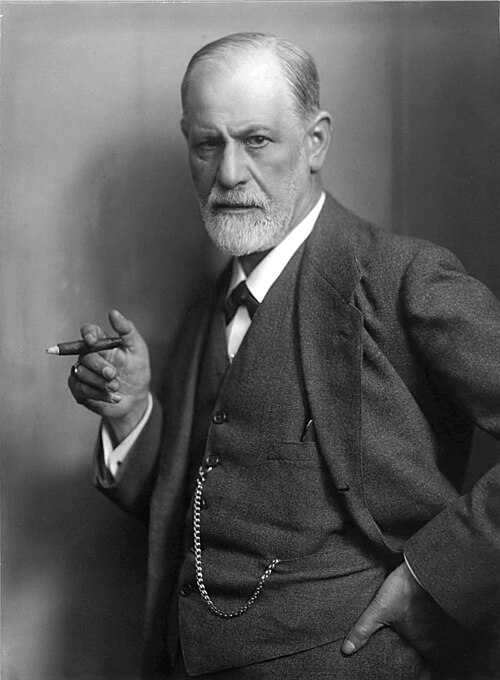
More about Sigmund Freud
- Freud was an early researcher of cerebral palsyAs a neurologist, Sigmund Freud published several papers on cerebral palsy and challenged the prevailing view that it was caused only by lack of oxygen at birth.
- Freud's nerve research helped pave the way to the neuronBefore psychoanalysis, Sigmund Freud spent six years in Ernst Brücke's laboratory studying nerve cells, work that proved seminal for the discovery of the neuron in the 1890s.
- Freud's Interpretation of Dreams opened a new scienceIn The Interpretation of Dreams (1899), Sigmund Freud argued that dreams have meaning and set out his model of the unconscious mind.
- Freud's essay on mourning changed how we understand griefSigmund Freud's 1917 essay “Mourning and Melancholia” distinguished normal grief, painful but inevitable, from depression, laying groundwork for later study of grief and depression.
- Freud coined the medical term agnosiaIn his first book, On Aphasia (1891), Sigmund Freud coined the term agnosia and warned against linking each brain function too rigidly to one location.
- Freud's talking cure became the basis of psychotherapySigmund Freud developed free association, in which patients talk freely about whatever comes to mind. His talking cure set the basic format for all later psychotherapy.
Sources
- Sigmund Freud Wikipedia
- The Freud-Einstein Correspondence of 1932: Theories of War Transcend Media Service
Another act of tikkun olam. This is part of tikkun olam, the Jewish idea of repairing the world, and every one of us can add to it.