- Person
- Sigmund Freud
- Lived
- 1856–1939
- Field
- Psychology
- From
- Austrian
The story
Aphasia, the loss of the ability to understand or express language after brain damage, was one of the great puzzles of nineteenth-century neurology. Leading researchers of the classical German school, including Theodor Meynert, Carl Wernicke and Ludwig Lichtheim, tried to explain each form of aphasia by damage to a precise centre in the brain. Wernicke, for example, linked an inability to understand speech to lesions in a specific part of the left temporal lobe.
Sigmund Freud had trained in Brücke's physiology laboratory and worked in Meynert's clinic at Vienna General Hospital, and by the late 1880s he was a lecturer in neuropathology in private practice. In 1891 he published his first book, On Aphasia: A Critical Study (Zur Auffassung der Aphasien). In it he challenged the main authorities of the time, arguing that their way of understanding aphasias was no longer tenable because it confused psychological and physiological concepts.
Freud counselled against too strict a localist view of neurological deficits. Like his contemporary Eugen Bleuler, he emphasised how the brain functions rather than simply mapping its structures. In the book he also introduced a new term. For disturbances in the recognition of objects, which the physician Finkelnburg had classed as asymbolia, Freud proposed the word agnosia, from the Greek for absence of knowledge.
Agnosia remains a standard term in neurology and neuropsychology today. It describes an inability to recognise objects, people, sounds, shapes or smells even though the senses themselves work and memory is largely intact. Doctors now distinguish many forms, such as visual agnosia and prosopagnosia, the inability to recognise faces, which can follow strokes, dementia or other brain injuries.
On Aphasia also contains Freud's earliest thinking about psychology and language, including speculation about how children acquire speech. He returned to the subject in his 1915 paper The Unconscious. His interest in how the mind links words and meanings carried over into psychoanalysis, which treats a patient's speech as a window into mental life.
Why it matters
Freud's coinage of agnosia gave doctors a lasting name for a group of neurological disorders, still used in diagnosis and research.
About Sigmund Freud
Founder of psychoanalysis; reshaped how the world thinks about the mind, the unconscious, and human motivation.
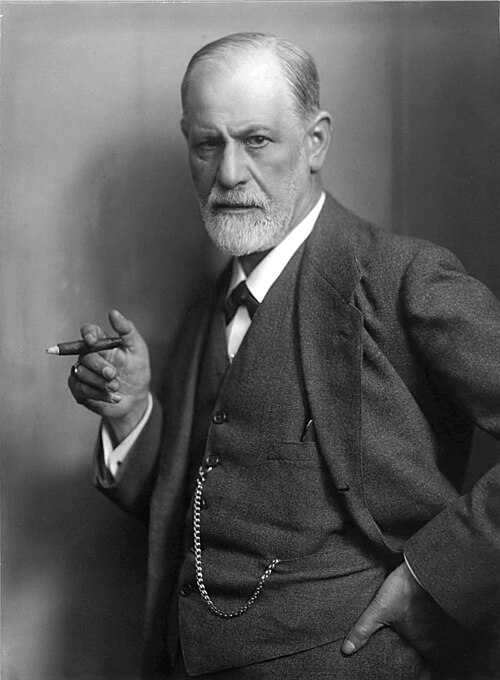
More about Sigmund Freud
- Freud was an early researcher of cerebral palsyAs a neurologist, Sigmund Freud published several papers on cerebral palsy and challenged the prevailing view that it was caused only by lack of oxygen at birth.
- Freud's nerve research helped pave the way to the neuronBefore psychoanalysis, Sigmund Freud spent six years in Ernst Brücke's laboratory studying nerve cells, work that proved seminal for the discovery of the neuron in the 1890s.
- Freud's Interpretation of Dreams opened a new scienceIn The Interpretation of Dreams (1899), Sigmund Freud argued that dreams have meaning and set out his model of the unconscious mind.
- Freud's essay on mourning changed how we understand griefSigmund Freud's 1917 essay “Mourning and Melancholia” distinguished normal grief, painful but inevitable, from depression, laying groundwork for later study of grief and depression.
- Freud's talking cure became the basis of psychotherapySigmund Freud developed free association, in which patients talk freely about whatever comes to mind. His talking cure set the basic format for all later psychotherapy.
- Freud and Einstein debated how to prevent warIn 1932, at the League of Nations' invitation, Sigmund Freud and Albert Einstein exchanged open letters on the causes of war, published in 1933 as Why War?
Sources
- Sigmund Freud Wikipedia
- Agnosia Wikipedia
- On Aphasia Wikipedia
Another act of tikkun olam. This is part of tikkun olam, the Jewish idea of repairing the world, and every one of us can add to it.