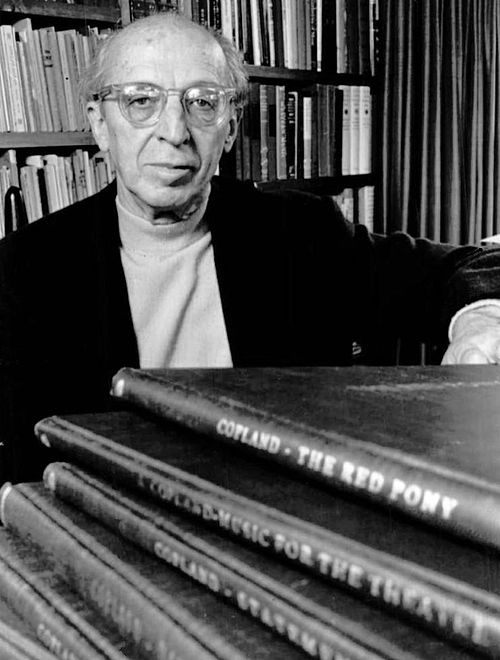
A Brooklyn beginning
Aaron Copland was born on 14 November 1900 in Brooklyn, New York, the youngest of five children in a family of Lithuanian Jewish immigrants. His parents, Harris and Sarah Copland, ran a department store, H. M. Copland's, on Washington Avenue, and the family lived in the rooms above it. His father had spent two or three years working in Scotland to pay for the passage to America, and the surname itself was a softening of the original Kaplan; remarkably, Copland did not learn this until late in life, his parents having never told him. The household was musical only in a modest, ordinary way, and it was one of his older sisters who first showed him how to pick out notes on the piano. He began composing small pieces before he was nine, and by the age of fifteen, after attending a recital, he had quietly decided what he wished to become. It was an unlikely ambition for a shopkeeper's son in early twentieth-century Brooklyn, with no concert tradition in the family and no models of the composer's life anywhere close to hand. That he managed to imagine such a future at all says much about the determination that would carry him through the lean years ahead.
Lessons and a leap to Paris
Copland's formal training began with the New York teacher Rubin Goldmark, a respected but conservative musician who gave him a solid grounding in harmony and counterpoint while gently discouraging his appetite for the modern. Sensing that his real education lay elsewhere, Copland set out for France in 1921, drawn first to a new summer school for Americans at Fontainebleau. There he encountered Nadia Boulanger, then in her mid-thirties, a teacher of formidable intelligence and breadth. He became one of her earliest American pupils, studying with her from 1921 to 1924, and the relationship shaped him permanently. Boulanger insisted that a composer master the whole sweep of musical history rather than fashionable fragments of it, and she gave Copland both rigour and a quiet, durable confidence in his own ideas. Paris in those years was alive with new painting, new writing and new music, and the young man absorbed it all eagerly while keeping his own counsel. He returned to America in 1924 not as an imitator of Europe but as someone determined to write music that would sound recognisably of his own country, and Boulanger soon helped him secure his first significant American performances.
Finding an American voice
Back in New York, Copland faced the practical problem confronting every serious composer: how to be heard at all. His early works, including the jazz-inflected Music for the Theatre and a Piano Concerto, announced a sharp, modern talent but puzzled and sometimes irritated audiences. Through the late 1920s and into the 1930s he wrote in a spare, sometimes severe idiom, and pieces such as the Piano Variations showed just how uncompromising he could be. Yet Copland was also a tireless organiser of musical life, founding concert series, championing fellow composers and writing lucidly about music for the general reader. Gradually his thinking shifted. Troubled that new music was drifting away from ordinary listeners and risked becoming a private affair, he resolved to compose works of greater simplicity and directness without sacrificing his hard-won craft. This was a deliberate artistic choice rather than a retreat, and it opened the most celebrated phase of his long career. The change coincided with the Depression years, when many American artists were urgently asking how their work might speak to a wide public rather than to a narrow and self-regarding circle.
The ballets and the open-prairie sound
It was in a series of ballet scores that Copland forged the music for which he is best loved. Billy the Kid in 1938 and Rodeo in 1942 conjured the American West with wide, clean harmonies, syncopated dance rhythms and the careful, affectionate use of cowboy songs. Then, in 1944, came Appalachian Spring, written for the choreographer Martha Graham. Its quiet pioneer drama and its luminous variations on the Shaker melody Simple Gifts produced one of the most beloved works in all of American concert music, and it earned Copland the Pulitzer Prize for Music in 1945. The sound he created in these scores, often described as the open-prairie or wide-horizon style, became so closely identified with America itself that it has shaped countless film and television scores ever since. Copland, a city composer who had studied in Paris, freely admitted that his frontier was partly imagined, assembled from memory, from printed song collections and from the movies he had watched as a boy. The imaginative leap was precisely the point, and audiences across the country recognised something genuine and unforced in the result.
Fanfare for the Common Man
In 1942, with the United States newly at war, the conductor Eugene Goossens invited a number of composers to write fanfares to open his Cincinnati Symphony concerts. Copland's contribution, scored for brass and percussion, was Fanfare for the Common Man. The title drew on a wartime speech by Vice President Henry Wallace, who had spoken of the dawning century of the common man, and Copland chose deliberately to honour ordinary citizens and ordinary soldiers rather than generals or statesmen. The result is among the most recognisable pieces of music ever written by an American: a slow, grave summons of trumpets and drums that manages to be at once monumental and deeply humane. Copland thought well enough of it to weave its material into the finale of his Third Symphony, completed in 1946 and regarded as one of his finest large works. The Fanfare has since been played at presidential inaugurations, memorials, sporting events and space missions, and borrowed by popular musicians, becoming a kind of secular hymn detached from any single occasion and belonging, fittingly, to everyone.
A wider career: film, teaching and the concert hall
Copland's gifts ranged well beyond the ballet. He wrote distinguished scores for Hollywood, bringing seriousness and restraint to films including Of Mice and Men and Our Town, and winning an Academy Award for his music to The Heiress in 1950. He composed the Lincoln Portrait, in which a narrator speaks the president's words over the orchestra, and an opera, The Tender Land, as well as chamber works and songs. His books, among them the much-loved What to Listen for in Music, introduced generations of readers to the art with warmth and clarity. From 1940 he taught composition at the Berkshire Music Center at Tanglewood, a role he held for some twenty-five years, mentoring younger composers and helping to shape American musical education. A private and self-contained man, Copland was homosexual at a time of deep social hostility; he did not publicly proclaim it, yet, unusually for his era, he also did not conceal it from those who knew him, and he maintained long personal relationships, including with the photographer Victor Kraft. His generosity to younger musicians was remembered by all who studied with him.
Politics and the shadow of the Red Scare
Like many artists of the 1930s, Copland held left-wing sympathies, supporting progressive causes and candidates during the Depression and its difficult aftermath. In the anxious climate of the early Cold War this history drew the attention of investigators. In 1953 his Lincoln Portrait was abruptly dropped from a concert connected to President Eisenhower's inauguration, and he was summoned to a private hearing before Senator Joseph McCarthy's subcommittee, where he was questioned by McCarthy and the lawyer Roy Cohn about his associations and his lectures abroad. Copland answered carefully and named no one, conducting himself with composure and dignity under considerable pressure. The episode was wounding, but it did not destroy his career or his international standing. Copland had, in any case, grown disillusioned with the Soviet Union, dismayed by its persecution of artists such as Dmitri Shostakovich, and from around 1950 he had begun quietly stepping back from the political organisations of his earlier years. The honours of the American establishment, withheld in that suspicious decade, would later come to him in great abundance.
Honours and the long silence
From the 1950s onward Copland was increasingly celebrated as the senior figure of American music, often called the dean of American composers. He took up conducting with real enthusiasm, touring widely at home and abroad and recording much of his own work, which spread it to audiences far beyond the concert hall and fixed his interpretations for later listeners. Presidents who in earlier decades might have viewed him with suspicion now decorated him: he received the Presidential Medal of Freedom and, in 1986, the Congressional Gold Medal from the same House of Representatives that had once labelled his politics un-American. Yet his creative life followed a poignant arc. From roughly the early 1970s Copland essentially stopped composing, finding, as he candidly acknowledged, that the musical ideas no longer came to him as they once had. He did not lament this loudly; he simply turned his remaining energy to conducting and to encouraging others. He spent his last years at his home north of New York City and died on 2 December 1990, at the age of ninety, honoured across his country.
Impact and legacy
Aaron Copland did more than any other composer to give the United States a music that its people could hear as their own. The clear, spacious sound he developed in Appalachian Spring, Rodeo and the Fanfare for the Common Man became a shared vocabulary, echoed by later composers and by the film industry whenever a scene calls for the American landscape or for a moment of plain dignity. He was also a builder of institutions and a natural educator: through Tanglewood, his writings and his tireless advocacy he widened the audience for serious music and supported the careers of those who followed him. His example, that of a shopkeeper's son from an immigrant Jewish family who studied in Paris and returned home to compose for the whole of his country, speaks of how openly American culture could absorb a new voice and be enlarged by it. Copland believed that music would endure as long as the human spirit itself, and his own work, by turns austere and generous, modern and welcoming, remains a central and durable part of the American cultural inheritance.
Sources & further reading
Aaron Copland, Wikipedia · Researched from the sources above and checked against them. Spotted an error? Tell us.
A life of tikkun olam. This is part of tikkun olam, the Jewish idea of repairing the world, and every one of us can add to it.