- Person
- Aaron Copland
- Lived
- 1900–1990
- Field
- Music
- From
- American
The story
When the United States entered the Second World War, Aaron Copland, the Brooklyn-born son of Jewish immigrants, had already spent several years developing a simpler, more accessible style so that serious music could reach ordinary listeners. With the nation at war, he turned that style to music that could speak to everyone. Two works written in 1942 became part of American public life.
The first was commissioned by the conductor Andre Kostelanetz, who asked Copland for a musical portrait of an eminent American to be played by the New York Philharmonic. Copland chose Abraham Lincoln. Lincoln Portrait, for speaker and orchestra, combines words from Lincoln's speeches and letters, including the close of the Gettysburg Address and his definition of democracy, with period folk songs such as Camptown Races. The Cincinnati Symphony Orchestra gave the premiere on 14 May 1942. Over the years its narrators have included Marian Anderson, Coretta Scott King, Henry Fonda, Neil Armstrong and Copland himself.
The second came from Eugene Goossens, conductor of the Cincinnati Symphony, who invited American composers to write fanfares to open each concert of the 1942 to 1943 season. Goossens suggested titles honouring soldiers, sailors or airmen. Copland, inspired in part by Vice President Henry Wallace's speech proclaiming the Century of the Common Man, instead dedicated his heroic music for brass and percussion to ordinary people. Fanfare for the Common Man premiered on 12 March 1943. Goossens proposed launching it at income tax time, and Copland replied that he was all for honouring the common man then. Of the ten fanfares written for Goossens, Copland's is the only one still regularly played.
Copland later used the fanfare as the main theme of the finale of his Third Symphony. The rock band Emerson, Lake and Palmer turned it into a hit single in 1977, and it has been played at the dedication of the Oklahoma City National Memorial, the landing of the Space Shuttle Endeavour in Los Angeles and the opening of the 9/11 Memorial Museum.
Both works became American patriotic standards. They express a belief that ran through Copland's career: that music should honour the dignity of ordinary citizens and the ideals of democracy, and that it should be heard by the whole public, not just by specialists.
Why it matters
Copland gave the United States music that honours ordinary citizens and democratic ideals, still chosen for moments of national celebration and remembrance.
About Aaron Copland
Composer of "Appalachian Spring" and "Fanfare for the Common Man"; defined the sound of American classical music.
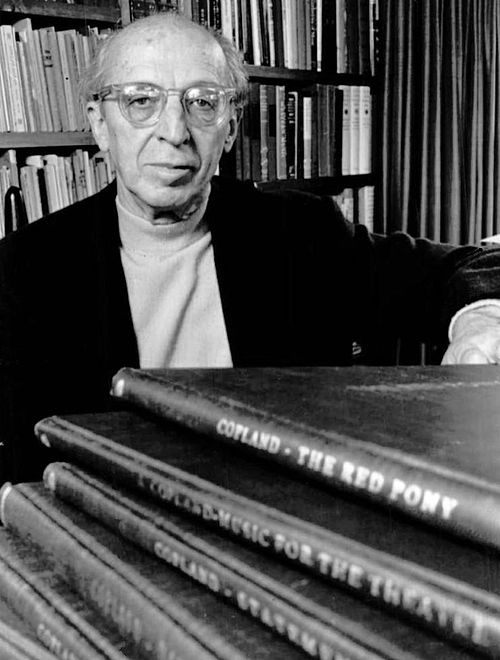
More about Aaron Copland
- Aaron Copland founded groups to promote American musicAaron Copland co-founded the Copland-Sessions Concerts and in 1937 helped form the American Composers Alliance, serving as its president from 1939 to 1945.
- Aaron Copland's Billy the Kid created American ballet musicAaron Copland's 1938 ballet Billy the Kid, using six cowboy folk songs, was among the first to display a truly American music and dance vocabulary.
- Aaron Copland left his fortune to support new musicAaron Copland left much of his large estate to create the Aaron Copland Fund for Composers, which gives more than 600,000 dollars a year to performing groups.
- Aaron Copland helped hundreds of young composersAaron Copland met and helped hundreds of young composers, teaching for many summers at Tanglewood and earning the title Dean of American Music.
- Aaron Copland wrote an opera for schoolchildrenFrom about 1935 Aaron Copland composed music for young performers and audiences, including the piano pieces The Young Pioneers and the children's opera The Second Hurricane.
- Aaron Copland taught the public What to Listen for in MusicAaron Copland's lectures at New York's New School became What to Listen for in Music, a guide for ordinary listeners first published in 1939 and reprinted many times.
Sources
- Aaron Copland Wikipedia
- Fanfare for the Common Man Wikipedia
- Lincoln Portrait Wikipedia
Another act of tikkun olam. This is part of tikkun olam, the Jewish idea of repairing the world, and every one of us can add to it.