- Person
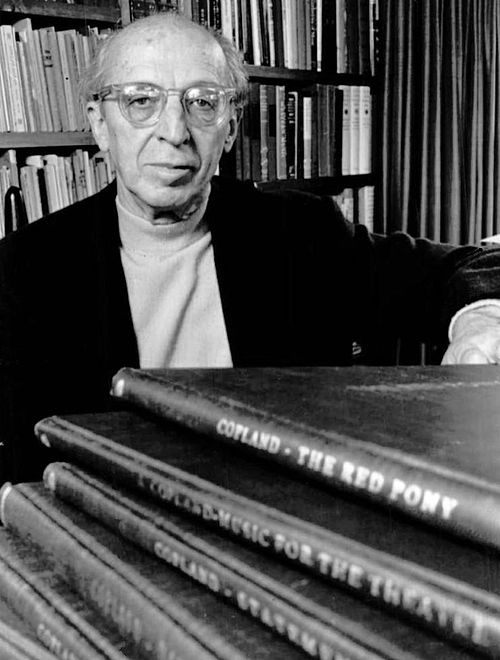
- Aaron Copland
- Lived
- 1900–1990
- Field
- Music
- From
- American
The story
Aaron Copland knew from experience how hard it was for a living American composer to be heard. When he came home from three years of study in Paris in the mid-1920s, he lived frugally in a studio near Carnegie Hall and got by on two Guggenheim Fellowships, lecture-recitals, small commissions, some teaching and writing, and even personal loans. Wealthy patrons, and above all the Boston Symphony Orchestra's music director Serge Koussevitzky, who championed new music, made a decisive difference to his early career.
Copland spent the rest of his life trying to give other composers the kind of help he had received. With Roger Sessions he founded the Copland-Sessions Concerts to present new American chamber music, in 1938 he helped form the American Composers Alliance to promote and publish contemporary American works, and he was generous with his time to nearly every young composer he met. As a conductor he filled his programmes with twentieth-century music and lesser-known names, and only rarely built a concert around his own works.
He died on 2 December 1990 in North Tarrytown, New York, aged 90, and his ashes were scattered over the Tanglewood Music Center in Massachusetts, where he had spent many summers teaching young musicians. In keeping with his lifelong devotion to contemporary music, he had arranged for a large part of his estate to be left to a fund in his name. The Aaron Copland Fund, now called the Aaron Copland Fund for Music, was announced to the public in 1992 with the purpose of encouraging and improving public knowledge and appreciation of contemporary American music.
The fund gives more than 600,000 dollars a year to performing groups. Its General Support Program makes unrestricted grants to ensembles, presenters, music service organisations and record companies with a long commitment to contemporary American concert music and jazz, while its Project Support Program backs specific projects. For years it also ran a dedicated Recording Program to document new American music on commercial recordings. Organisations across the United States can apply, and the fund also handles permission requests for the use of Copland's own music.
The result is that more than three decades after his death, Copland is still doing what he did throughout his career: putting new American music in front of audiences. Ensembles that might struggle to fund a season of contemporary works or a recording can turn to the fund for support, a fitting legacy for the man his colleagues called the Dean of American Music.
Why it matters
Copland's bequest created a permanent source of grants that helps American ensembles perform, present and record new concert music and jazz every year.
About Aaron Copland
Composer of "Appalachian Spring" and "Fanfare for the Common Man"; defined the sound of American classical music.
More about Aaron Copland
- Aaron Copland founded groups to promote American musicAaron Copland co-founded the Copland-Sessions Concerts and in 1937 helped form the American Composers Alliance, serving as its president from 1939 to 1945.
- Aaron Copland's Billy the Kid created American ballet musicAaron Copland's 1938 ballet Billy the Kid, using six cowboy folk songs, was among the first to display a truly American music and dance vocabulary.
- Aaron Copland wrote America's wartime anthems for everyoneDuring the Second World War Aaron Copland wrote Fanfare for the Common Man and Lincoln Portrait, which both became American patriotic standards.
- Aaron Copland helped hundreds of young composersAaron Copland met and helped hundreds of young composers, teaching for many summers at Tanglewood and earning the title Dean of American Music.
- Aaron Copland wrote an opera for schoolchildrenFrom about 1935 Aaron Copland composed music for young performers and audiences, including the piano pieces The Young Pioneers and the children's opera The Second Hurricane.
- Aaron Copland taught the public What to Listen for in MusicAaron Copland's lectures at New York's New School became What to Listen for in Music, a guide for ordinary listeners first published in 1939 and reprinted many times.
Sources
- Aaron Copland Wikipedia
- About the Fund The Aaron Copland Fund for Music
Another act of tikkun olam. This is part of tikkun olam, the Jewish idea of repairing the world, and every one of us can add to it.