- Person
- Aaron Copland
- Lived
- 1900–1990
- Field
- Music
- From
- American
The story
During the Great Depression many composers asked what use their music could be to ordinary people. Aaron Copland had spent the 1920s writing in a modernist style for a small, sophisticated audience, but works such as his Symphonic Ode and Short Symphony had proved hard to perform and financially unrewarding. By the mid-1930s he was looking for a simpler, more direct way to reach listeners.
He found a model in the German idea of Gebrauchsmusik, or music for use: works that could serve a practical purpose as well as an artistic one. The idea had two strands. One was music that students could easily learn and perform; the other was music with wide appeal, written for plays, films and radio. Around 1935 Copland began composing pieces specifically for young people, including piano pieces collected as The Young Pioneers.
His most ambitious work for children was The Second Hurricane, his first opera, written to a libretto by Edwin Denby and commissioned by the Henry Street Settlement in New York. Lasting just under an hour, it tells of a group of high school students who become stranded on an island while helping to rescue hurricane victims. It premiered at the settlement's playhouse on 21 April 1937, sung by students from its music school, in a production designed by the young Orson Welles and conducted by Lehman Engel. CBS Radio broadcast it a few weeks later.
In The Second Hurricane and in El Salón México, Copland said, he began experimenting with a simpler, more accessible style. That experiment shaped everything that followed. The direct, open style he developed in these years led to his most loved works, including Billy the Kid, Rodeo and Appalachian Spring. Writing for children helped Copland find the musical voice that would speak to the whole nation.
The opera has continued to be revived for young performers. Students from the Memphis public schools sang it for Copland's 80th birthday in 1980, the Henry Street Settlement restaged it for his 85th, and a new version for the centenary of his birth in 2000 updated the story for a television-age audience. Leonard Bernstein recorded it with the New York Philharmonic and soloists and chorus from New York's High School of Music and Art.
Why it matters
Copland's music for children gave young people serious, modern music they could perform themselves, and it helped him discover the plain-spoken style that made his work so widely loved.
About Aaron Copland
Composer of "Appalachian Spring" and "Fanfare for the Common Man"; defined the sound of American classical music.
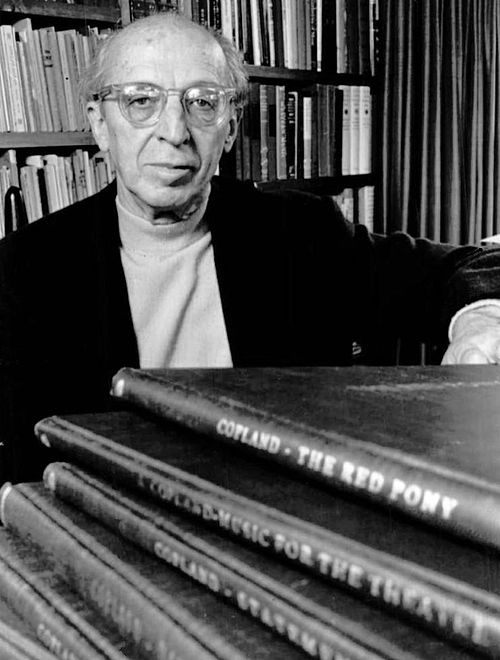
More about Aaron Copland
- Aaron Copland founded groups to promote American musicAaron Copland co-founded the Copland-Sessions Concerts and in 1937 helped form the American Composers Alliance, serving as its president from 1939 to 1945.
- Aaron Copland's Billy the Kid created American ballet musicAaron Copland's 1938 ballet Billy the Kid, using six cowboy folk songs, was among the first to display a truly American music and dance vocabulary.
- Aaron Copland wrote America's wartime anthems for everyoneDuring the Second World War Aaron Copland wrote Fanfare for the Common Man and Lincoln Portrait, which both became American patriotic standards.
- Aaron Copland left his fortune to support new musicAaron Copland left much of his large estate to create the Aaron Copland Fund for Composers, which gives more than 600,000 dollars a year to performing groups.
- Aaron Copland helped hundreds of young composersAaron Copland met and helped hundreds of young composers, teaching for many summers at Tanglewood and earning the title Dean of American Music.
- Aaron Copland taught the public What to Listen for in MusicAaron Copland's lectures at New York's New School became What to Listen for in Music, a guide for ordinary listeners first published in 1939 and reprinted many times.
Sources
- Aaron Copland Wikipedia
Another act of tikkun olam. This is part of tikkun olam, the Jewish idea of repairing the world, and every one of us can add to it.