- Person
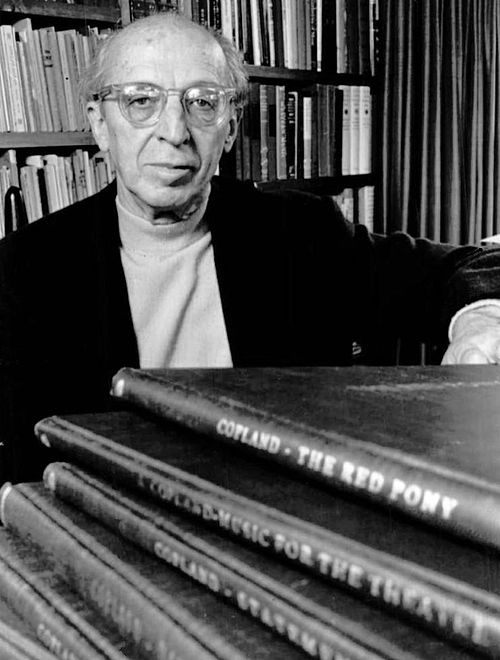
- Aaron Copland
- Lived
- 1900–1990
- Field
- Music
- From
- American
The story
When Aaron Copland returned to New York from Paris in the mid-1920s, he brought with him a deep knowledge of the newest European music, from Stravinsky and Les Six to Schoenberg and Bartok. Few Americans had heard this music, and many found it baffling. Copland quickly came into demand as a lecturer and writer who could explain it, and he believed that ordinary people could learn to enjoy serious music if someone showed them how to listen.
From 1927 to 1930 and again from 1935 to 1938 he taught at The New School for Social Research in New York, an institution devoted to adult education. Over roughly a decade there he also acted as a presenter and curator, using the school to introduce audiences to a wide range of composers and performers. At the same time he wrote regularly for The New York Times, The Musical Quarterly and other journals.
His New School lectures became the basis of his first book, What to Listen for in Music, published by McGraw-Hill in 1939 and revised in 1957. In plain language it explains how a listener can follow melody, rhythm, harmony and musical form, so that a newcomer can hear what a composer is doing rather than simply letting the sound wash past. It has been reprinted many times and is still read by students and music lovers. A second book drawn from the same teaching, Our New Music, guided readers through the modern composers of his time and was later revised as The New Music: 1900 to 1960.
Copland never thought of himself as a professional writer. He called his writing a by-product of his trade and described himself as a kind of salesman for contemporary music. Yet the writing kept coming. In the 1951 to 1952 academic year he gave the Charles Eliot Norton lectures at Harvard, published as Music and Imagination, and his collected articles appeared in 1960 as Copland on Music. Late in life he worked with Vivian Perlis on a two-volume autobiography.
His books remain among the most accessible introductions to classical music in English. By refusing to talk down to readers and by explaining the craft of composition from the inside, Copland helped make the concert hall feel open to anyone willing to listen closely, the same democratic spirit that runs through his best-loved music.
Why it matters
Copland's plain-spoken guide has helped generations of ordinary listeners understand how music works and enjoy it more deeply.
About Aaron Copland
Composer of "Appalachian Spring" and "Fanfare for the Common Man"; defined the sound of American classical music.
More about Aaron Copland
- Aaron Copland founded groups to promote American musicAaron Copland co-founded the Copland-Sessions Concerts and in 1937 helped form the American Composers Alliance, serving as its president from 1939 to 1945.
- Aaron Copland's Billy the Kid created American ballet musicAaron Copland's 1938 ballet Billy the Kid, using six cowboy folk songs, was among the first to display a truly American music and dance vocabulary.
- Aaron Copland wrote America's wartime anthems for everyoneDuring the Second World War Aaron Copland wrote Fanfare for the Common Man and Lincoln Portrait, which both became American patriotic standards.
- Aaron Copland left his fortune to support new musicAaron Copland left much of his large estate to create the Aaron Copland Fund for Composers, which gives more than 600,000 dollars a year to performing groups.
- Aaron Copland helped hundreds of young composersAaron Copland met and helped hundreds of young composers, teaching for many summers at Tanglewood and earning the title Dean of American Music.
- Aaron Copland wrote an opera for schoolchildrenFrom about 1935 Aaron Copland composed music for young performers and audiences, including the piano pieces The Young Pioneers and the children's opera The Second Hurricane.
Sources
- Aaron Copland Wikipedia
Another act of tikkun olam. This is part of tikkun olam, the Jewish idea of repairing the world, and every one of us can add to it.