- Person
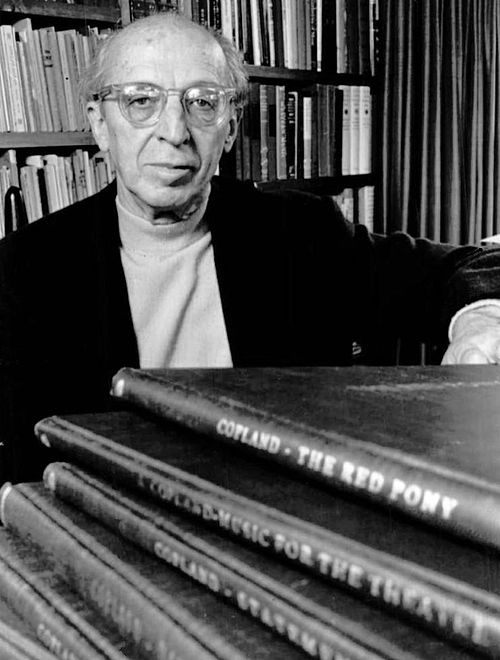
- Aaron Copland
- Lived
- 1900–1990
- Field
- Music
- From
- American
The story
In the 1930s American ballet companies relied heavily on European music and stories, and American choreographers had little homegrown music to dance to. Aaron Copland, the Brooklyn-born son of Jewish immigrants, had recently changed direction. After years of writing in a demanding modernist style, he had started using folk material in El Salón México, inspired by a visit to a Mexican dance hall that won him a popular following.
The arts patron Lincoln Kirstein commissioned Copland to write a ballet about the legendary outlaw Billy the Kid for his company Ballet Caravan, with choreography by Eugene Loring. The story, based on a book by Walter Noble Burns, follows Billy from a frontier town to his death at the hands of Sheriff Pat Garrett, framed by an opening and closing scene of pioneers trekking westward across the open prairie. Copland wove six cowboy songs into the score, including Git Along, Little Dogies, The Old Chisholm Trail and Goodbye Old Paint, along with a Mexican jarabe dance played by solo trumpet.
Rather than quoting the tunes plainly, Copland reshaped them with modern rhythms, layered harmonies and syncopation, and drew the score's spare harmonies from the cowboy melodies themselves. The biographer Howard Pollack called the result an archetypal depiction of the legendary American West, and it was among the first ballets to display a truly American music and dance vocabulary.
Billy the Kid premiered in Chicago on 16 October 1938, with the score played in a two-piano version, and reached New York on 24 May 1939 with a full orchestra. Copland later said he could not remember another work of his that was so unanimously received. Together with El Salón México it became his first widespread public success, and it opened the way for Rodeo in 1942 and Appalachian Spring in 1944.
The ballet came at a moment when artists from Fred Astaire to George Balanchine and Martha Graham were working to democratise and Americanise dance. Copland's score helped fill the gap in the American dance repertory, and the musicologist Elizabeth Crist has described Billy the Kid and Rodeo as the basis of his reputation as a composer of Americana. The concert suite drawn from the ballet remains one of his most widely performed works.
Why it matters
Billy the Kid gave American dance a musical voice drawn from the country's own folk songs, and it shaped how the Wild West has sounded in concert halls and films ever since.
About Aaron Copland
Composer of "Appalachian Spring" and "Fanfare for the Common Man"; defined the sound of American classical music.
More about Aaron Copland
- Aaron Copland founded groups to promote American musicAaron Copland co-founded the Copland-Sessions Concerts and in 1937 helped form the American Composers Alliance, serving as its president from 1939 to 1945.
- Aaron Copland wrote America's wartime anthems for everyoneDuring the Second World War Aaron Copland wrote Fanfare for the Common Man and Lincoln Portrait, which both became American patriotic standards.
- Aaron Copland left his fortune to support new musicAaron Copland left much of his large estate to create the Aaron Copland Fund for Composers, which gives more than 600,000 dollars a year to performing groups.
- Aaron Copland helped hundreds of young composersAaron Copland met and helped hundreds of young composers, teaching for many summers at Tanglewood and earning the title Dean of American Music.
- Aaron Copland wrote an opera for schoolchildrenFrom about 1935 Aaron Copland composed music for young performers and audiences, including the piano pieces The Young Pioneers and the children's opera The Second Hurricane.
- Aaron Copland taught the public What to Listen for in MusicAaron Copland's lectures at New York's New School became What to Listen for in Music, a guide for ordinary listeners first published in 1939 and reprinted many times.
Sources
- Aaron Copland Wikipedia
- Billy the Kid (ballet) Wikipedia
Another act of tikkun olam. This is part of tikkun olam, the Jewish idea of repairing the world, and every one of us can add to it.