- Person
- Aaron Copland
- Lived
- 1900–1990
- Field
- Music
- From
- American
The story
Aaron Copland had himself been shaped by great teaching. In Brooklyn he studied harmony and composition with Rubin Goldmark from 1917 to 1921, and in Paris he spent three years with Nadia Boulanger, whose wide-ranging approach and confidence in his talent he later described as crucial to his development. When he settled in New York in the mid-1920s, determined to make his living as a composer, he set out to pass on that kind of encouragement.
Over his long career he met and helped hundreds of young composers, who were drawn to him by his constant interest in what was new. Very little of this help came through a formal classroom. His biographer Howard Pollack notes that only a small number of composers actually studied with him, and then only briefly; most received intermittent advice, introductions and practical aid. His teaching posts were limited to many summers at the Berkshire Music Center at Tanglewood, the summer academy linked to the Boston Symphony Orchestra, about a decade of teaching and curating concerts at The New School in New York, and a few semesters at Harvard and the State University of New York at Buffalo.
What made his guidance valuable was its focus. Copland steered younger composers towards expressive content rather than purely technical display, and towards a voice of their own. The composer William Schuman recalled that Copland tried to understand what each writer was aiming for instead of turning them into copies of himself, asking questions that led them to question their own choices, while still being ready to criticise firmly when needed.
He also held together his own generation. Copland, Roger Sessions, Roy Harris, Virgil Thomson and Walter Piston formed a circle of mutual support and rivalry that he kept united until after the Second World War. Later, as a busy conductor, he gave programme space to twentieth-century music and lesser-known composers, and he kept up contact with musicians abroad, including a decade-long correspondence with the Japanese composer Toru Takemitsu.
This generosity is why his peers and critics called him the Dean of American Music. Pollack judged that Copland exerted enormous influence on multitudes of contemporaries and successors, and the composer Ned Rorem credited him with giving American music a lean, direct language of its own. Even after his death the support continued, because his bequest created the Aaron Copland Fund, which still helps ensembles perform new American music, extending the help he once gave in person.
Why it matters
By encouraging hundreds of young composers to find their own voices, Copland helped build a confident, varied tradition of American concert music.
About Aaron Copland
Composer of "Appalachian Spring" and "Fanfare for the Common Man"; defined the sound of American classical music.
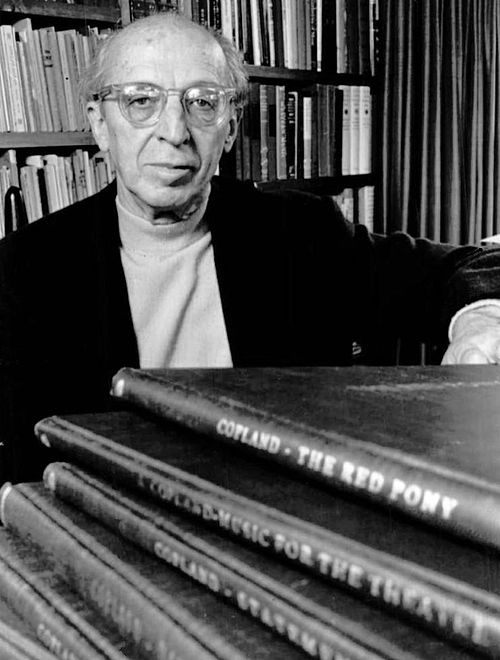
More about Aaron Copland
- Aaron Copland founded groups to promote American musicAaron Copland co-founded the Copland-Sessions Concerts and in 1937 helped form the American Composers Alliance, serving as its president from 1939 to 1945.
- Aaron Copland's Billy the Kid created American ballet musicAaron Copland's 1938 ballet Billy the Kid, using six cowboy folk songs, was among the first to display a truly American music and dance vocabulary.
- Aaron Copland wrote America's wartime anthems for everyoneDuring the Second World War Aaron Copland wrote Fanfare for the Common Man and Lincoln Portrait, which both became American patriotic standards.
- Aaron Copland left his fortune to support new musicAaron Copland left much of his large estate to create the Aaron Copland Fund for Composers, which gives more than 600,000 dollars a year to performing groups.
- Aaron Copland wrote an opera for schoolchildrenFrom about 1935 Aaron Copland composed music for young performers and audiences, including the piano pieces The Young Pioneers and the children's opera The Second Hurricane.
- Aaron Copland taught the public What to Listen for in MusicAaron Copland's lectures at New York's New School became What to Listen for in Music, a guide for ordinary listeners first published in 1939 and reprinted many times.
Sources
- Aaron Copland Wikipedia
Another act of tikkun olam. This is part of tikkun olam, the Jewish idea of repairing the world, and every one of us can add to it.