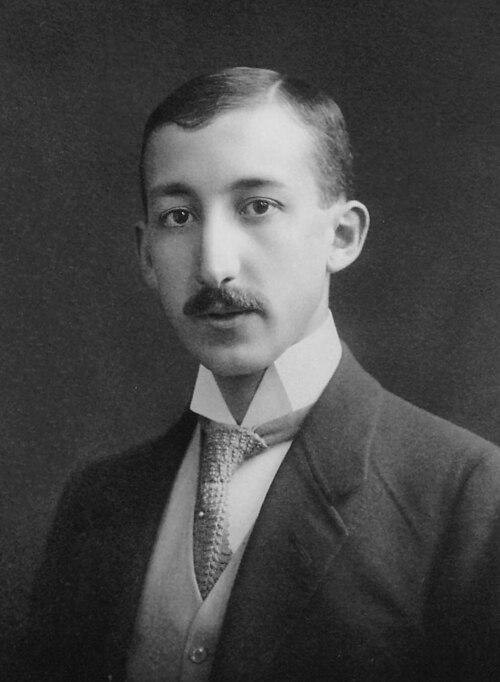
A Budapest family of means
George de Hevesy was born György Bischitz in Budapest on August 1, 1885, the fifth of eight children of Lajos Bischitz and Baroness Eugénie Schossberger. Both sides of the family were wealthy and ennobled, prominent in the landowning and commercial elite of late nineteenth-century Hungary, and both were of Jewish descent. Like many such families in the Austro-Hungarian Empire, they had converted to Catholicism, and young György was raised a Catholic. The family carried the noble predicate Hevesy; in time he dropped the Bischitz altogether and was known to the world as George de Hevesy, or in German, Georg von Hevesy.
He was educated at the Piarist Gymnasium in Budapest, a Catholic school run by a teaching order, and matriculated in 1903. The privileges of his background gave him freedom to roam Europe in search of the best laboratories, a freedom he used to the full.
An apprenticeship across Europe
Hevesy studied at Budapest University and the Technical University in Berlin before moving to the University of Freiburg im Breisgau, where he earned his doctorate in 1908. He worked as an assistant at the Swiss Federal Institute of Technology in Zurich and spent a short spell with Fritz Haber in Karlsruhe, just as Haber was perfecting the synthesis of ammonia. In 1910 he travelled to Manchester to study under Ernest Rutherford, the leading figure in the new science of radioactivity. There he met a young Danish physicist, Niels Bohr, beginning a friendship that would shape the rest of his life.
Rutherford set him what looked like a routine task: separate ‘radium D’, a radioactive substance, from the ordinary lead in which it was found. Hevesy failed, because, as was soon understood, radium D was itself a radioactive form of lead, chemically identical to it. Instead of abandoning the problem, he turned the failure inside out. If radioactive lead could not be separated from ordinary lead, it would follow ordinary lead wherever it went, and its radiation would betray its location. A radioactive atom could serve as a spy.
The tracer idea
In early 1913, working with Friedrich Paneth at the Vienna Institute for Radium Research, Hevesy carried out the first radioactive-tracer experiment, using a radioactive form of lead to follow the chemistry of ordinary lead. During the First World War he served in the Austro-Hungarian army, and after the war taught briefly in Budapest. In 1923 he published the first biological application of the method, tracking how bean plants absorbed and moved lead by following a minute quantity of radioactive lead among the ordinary atoms.
The principle was simple and profound. Chemists had always been able to measure how much of a substance was present; now they could tag particular atoms and watch where they went, even inside a living organism, without disturbing the processes they were studying. Over the following decades Hevesy extended the method from plants to animals and humans, and from naturally radioactive elements to artificially made isotopes, which became available in the 1930s. His experiments helped establish that the body’s constituents are constantly being broken down and rebuilt, that life is a dynamic state rather than a fixed structure.
Copenhagen and element 72
In 1920 Hevesy settled in Copenhagen, at the institute Niels Bohr was building. There, guided by Bohr’s new theory of atomic structure, he and the Dutch physicist Dirk Coster went looking for the missing element 72 among zirconium ores and found it, announcing the discovery in 1923. They named it hafnium, after Hafnia, the Latin name for Copenhagen. Hevesy also developed the analytical technique of X-ray fluorescence and, with Rockefeller Foundation support, pursued a stream of studies on the abundance of elements.
In 1924 he married Pia Riis, with whom he had a son and three daughters. In the mid-1920s he returned to Freiburg as professor of physical chemistry, where he was involved in the first clinical use of isotopes, and in 1930 he spent time at Cornell University as Baker Lecturer. After the Nazis came to power in Germany he left Freiburg and, in 1934, returned to Bohr’s institute in Copenhagen. There, in 1936, he invented neutron activation analysis, a way of identifying minute traces of elements by bombarding a sample with neutrons and measuring the radioactivity produced.
From 1934, with grants from the Carlsberg Foundation, the Rask-Ørsted Foundation and the Rockefeller Foundation, he launched numerous studies in plant and animal physiology using labelled atoms, work that turned the tracer from a chemist’s curiosity into an everyday instrument of biology and medicine. He was by then honoured abroad as well: the Academy of Sciences in Rome had awarded him its Cannizzaro Prize in 1929.
Gold in a bottle
Bohr’s institute had been a haven for refugee physicists since 1933, and it held two objects the Nazis would have dearly liked to find: the gold Nobel medals of the German physicists Max von Laue and James Franck, sent to Copenhagen for safekeeping. Exporting gold from Germany was close to a capital offence, and the laureates’ names were engraved on the medals. When German troops occupied Denmark in April 1940, the medals became Bohr’s first worry.
Hevesy proposed burying them; Bohr feared they might be dug up. So Hevesy, in his own words, decided to dissolve them. While German forces marched through the streets of Copenhagen, he dropped the medals into aqua regia, the mixture of nitric and hydrochloric acids that can attack gold. He later wrote to von Laue that the job was not easy, gold being exceedingly unreactive. The resulting solution sat on a shelf in the laboratory for the rest of the occupation, and when the Germans occupied and searched the institute, they found nothing. After the war the gold was recovered from the solution; Bohr arranged its delivery to the Royal Swedish Academy of Sciences in 1950, and the Nobel Foundation recast the medals. Franck received his at a ceremony at the University of Chicago in January 1952.
Flight to Sweden and the Nobel Prize
In 1943, as the Nazi regime moved against Denmark’s Jews and the danger to people of Jewish descent grew acute, Hevesy fled Copenhagen for neutral Sweden. He settled in Stockholm, where he became an associate of the Institute of Research in Organic Chemistry and worked at Stockholm University until 1961. There, as a refugee, he received the 1943 Nobel Prize in Chemistry ‘for his work on the use of isotopes as tracers in the study of chemical processes.’ The wartime prize was held over and awarded the following year, and he delivered his Nobel lecture in Stockholm on December 12, 1944.
Sweden gave him a second scientific home. With support from the Swedish State Research Council and the Wallenberg Foundation he continued his labelled-atom studies, investigating how X-rays affect the formation of nucleic acids in tumours and normal organs and how iron is transported in healthy and cancerous tissue, early steps in the use of isotopes to understand cancer and radiation therapy. In 1949 he was also elected Franqui Professor at the University of Ghent, and in retirement he remained an active scientific associate of Stockholm University. He wrote several important books on radiochemistry, and his collected papers were later published as Adventures in Radioisotope Research.
Honours followed in a long procession: the Copley Medal of the Royal Society in 1949, the Faraday medal in 1950, the Atoms for Peace Award, and the Niels Bohr International Gold Medal in 1961, along with honorary degrees in medicine, science and philosophy from universities across Europe, Africa and South America.
What tracers gave the world
Hevesy is often called the father of nuclear medicine, and the title is earned. The tracer principle he devised underlies the radioactive iodine tests used to examine the thyroid, the bone scans that reveal fractures and tumours, the heart-perfusion studies that show where blood flow is failing, and the positron emission tomography (PET) scans that map cancer, brain activity and inflammation in millions of patients each year. In research laboratories, radioactively labelled molecules made it possible to trace how food is metabolised, how hormones and drugs move through the body, and how DNA and proteins are built.
Beyond medicine, isotope tracers became standard tools in agriculture, hydrology, industry and environmental science, used to follow fertilisers through soil, water through aquifers and pollutants through ecosystems. Activation analysis, his other great invention, is still used to detect trace elements in archaeology, geology and forensic science. Few chemists have handed so many other disciplines so versatile a tool.
Origins, character and last years
Hevesy’s relation to Jewishness was that of many assimilated Central European families of his generation: Jewish by descent, Catholic by upbringing, and recognised as Jewish by those who drew racial lines. The Nobel Foundation itself describes him as being of Jewish origin. That origin shaped his path in the 1930s and 1940s, when he left Germany and later fled Denmark, and in Copenhagen he worked inside an institute that had become a refuge for scientists driven out of Germany. A meticulous, cosmopolitan man who wrote in several languages, he published nearly four hundred scientific papers and remained an active researcher well into retirement.
He died in Freiburg on July 5, 1966, at the age of eighty, and was buried there. In 2001, at the family’s request, his remains were brought home to Budapest and reinterred in the city’s Kerepesi Cemetery, a resting place for Hungary’s national figures. He is remembered as a chemist who made atoms visible, and as the scientist who, with a flask of acid and a cool head, made two symbols of science disappear from under the noses of an occupying army.
Sources & further reading
George de Hevesy, Wikipedia · George de Hevesy – Biographical, NobelPrize.org · The Nobel medals and the medal for the prize in economic sciences, NobelPrize.org · Researched from the sources above and checked against them. Spotted an error? Tell us.
A life of tikkun olam. This is part of tikkun olam, the Jewish idea of repairing the world, and every one of us can add to it.