- Person
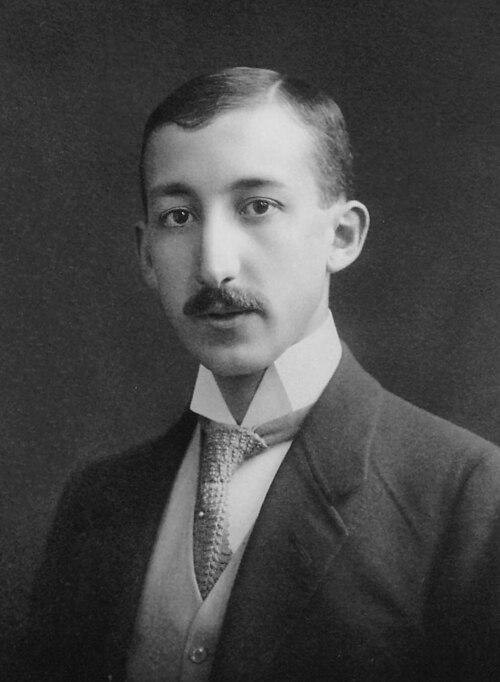
- George de Hevesy
- Lived
- 1885–1966
- Field
- Radiochemistry
- From
- Hungarian
The story
George de Hevesy was born in Budapest in 1885 into a wealthy family of Hungarian-Jewish descent; his grandparents on both sides had led the Jewish community of Pest. He co-discovered the element hafnium in Copenhagen and pioneered radioactive tracers, using tiny amounts of radioactive atoms to follow how substances move through plants and animals. That method became a foundation of modern nuclear medicine.
After the Nazis came to power in Germany, de Hevesy left his professorship in Freiburg and in 1934 returned to Niels Bohr's institute in Copenhagen. The German physicists Max von Laue and James Franck had sent their gold Nobel medals there to keep them from being confiscated by the Nazis. Von Laue had received the physics prize in 1914 and Franck in 1925.
When Germany invaded Denmark in 1940, the medals became dangerous. Sending gold out of Germany was illegal, and if the medals were found, the two men could have faced prosecution. De Hevesy dissolved the medals in aqua regia, a mixture of nitric and hydrochloric acids strong enough to dissolve gold, and left the solution on a shelf in his laboratory at the Niels Bohr Institute, where it went unnoticed by the occupiers.
By 1943 Copenhagen was no longer safe for a scientist of Jewish descent, and de Hevesy fled to neutral Sweden. That year he was awarded the Nobel Prize in Chemistry himself, for his work on the use of isotopes as tracers.
After the war he returned, found the solution undisturbed and precipitated the gold out of it. The Nobel organisation then recast the medals from the recovered gold and returned them to von Laue and Franck.
The episode is remembered as an example of scientists protecting one another under Nazi rule. De Hevesy continued to work in Stockholm for many years, and in 1958 received the Atoms for Peace Award for his peaceful use of radioactive isotopes.
Why it matters
De Hevesy's quick thinking protected colleagues who had defied the Nazis, and his tracer method still helps doctors diagnose and treat disease every day.
About George de Hevesy
Hungarian chemist of Jewish origin who invented radioactive tracers, co-discovered hafnium, hid two Nobel medals from the Nazis in acid, and won the 1943 Nobel Prize in Chemistry.
More about George de Hevesy
- George de Hevesy traced lead through a bean plantIn 1923 George de Hevesy published the first use of a radioactive tracer in a living organism, following lead-212 through the roots, stems and leaves of broad beans.
- George de Hevesy co-discovered the element hafniumGuided by Niels Bohr's atomic theory, George de Hevesy and Dirk Coster found the missing element 72 in Copenhagen and named it hafnium, after the city's Latin name.
- George de Hevesy ran the first radioactive tracer experimentIn early 1913, with Friedrich Paneth at the Vienna Institute for Radium Research, George de Hevesy carried out the first radioactive-tracer experiment.
- George de Hevesy used isotopes to study cancerAfter fleeing to Sweden in 1943, George de Hevesy used labelled atoms to study how X-rays affect nucleic acids in tumours and how iron moves in healthy and cancerous tissue.
- George de Hevesy invented neutron activation analysisIn 1936 George de Hevesy invented neutron activation analysis, identifying tiny traces of elements by bombarding a sample with neutrons and measuring the radioactivity produced.
- George de Hevesy developed X-ray fluorescence analysisWith Rockefeller Foundation support, George de Hevesy developed X-ray fluorescence analysis, a way to identify the elements in a sample from the X-rays they emit.
Sources
- George de Hevesy Wikipedia
- George de Hevesy: Biographical Nobel Prize
Another act of tikkun olam. This is part of tikkun olam, the Jewish idea of repairing the world, and every one of us can add to it.