- Person
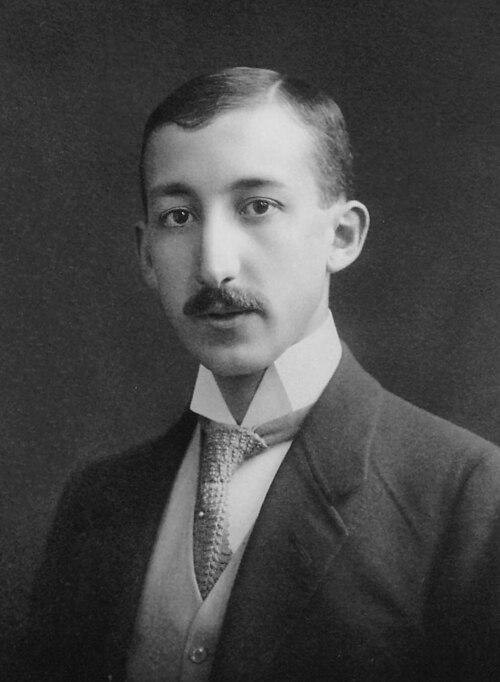
- George de Hevesy
- Lived
- 1885–1966
- Field
- Radiochemistry
- From
- Hungarian
The story
George de Hevesy, born in Budapest in 1885 into a family of Hungarian-Jewish descent, was professor of physical chemistry at Freiburg in Germany from the mid-1920s. There he introduced X-ray fluorescence analysis and was involved in the first clinical use of isotopes. After the Nazis came to power in Germany, he left Freiburg and in 1934 returned to Niels Bohr's institute in Copenhagen, where he had worked in the early 1920s. His association with Bohr's institute would last until 1952.
Back in Copenhagen he demonstrated the formation of new artificially radioactive isotopes. Working with Hilde Levi, he noticed that samples containing certain rare earth elements became highly radioactive after exposure to a source of neutrons, an observation that suggested a new way of identifying elements.
Building on that work, in 1936 he introduced a method of analysis based on bombarding the element to be investigated with neutrons. The neutrons make some atoms in the sample radioactive, and the particular radiation each element then gives off reveals which elements are present and in what amounts, even in minute traces. The method became known as neutron activation analysis. According to his Nobel biography, it was to replace the X-ray fluorescence analysis that de Hevesy had himself introduced during his years in Freiburg.
The same years saw de Hevesy launch numerous studies in plant and animal physiology using labelled atoms, supported by the Carlsberg Foundation, the Rask-Ørsted Foundation and the Rockefeller Foundation. They also brought danger: after Germany occupied Denmark in 1940, he dissolved the gold Nobel medals of Max von Laue and James Franck in acid to hide them, and in 1943 he fled to Sweden. That year he was awarded the Nobel Prize in Chemistry for his work on isotopes as tracers.
Neutron activation analysis proved to be a lasting contribution. Because it reads the nuclei themselves rather than their chemical form, it can measure many elements at once, down to concentrations of less than one part per million, with little or no sample preparation. For decades it was the standard method for this kind of multi-element analysis, and because it does not destroy the sample, it has been used to study works of art and historical artefacts.
Why it matters
Neutron activation analysis gave science a highly sensitive way to detect trace elements, able to reveal minute traces in many kinds of material.
About George de Hevesy
Hungarian chemist of Jewish origin who invented radioactive tracers, co-discovered hafnium, hid two Nobel medals from the Nazis in acid, and won the 1943 Nobel Prize in Chemistry.
More about George de Hevesy
- George de Hevesy traced lead through a bean plantIn 1923 George de Hevesy published the first use of a radioactive tracer in a living organism, following lead-212 through the roots, stems and leaves of broad beans.
- George de Hevesy co-discovered the element hafniumGuided by Niels Bohr's atomic theory, George de Hevesy and Dirk Coster found the missing element 72 in Copenhagen and named it hafnium, after the city's Latin name.
- George de Hevesy hid colleagues' Nobel medals in acidWhen the Nazis invaded Denmark, chemist George de Hevesy dissolved two colleagues' gold Nobel medals in acid to protect them; after the war the gold was recovered and the medals recast.
- George de Hevesy ran the first radioactive tracer experimentIn early 1913, with Friedrich Paneth at the Vienna Institute for Radium Research, George de Hevesy carried out the first radioactive-tracer experiment.
- George de Hevesy used isotopes to study cancerAfter fleeing to Sweden in 1943, George de Hevesy used labelled atoms to study how X-rays affect nucleic acids in tumours and how iron moves in healthy and cancerous tissue.
- George de Hevesy developed X-ray fluorescence analysisWith Rockefeller Foundation support, George de Hevesy developed X-ray fluorescence analysis, a way to identify the elements in a sample from the X-rays they emit.
Sources
- George de Hevesy Wikipedia
- George de Hevesy: Biographical NobelPrize.org
- Neutron activation analysis Wikipedia
Another act of tikkun olam. This is part of tikkun olam, the Jewish idea of repairing the world, and every one of us can add to it.