- Person
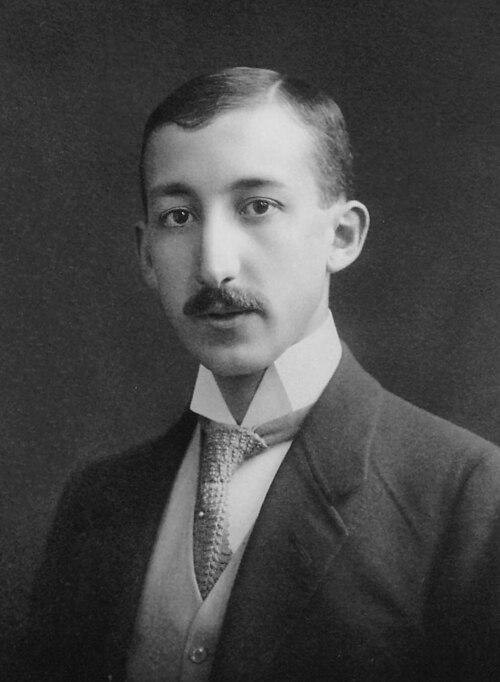
- George de Hevesy
- Lived
- 1885–1966
- Field
- Radiochemistry
- From
- Hungarian
The story
George de Hevesy, born in Budapest in 1885 into a family of Hungarian-Jewish descent, had invented the radioactive tracer method with Friedrich Paneth in Vienna in 1913. The idea was simple: a radioactive form of an element behaves chemically exactly like the ordinary element, so a small amount mixed in can be followed by its radiation, showing where the element goes.
After the First World War he settled in Copenhagen in 1920 at the new institute of his friend Niels Bohr. There, supported by the Rockefeller Foundation, he had a very productive period, and he began using radioactive isotopes to study the metabolism of living things, replacing part of a stable element with a small quantity of a radioactive isotope and tracking it.
In 1923 he published the first study using a radioactive tracer in biology, in the Biochemical Journal, under the title The Absorption and Translocation of Lead by Plants. He used the naturally radioactive isotope lead-212 to follow how the broad bean, Vicia faba, absorbs lead and moves it through its roots, stems and leaves. The radiation revealed where the lead went, even in tiny quantities, while the plant went on living and growing.
This was the beginning of the use of tracers in the life sciences. Later, in Freiburg, where he became professor of physical chemistry in the mid-1920s, de Hevesy was involved in the first clinical use of isotopes. From 1934, back in Copenhagen, he launched numerous studies in plant and animal physiology using labelled atoms, supported by the Carlsberg Foundation, the Rask-Ørsted Foundation and the Rockefeller Foundation.
In 1943 he was awarded the Nobel Prize in Chemistry for his work on the use of isotopes as tracers. Medical scientists have called him the father of nuclear medicine, and the principle first tested on a bean plant now lies behind diagnostic scans, studies of how drugs and nutrients move through the body, and research across biology.
Why it matters
Tracing atoms inside living organisms transformed physiology and medicine, from studies of nutrition to diagnostic scans.
About George de Hevesy
Hungarian chemist of Jewish origin who invented radioactive tracers, co-discovered hafnium, hid two Nobel medals from the Nazis in acid, and won the 1943 Nobel Prize in Chemistry.
More about George de Hevesy
- George de Hevesy co-discovered the element hafniumGuided by Niels Bohr's atomic theory, George de Hevesy and Dirk Coster found the missing element 72 in Copenhagen and named it hafnium, after the city's Latin name.
- George de Hevesy hid colleagues' Nobel medals in acidWhen the Nazis invaded Denmark, chemist George de Hevesy dissolved two colleagues' gold Nobel medals in acid to protect them; after the war the gold was recovered and the medals recast.
- George de Hevesy ran the first radioactive tracer experimentIn early 1913, with Friedrich Paneth at the Vienna Institute for Radium Research, George de Hevesy carried out the first radioactive-tracer experiment.
- George de Hevesy used isotopes to study cancerAfter fleeing to Sweden in 1943, George de Hevesy used labelled atoms to study how X-rays affect nucleic acids in tumours and how iron moves in healthy and cancerous tissue.
- George de Hevesy invented neutron activation analysisIn 1936 George de Hevesy invented neutron activation analysis, identifying tiny traces of elements by bombarding a sample with neutrons and measuring the radioactivity produced.
- George de Hevesy developed X-ray fluorescence analysisWith Rockefeller Foundation support, George de Hevesy developed X-ray fluorescence analysis, a way to identify the elements in a sample from the X-rays they emit.
Sources
- George de Hevesy Wikipedia
- George de Hevesy: Biographical NobelPrize.org
Another act of tikkun olam. This is part of tikkun olam, the Jewish idea of repairing the world, and every one of us can add to it.