- Person
- George de Hevesy
- Lived
- 1885–1966
- Field
- Radiochemistry
- From
- Hungarian
The story
When Dmitri Mendeleev published his periodic table in 1869, he left gaps for elements not yet found. One of them, element 72, was still missing in the early 1920s. The French chemist Georges Urbain claimed to have found it among the rare earth elements and called it celtium, but his evidence did not hold up.
George de Hevesy, born in Budapest in 1885 into a family of Hungarian-Jewish descent, had first met Niels Bohr in Ernest Rutherford's laboratory in Manchester. In 1920 he settled in Copenhagen to work at the institute Bohr was building, where his research initially concerned the separation of isotopes. Bohr's new theory of atomic structure, in line with a 1921 suggestion by the chemist Charles Bury, indicated that element 72 should not be a rare earth at all, but should resemble zirconium. De Hevesy set out to look for it on that basis.
With the Dutch physicist Dirk Coster, he examined zirconium minerals, including zircon from Norway, supplied by the mineralogical museum in Copenhagen. X-ray spectroscopy showed the characteristic lines of a new element. The discovery, made in Copenhagen in 1922 and 1923, confirmed both Mendeleev's prediction and the new understanding of the atom.
They named the new element hafnium, from Hafnia, the Latin name for Copenhagen, Bohr's home town. De Hevesy then worked with Valdemar Thal Jantzen to separate hafnium from zirconium by repeated crystallisation, a difficult task because the two elements are almost identical chemically. In 1924 the Dutch chemists Anton van Arkel and Jan Hendrik de Boer prepared the first metallic hafnium.
Hafnium turned out to be far from a curiosity. It absorbs neutrons very strongly, so it has been used to make control rods for nuclear reactors, and its oxide is used in the manufacture of modern computer chips. The University of Copenhagen's Faculty of Science still uses a stylised hafnium atom in its seal.
Why it matters
The discovery of hafnium filled a gap in the periodic table, showed the power of quantum atomic theory to predict real chemistry, and gave industry a valuable metal.
About George de Hevesy
Hungarian chemist of Jewish origin who invented radioactive tracers, co-discovered hafnium, hid two Nobel medals from the Nazis in acid, and won the 1943 Nobel Prize in Chemistry.
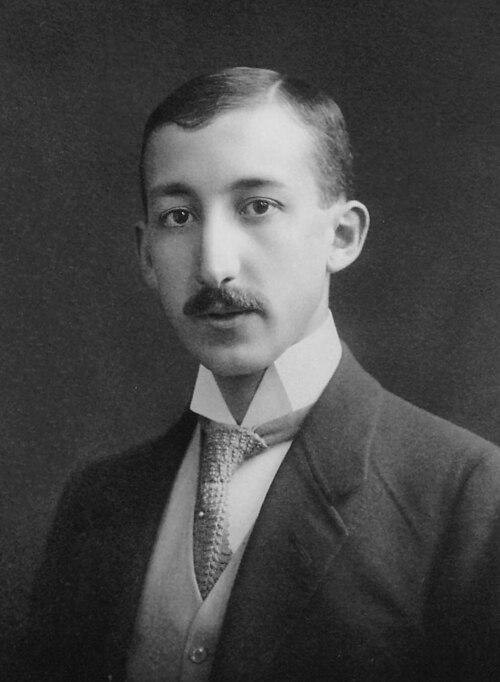
More about George de Hevesy
- George de Hevesy traced lead through a bean plantIn 1923 George de Hevesy published the first use of a radioactive tracer in a living organism, following lead-212 through the roots, stems and leaves of broad beans.
- George de Hevesy hid colleagues' Nobel medals in acidWhen the Nazis invaded Denmark, chemist George de Hevesy dissolved two colleagues' gold Nobel medals in acid to protect them; after the war the gold was recovered and the medals recast.
- George de Hevesy ran the first radioactive tracer experimentIn early 1913, with Friedrich Paneth at the Vienna Institute for Radium Research, George de Hevesy carried out the first radioactive-tracer experiment.
- George de Hevesy used isotopes to study cancerAfter fleeing to Sweden in 1943, George de Hevesy used labelled atoms to study how X-rays affect nucleic acids in tumours and how iron moves in healthy and cancerous tissue.
- George de Hevesy invented neutron activation analysisIn 1936 George de Hevesy invented neutron activation analysis, identifying tiny traces of elements by bombarding a sample with neutrons and measuring the radioactivity produced.
- George de Hevesy developed X-ray fluorescence analysisWith Rockefeller Foundation support, George de Hevesy developed X-ray fluorescence analysis, a way to identify the elements in a sample from the X-rays they emit.
Sources
- George de Hevesy Wikipedia
- George de Hevesy: Biographical NobelPrize.org
- Hafnium Wikipedia
Another act of tikkun olam. This is part of tikkun olam, the Jewish idea of repairing the world, and every one of us can add to it.