- Person
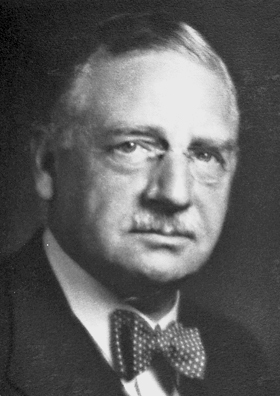
- Otto Loewi
- Lived
- 1873–1961
- Field
- Pharmacology
- From
- German-Austrian-American
The story
In 1909 Otto Loewi was appointed to the chair of pharmacology at the University of Graz in Austria. A year earlier he had married Guida Goldschmiedt, daughter of the chemistry professor Guido Goldschmiedt, and the couple had three sons and a daughter. He would spend nearly three decades there, until the Nazi annexation of Austria forced him out in 1938.
According to the Nobel Foundation's biography, it was in Graz that Loewi cultivated his gifts as a lecturer, and a number of his associates came from the United States. He had a lifelong love of music, architecture and painting, and in his younger years seldom missed a chance to visit museums and exhibitions.
His research in Graz ranged widely. He continued to study carbohydrate metabolism, including the conditions responsible for the rise in blood sugar caused by adrenaline, and published research on the connection between digitalis, the old heart drug, and the action of calcium. Above all, his Graz laboratory produced the 1921 discovery that nerves transmit their signals chemically. Over the following years he and his co-workers showed that the chemical released by the vagus nerve is acetylcholine, work that earned him the 1936 Nobel Prize in Physiology or Medicine.
In March 1938, after German troops entered Austria, Loewi was arrested because he was Jewish and was forced to give up his possessions and his prize money before he could leave. He never returned to his old post, and spent the rest of his career in Britain and the United States.
Graz later honoured him. The university gave him an honorary doctorate, and in 1959 the city awarded him its Honorary Ring. A street in the St. Peter district, Otto-Loewi-Gasse, bears his name. In 1983 his son gave Loewi's Nobel diploma to the University of Graz, the institution that had been forced to dismiss him, where it remains alongside a bronze copy of a bust of Loewi whose original stands at the Marine Biological Laboratory in Woods Hole, Massachusetts.
Why it matters
Loewi trained and inspired researchers on both sides of the Atlantic, spreading the new science of pharmacology.
About Otto Loewi
Pharmacologist whose 1921 frog-heart experiment, famously conceived in a dream, proved that nerves talk through chemicals, founding the science of neurotransmitters and winning the 1936 Nobel Prize.
More about Otto Loewi
- Loewi showed animals rebuild proteins from amino acidsIn 1902 Otto Loewi proved that animals can rebuild their own proteins from amino acids, the products of protein breakdown, an essential finding for nutrition science.
- Otto Loewi chose research to fight untreatable diseaseAfter watching patients with tuberculosis and pneumonia die for lack of any treatment in 1897–98, Otto Loewi abandoned clinical work to research how drugs act.
- Loewi's 1905 study opened years of nerve researchIn a classic 1905 paper, Otto Loewi and Alfred Fröhlich showed that small doses of cocaine strengthen the body's responses to adrenaline and sympathetic nerves.
- Otto Loewi's dream led to proof that nerves use chemicalsIn 1921 Otto Loewi dreamed up a two-frog-heart experiment that proved, for the first time, that nerves communicate by releasing chemicals.
- Otto Loewi identified the first neurotransmitterOtto Loewi showed that his 'Vagusstoff' is acetylcholine, the first known neurotransmitter, and that an adrenaline-like substance works at sympathetic nerves.
- Loewi's eye test helped surgeons diagnose pancreatitisOtto Loewi found that adrenaline dilates the pupils of dogs without a pancreas; surgeons adapted this 'Loewi test' to help diagnose acute pancreatitis.
Sources
- Otto Loewi – Biographical NobelPrize.org
- Otto Loewi Wikipedia
Another act of tikkun olam. This is part of tikkun olam, the Jewish idea of repairing the world, and every one of us can add to it.