- Person
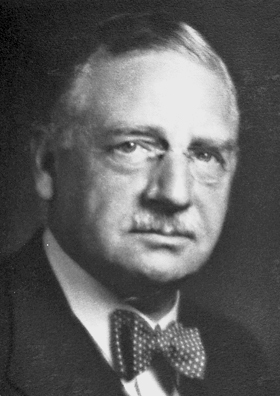
- Otto Loewi
- Lived
- 1873–1961
- Field
- Pharmacology
- From
- German-Austrian-American
The story
In 1905 Otto Loewi followed his mentor Hans Horst Meyer to Vienna, becoming an associate professor in Meyer's laboratory and taking Austrian citizenship. There he first returned to carbohydrate metabolism. He showed that a preference for fructose over glucose was found not only in dogs whose pancreas had been removed but also in dogs deprived of their stored glycogen in other ways, that the heart, unlike the liver, cannot use fructose, and that adrenaline injections could restore liver glycogen even in starving rabbits.
He then turned to the autonomic, or vegetative, nervous system, which controls involuntary functions such as heartbeat, blood pressure and digestion. He was stimulated by Walter Gaskell and John Langley's discovery that this system has two divisions with opposite effects, and by contact with T. R. Elliott in Cambridge, who was then carrying out his final experiments on the action of adrenaline.
Working with Alfred Fröhlich, Loewi published a classic paper in 1905. Its best-known result was the observation that small doses of cocaine potentiate the responses of organs supplied by sympathetic nerves, both to adrenaline and to stimulation of the nerves themselves. In other words, a drug could make the body's own nerve signals stronger.
The paper stimulated a considerable body of research in the years that followed, as did his later work on the link between digitalis, the old heart drug, and the action of calcium. Together these studies helped to clarify two mechanisms of great therapeutic importance: the blocking and the strengthening of nerve action by drugs.
The Vienna work also marked the start of Loewi's long interest in how nerves and drugs act on the organs of the autonomic system. That interest led him in 1921, by then professor of pharmacology at Graz, to his Nobel Prize-winning discovery that nerves pass on their signals by releasing chemicals. The questions he first asked in Vienna about how the sympathetic nerves and adrenaline work together were finally answered when he showed that a substance closely related to adrenaline acts at the endings of the sympathetic nerves.
Why it matters
Loewi's early autonomic research helped lay the groundwork for understanding how many drugs act on the heart and blood vessels.
About Otto Loewi
Pharmacologist whose 1921 frog-heart experiment, famously conceived in a dream, proved that nerves talk through chemicals, founding the science of neurotransmitters and winning the 1936 Nobel Prize.
More about Otto Loewi
- Loewi showed animals rebuild proteins from amino acidsIn 1902 Otto Loewi proved that animals can rebuild their own proteins from amino acids, the products of protein breakdown, an essential finding for nutrition science.
- Otto Loewi chose research to fight untreatable diseaseAfter watching patients with tuberculosis and pneumonia die for lack of any treatment in 1897–98, Otto Loewi abandoned clinical work to research how drugs act.
- Otto Loewi's dream led to proof that nerves use chemicalsIn 1921 Otto Loewi dreamed up a two-frog-heart experiment that proved, for the first time, that nerves communicate by releasing chemicals.
- Otto Loewi made Graz a magnet for pharmacologistsAs professor of pharmacology at Graz from 1909 to 1938, Otto Loewi became a celebrated lecturer whose associates included researchers from the United States.
- Otto Loewi identified the first neurotransmitterOtto Loewi showed that his 'Vagusstoff' is acetylcholine, the first known neurotransmitter, and that an adrenaline-like substance works at sympathetic nerves.
- Loewi's eye test helped surgeons diagnose pancreatitisOtto Loewi found that adrenaline dilates the pupils of dogs without a pancreas; surgeons adapted this 'Loewi test' to help diagnose acute pancreatitis.
Sources
- Otto Loewi – Biographical NobelPrize.org
- Otto Loewi Wikipedia
Another act of tikkun olam. This is part of tikkun olam, the Jewish idea of repairing the world, and every one of us can add to it.