- Person
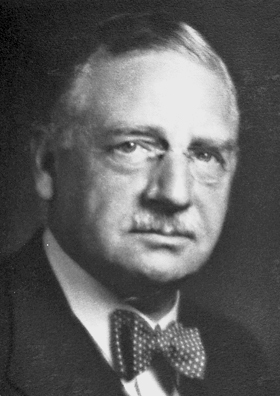
- Otto Loewi
- Lived
- 1873–1961
- Field
- Pharmacology
- From
- German-Austrian-American
The story
In the early twentieth century physiologists were divided over how a nerve passes its signal to the organ it controls. Experiments had shown that chemicals applied to tissues could trigger responses such as muscle contraction, but nobody had shown that cells released such chemicals themselves. Electrical stimulation could also produce responses, which suggested to many that signalling was purely electrical. The controversy split even the most prominent scientists.
Otto Loewi, a Jewish pharmacologist from Frankfurt who had been professor of pharmacology at Graz since 1909, dreamed of an answer on the night of Easter Saturday 1921. He woke, scribbled the idea on a scrap of paper on his night-stand and went back to sleep. In the morning, to his horror, he could not read his writing, and he later called that day the longest of his life. The next night the dream returned, and this time he went straight to his laboratory.
He took two beating frog hearts bathed in salt solution, one still attached to its vagus nerve, the nerve that slows the heartbeat, and the other on its own. Stimulating the nerve electrically slowed the first heart. When Loewi applied fluid from around the first heart to the second, it slowed too. A soluble chemical released by the nerve was carrying the message. He called it Vagusstoff, from the name of the nerve and the German word for substance.
Published in 1921, the experiment was the first to show that a nerve releases a chemical that can produce a response without any electrical stimulation. It showed that the electrical impulse in a nerve triggers the release of a chemical messenger, which then acts on the target tissue. Loewi and his co-workers later identified Vagusstoff as acetylcholine.
From then on, many felt that a Nobel Prize for Loewi was a question not of if but of when. It came in 1936, shared with his friend Henry Dale. The idea that nerves talk to each other and to the body's organs through chemicals, now called neurotransmitters, became one of the foundations of modern neuroscience and of the drugs that act on the brain and nervous system.
Why it matters
Loewi's experiment founded the science of neurotransmitters, on which much of modern neuroscience and pharmacology is built.
About Otto Loewi
Pharmacologist whose 1921 frog-heart experiment, famously conceived in a dream, proved that nerves talk through chemicals, founding the science of neurotransmitters and winning the 1936 Nobel Prize.
More about Otto Loewi
- Loewi showed animals rebuild proteins from amino acidsIn 1902 Otto Loewi proved that animals can rebuild their own proteins from amino acids, the products of protein breakdown, an essential finding for nutrition science.
- Otto Loewi chose research to fight untreatable diseaseAfter watching patients with tuberculosis and pneumonia die for lack of any treatment in 1897–98, Otto Loewi abandoned clinical work to research how drugs act.
- Loewi's 1905 study opened years of nerve researchIn a classic 1905 paper, Otto Loewi and Alfred Fröhlich showed that small doses of cocaine strengthen the body's responses to adrenaline and sympathetic nerves.
- Otto Loewi made Graz a magnet for pharmacologistsAs professor of pharmacology at Graz from 1909 to 1938, Otto Loewi became a celebrated lecturer whose associates included researchers from the United States.
- Otto Loewi identified the first neurotransmitterOtto Loewi showed that his 'Vagusstoff' is acetylcholine, the first known neurotransmitter, and that an adrenaline-like substance works at sympathetic nerves.
- Loewi's eye test helped surgeons diagnose pancreatitisOtto Loewi found that adrenaline dilates the pupils of dogs without a pancreas; surgeons adapted this 'Loewi test' to help diagnose acute pancreatitis.
Sources
- Otto Loewi Wikipedia
- Neurotransmitter Wikipedia
- Otto Loewi – Biographical NobelPrize.org
Another act of tikkun olam. This is part of tikkun olam, the Jewish idea of repairing the world, and every one of us can add to it.