- Person
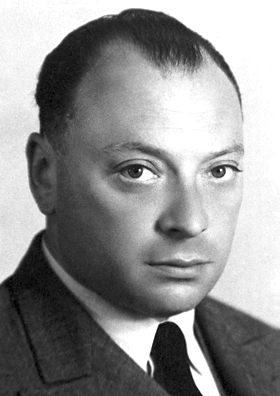
- Wolfgang Pauli
- Lived
- 1900–1958
- Field
- Theoretical physics
- From
- Austrian-Swiss
The story
Wolfgang Pauli was born in Vienna in 1900. Three of his grandparents were Jewish: his paternal grandparents came from prominent Jewish families of Prague, and his mother’s father was the Jewish writer Friedrich Schütz. He was raised a Roman Catholic. A brilliant student of Arnold Sommerfeld in Munich, he worked with Max Born in Göttingen and Niels Bohr in Copenhagen before becoming a lecturer in Hamburg.
Physicists of the early 1920s knew that electrons in atoms are arranged in shells and that an element’s chemistry depends on its outermost electrons, but not why the shells fill as they do. In 1924 and 1925 Pauli proposed that electrons have a new two-valued property, soon identified by George Uhlenbeck and Samuel Goudsmit as spin, and formulated the exclusion principle: no two electrons in an atom can have the same set of quantum numbers. He later showed, in the spin-statistics theorem of 1940, that the rule applies to all particles of half-integer spin, including protons and neutrons.
Because electrons cannot all crowd into the lowest state, they fill successive shells, producing the periodic table and the chemical bonds that hold molecules together. In 1967 Freeman Dyson and Andrew Lenard proved that without the principle ordinary matter would collapse into a much smaller volume. In solids, the principle forces electrons into energy bands, and many of the electrical, magnetic and optical properties of materials follow directly from it; Pauli used it in 1926 to explain the magnetism of metals.
That band picture is the basis of semiconductor physics, and so of transistors, computer chips, solar cells and LEDs. Engineers designing a microchip or a solar panel are, in effect, arranging materials so that electrons obeying Pauli’s rule flow where they are wanted. The same principle explains why white dwarf and neutron stars do not collapse under their own gravity. Pauli received the 1945 Nobel Prize in Physics for the discovery, after being nominated by Albert Einstein.
Why it matters
Chemistry, materials science and the semiconductor electronics in every phone and computer all rest on the exclusion principle that Pauli discovered.
About Wolfgang Pauli
Vienna-born physicist whose exclusion principle explains atomic structure, the periodic table and the electrons in every electronic device. He also predicted the neutrino. Nobel Prize 1945.
Sources
- Pauli exclusion principle Wikipedia
- Wolfgang Pauli, Biographical NobelPrize.org
- Wolfgang Pauli Wikipedia
Another act of tikkun olam. This is part of tikkun olam, the Jewish idea of repairing the world, and every one of us can add to it.