- Person
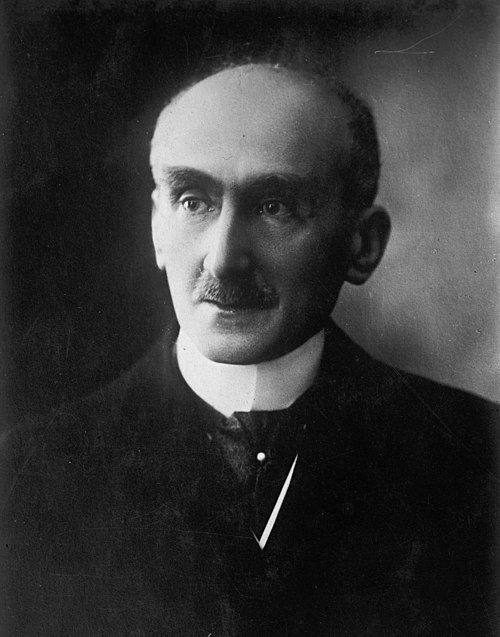
- Henri Bergson
- Lived
- 1859–1941
- Field
- Philosophy
- From
- French
The story
In the 1920s Henri Bergson suffered from severe arthritis that eventually forced him to withdraw from public life. The Collège de France relieved him of his teaching duties so that he could work on a new book on ethics, religion and society, and his disciple Édouard Le Roy took over his lectures. In 1932, to general surprise, he published his last major work, Les deux sources de la morale et de la religion (The Two Sources of Morality and Religion).
Bergson said the book developed ideas from Creative Evolution. He argued that morality has two sources. Closed morality and static religion serve social cohesion: they bind members of a group together, as nature binds the members of a beehive, and enforce strict obedience. Because closed morality concerns the survival of one particular society, it always excludes others and is bound up with war. Static religion supports it through what Bergson called the fabulation function, the imagination's power to invent images of gods that watch over the group.
Open morality and dynamic religion, by contrast, are concerned with creativity and progress, and open the way beyond the closed group. Because it includes everyone, open morality is genuinely universal and aims at peace and an open society. Its source is creative emotion, of the kind that drives a composer to write a symphony, and Bergson found it above all in the great mystics, whose experience led to action and not just contemplation. In the book, the Stanford Encyclopedia notes, sympathy progresses to the point of love for all things.
The book prompted renewed debate about his philosophy and his religious views. It was respectfully received by the public and by philosophers, and his former student Jacques Maritain, who had become a critic, came to praise Bergson after it appeared.
Published as nationalism and dictatorship were rising across Europe, The Two Sources offered a powerful argument that true morality cannot stop at the borders of one's own group. Its contrast between closed and open societies has continued to influence thinkers on ethics, religion and politics.
Why it matters
Bergson's vision of an open morality, reaching beyond any single group to all of humanity, inspired later thinkers on ethics and society.
About Henri Bergson
French philosopher of time, memory and the élan vital who won the 1927 Nobel Prize in Literature and, drawn to Catholicism, chose to remain among the persecuted Jews.
More about Henri Bergson
- Henri Bergson wrote a classic essay on why we laughIn Laughter (1900), Henri Bergson argued that comedy arises from "something mechanical encrusted on the living" and that laughter helps make social life possible.
- Bergson's Matter and Memory explored mind and brainIn Matter and Memory (1896), Henri Bergson investigated perception, memory and the brain, drawing on the medical research of his day.
- Henri Bergson, Nobel philosopher who stood with his peopleHenri Bergson won the 1927 Nobel Prize in Literature for his ideas on time and creativity, and later declined to convert so as not to leave the persecuted Jews of Europe.
- Bergson's first book redefined how we think about timeIn Time and Free Will (1889), Henri Bergson distinguished lived time, or duration, from clock time; Louis de Broglie said it anticipated ideas of Bohr and Heisenberg.
Sources
- Henri Bergson Stanford Encyclopedia of Philosophy
- Henri Bergson Wikipedia
Another act of tikkun olam. This is part of tikkun olam, the Jewish idea of repairing the world, and every one of us can add to it.